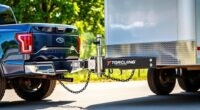
To choose the right trailer hitch, first identify your vehicle’s towing capacity by checking the owner’s manual or consulting a professional. Match this limit to the appropriate hitch class — from simple Class I for light loads to Class V for heavy-duty towing. Properly selecting and installing the correct hitch guarantees safety, ease of use, and reliable towing performance. Keep these factors in mind, and you’ll find the best fit for your needs. More details on how to make the perfect choice await you.
Key Takeaways
- Identify your vehicle’s towing capacity by consulting the owner’s manual or a professional.
- Match the trailer load weight with the appropriate hitch class, such as I-IV or V.
- Choose a hitch that exceeds your maximum trailer weight for added safety margin.
- Ensure the hitch installation is compatible and properly secured to handle the intended load.
- Select the correct hitch class to promote safe, efficient towing and prevent safety hazards.

Ever wondered how to choose the right trailer hitch for your vehicle? Picking the correct hitch isn’t just about compatibility; it’s vital for safe and efficient towing. The first thing to understand is that trailer hitches come in different classes, each designed for specific towing capacities and vehicle types. Knowing which class suits your needs can make all the difference in ensuring hitch installation is straightforward and towing safety is maintained.
Choosing the right trailer hitch is essential for safe, efficient towing and easy installation.
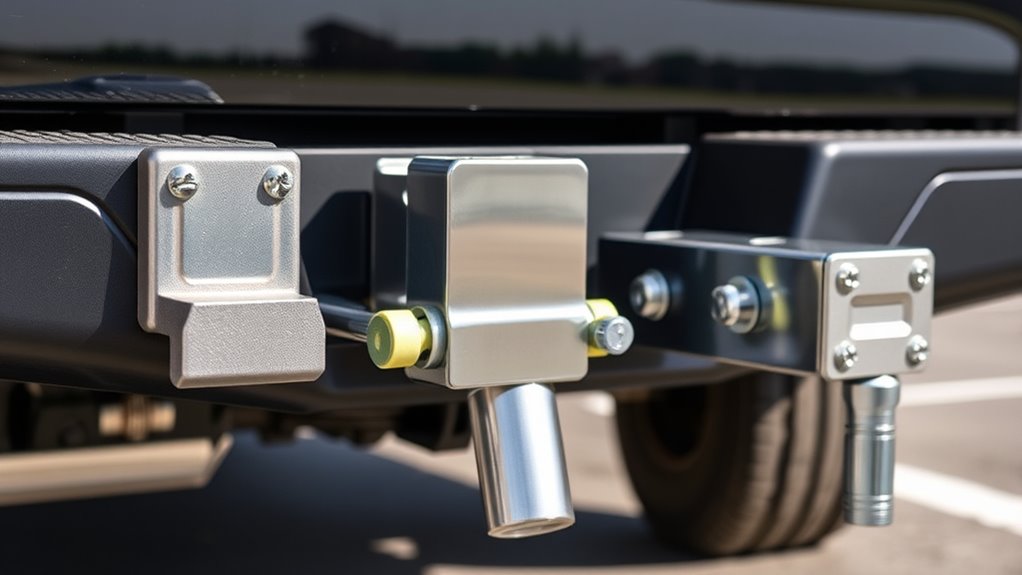
The hitch class you select depends on the weight you plan to tow. For light loads, such as small utility trailers or bike racks, a Class I or II hitch might suffice. These are typically rated for up to 3,500 pounds, making them perfect for smaller vehicles and lighter tasks. If you need to tow heavier loads, like larger boats or campers, you’ll want to consider a Class III or IV hitch. These offer higher weight capacities—up to 10,000 pounds—and are designed to handle more demanding towing requirements. For the most hefty jobs, like commercial hauling or RVs, a Class V hitch provides the maximum capacity, often exceeding 17,000 pounds.
Choosing the right hitch class also involves considering your vehicle’s towing capacity. Check your owner’s manual or consult a professional to determine what your vehicle can handle safely. Overloading a hitch can compromise hitch installation and, more critically, endanger towing safety. You don’t want to push your vehicle beyond its limits, as this can lead to dangerous situations on the road, including trailer sway or loss of control.
When it comes to hitch installation, it’s essential to match the hitch class with your vehicle’s specifications. Proper installation ensures that the hitch is securely attached and capable of handling the intended load. Many trailers and accessories are designed to fit specific hitch classes, so selecting the right one simplifies the installation process. Properly matching the hitch class to your vehicle enhances overall safety and performance. Remember, a poorly installed hitch or one that’s mismatched with your vehicle’s capacity can cause serious safety issues.
Ultimately, understanding trailer hitch classes helps you make an informed decision that aligns with your towing needs, vehicle capabilities, and safety standards. It’s not just about the right fit; it’s about ensuring that every trip you take is safe, secure, and hitch installation is done correctly. By choosing the appropriate class and paying attention to towing safety, you set yourself up for trouble-free adventures and peace of mind on every journey.
Frequently Asked Questions
Can I Upgrade My Hitch to a Higher Class Later?
Yes, you can upgrade your hitch to a higher class later, but you need to check hitch compatibility first. The upgrade process involves ensuring your vehicle’s frame and receiver are rated for the higher class hitch. Measure the receiver size and verify towing capacity. If compatible, you can replace your current hitch with a higher class model, providing increased towing strength and safety for heavier loads. Always consult your vehicle’s manual before upgrading.
How Do I Know if My Vehicle Can Handle a Heavier Hitch?
You can ascertain if your vehicle can handle a heavier hitch by checking its vehicle capacity and towing limits. Look at your owner’s manual or the placard on your driver’s side door frame for maximum towing capacity. If the heavier hitch exceeds these limits, it’s unsafe to install. Always match the hitch class to your vehicle’s specifications to ensure safe towing and avoid damage.
Are There Compatibility Issues With Different Trailer Types?
You might face trailer compatibility issues if your trailer’s coupler doesn’t match your hitch type. Always check your trailer’s specifications and your vehicle’s hitch class. If needed, use hitch adapters to fit different trailer types, but verify they’re rated for your trailer’s weight. Double-check compatibility beforehand to avoid accidents or damage, and consult your vehicle’s manual or a professional for guidance on the best fit.
What Are the Signs of a Worn or Damaged Hitch?
You’ll notice signs of a worn or damaged hitch through visual wear, rust, or corrosion. If you see cracks, bending, or excessive rust, it’s time to substitute it. Rust and corrosion weaken the metal, risking failure during towing. Check the hitch regularly, especially after harsh weather, and replace it if you spot any damage to ensure safe towing and avoid accidents.
How Does Climate Affect Hitch Performance and Durability?
Climate impacts your hitch’s performance and durability by accelerating corrosion, reducing strength, and causing wear. Hot temperatures can weaken metal, while cold can make parts brittle. To combat these issues, focus on corrosion prevention through protective coatings and choose a hitch with temperature resistance suited for your environment. Regularly inspect your hitch, especially in harsh climates, to ensure safe towing and prolong its lifespan.
Conclusion
Choosing the right trailer hitch class isn’t just a decision—it’s your vehicle’s handshake with the road ahead. Think of it as finding the perfect partner that matches your towing needs, ensuring safety and performance every mile. Don’t let confusion steer you wrong; instead, remember that the right hitch is the bridge between your vehicle’s potential and your adventure. So, pick wisely, and let your journey roll smoothly—because the road awaits your confident stride.