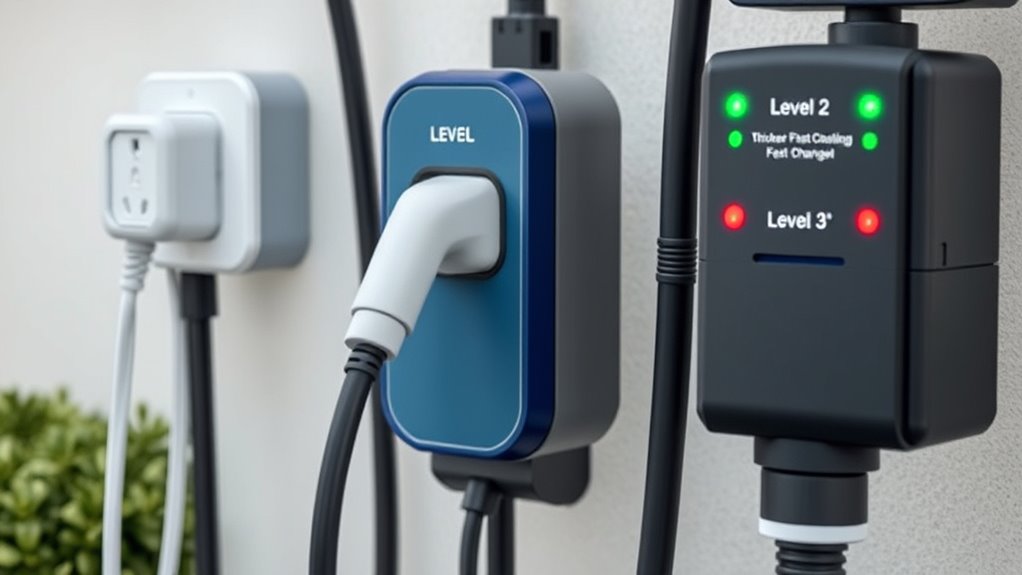

EV charging has three levels: Level 1 uses a standard 120V outlet, offering about 2-5 miles of range per hour—great for occasional topping off. Level 2 operates on 240V, delivering 10-60 miles of range hourly, ideal for daily use at home or work. Level 3, or DC fast charging, provides 60-100 miles in 20-30 minutes, perfect for quick stops on long trips. Understanding these differences helps you choose the right charger for your needs and habits.

Get business pricing on garage and car supplies
- Business-only prices and quantity discounts
- Tax-exempt purchasing
- Multiple users, one account, clear invoices
Key Takeaways
- Level 1 uses standard 120V outlets, providing 2-5 miles of range per hour, suitable for overnight charging.
- Level 2 operates on 240V, offering 10-60 miles of range per hour, ideal for daily home and workplace use.
- Level 3, or DC fast charging, delivers 60-100 miles in 20-30 minutes, mainly for highway and commercial stations.
- Installation complexity and costs increase from Level 1 to Level 3, with Level 3 requiring specialized, high-capacity infrastructure.
- Choosing the right level depends on driving habits, charging speed needs, and installation feasibility.
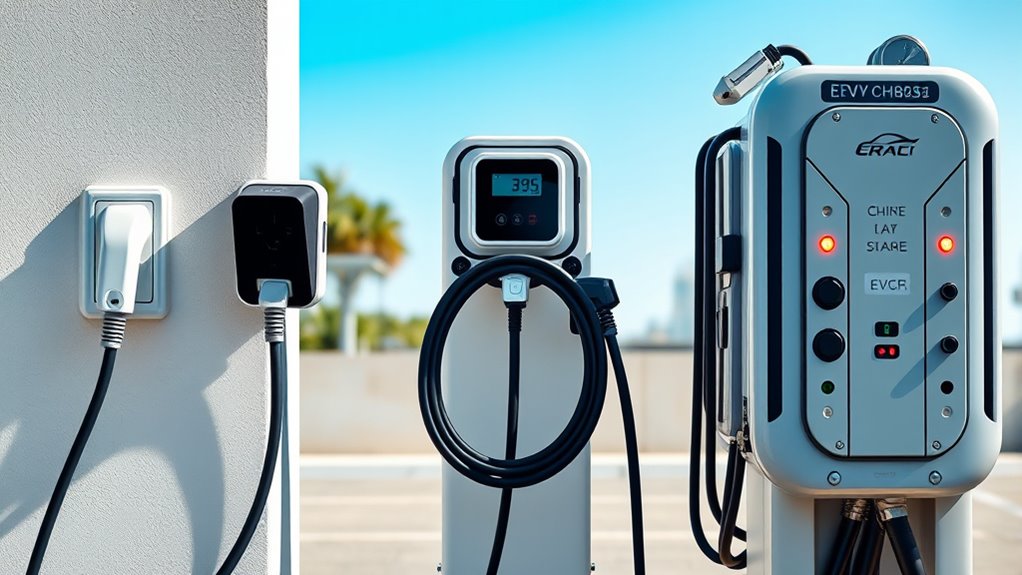
Ever wondered how electric vehicle (EV) owners charge their cars? The answer depends on the type of charging station they use. There are three main charging levels—Level 1, Level 2, and Level 3—each with different charging station types and installation requirements. Understanding these differences helps you decide which setup fits your needs best.
Level 1 charging is the simplest and most accessible. It uses a standard household outlet, usually 120 volts, and requires no special installation. You can plug your EV directly into a regular wall socket, making it ideal for those who drive short distances or only need to top off their battery overnight. However, since it supplies about 2 to 5 miles of range per hour of charging, it’s slow. The installation requirements are minimal; you don’t need professional help or upgrades to your electrical system—just a standard outlet and a compatible charging cord. This makes Level 1 perfect for residents who have limited access to dedicated charging stations or want a convenient, low-cost option at home.
Level 1 charging uses a standard outlet, requires no special setup, and provides a slow, convenient option for short-distance EV owners.
Level 2 charging ramps up the speed considerably. It uses a 240-volt power supply, similar to what’s used for large appliances like dryers. To install a Level 2 charger, you’ll need a dedicated circuit and sometimes an upgrade to your electrical panel—an installation requiring a licensed electrician. The charging stations are designed specifically for EVs and come in various models with features like Wi-Fi connectivity, timers, and different power outputs. With Level 2, you can expect about 10 to 60 miles of range per hour of charging, making it suitable for daily use and quicker top-offs. It’s common to find these stations installed in homes with garages, workplaces, or public charging locations. The installation requirements are more involved than Level 1 but are typically straightforward for professionals, ensuring safe and reliable operation. European cloud solutions are increasingly being integrated into smart charging infrastructure for enhanced efficiency.
Level 3 charging, also known as DC fast charging, is the most advanced and swiftest option. These charging stations are often found along highways and major transit routes, designed to rapidly replenish your EV’s battery. They operate at high voltages and require specialized equipment and electrical infrastructure, often involving substantial installation requirements. Installing a Level 3 station is complex and costly, requiring substantial electrical capacity and safety considerations, often involving permits and coordination with utility providers. The benefit is that you can add about 60 to 100 miles of range in just 20 to 30 minutes, making it ideal for long trips or quick stops. Because of their technical complexity and high setup costs, Level 3 chargers are typically found in commercial or public settings rather than private homes.
Frequently Asked Questions
Can I Upgrade My Home Charger to a Higher Level Later?
Yes, you can upgrade your EV home charger later. Planning for EV home upgrades allows you to enhance your charging infrastructure expansion as your needs grow. Upgrading to a higher level charger typically involves installing a more powerful outlet and possibly upgrading your electrical system. Check with a licensed electrician to confirm your home’s wiring can support the upgrade, making the process smooth and safe.
Are Level 3 Chargers Available for Residential Use?
Did you know only about 2% of homes currently have Level 3 chargers? Unfortunately, Level 3 chargers are generally not obtainable for residential installation due to their high power requirements and safety concerns. They require specialized infrastructure and are typically found at commercial charging stations. For residential use, focus on compatible Level 1 or Level 2 chargers, as they are designed for home installation and ensure safe, efficient charging.
How Do Charging Times Differ Between Levels?
You’ll notice charging times vary greatly by level. Level 1 chargers are the slowest, taking about 8-20 hours, offering lower charging speed and efficiency. Level 2 chargers markedly improve charging speed, usually completing a full charge in 4-10 hours. Level 3 chargers, also known as DC fast chargers, deliver the highest charging efficiency, often providing 80% charge in just 20-30 minutes. Your choice depends on your needs for speed and convenience.
What Safety Precautions Are Necessary for Fast Chargers?
Charging safety is your top priority with fast chargers; neglecting precautions can lead to hazards that are almost catastrophic. Always inspect the charging station for damage, keep the area dry, and guarantee proper grounding. Use only compatible equipment, and stay alert for overheating or sparks. Following fast charger precautions not only protects you but also preserves your vehicle’s battery health, making safe charging as crucial as the thrill of driving.
Do Different EV Models Support All Charging Levels?
Not all EV models support every charging level due to variations in charging compatibility and design. You should check your vehicle’s specifications to see which levels it accepts; some models are limited to Level 1 or Level 2 chargers, while others support fast charging at Level 3. Model variations mean compatibility can differ, so always verify your EV’s charging capabilities before planning your charging stations or trips.
Conclusion
Understanding the differences between Level 1, Level 2, and Level 3 charging helps you make informed decisions about your EV needs. Whether you’re plugging in for a quick top-up or a fast charge on the go, knowing which level suits your lifestyle is key. Remember, it’s better to be safe than sorry, so choose the right charger to keep your EV running smoothly. With this knowledge, you’re all set to navigate the charging landscape with confidence.
Columbus Day / Indigenous Peoples' Day Picks
long weekend sales
As an affiliate, we earn on qualifying purchases.