TL;DR

Get business pricing on garage and car supplies
- Business-only prices and quantity discounts
- Tax-exempt purchasing
- Multiple users, one account, clear invoices
A report by Jeff Kaufman finds that most available vehicle-to-home systems can discharge an EV to power a house during an outage but do not support recharging the car from solar while the grid is down. The report identifies Tesla’s Cybertruck Powershare setup as a current option, while other systems are unavailable, limited, or still in development. The author says he will likely install a stationary backup battery instead.
A review of available vehicle-to-home (V2H) systems finds that most can send power from an electric vehicle to a house during a grid outage but do not support recharging the vehicle from solar panels while the outage continues. In a report on his solar-battery plans, Jeff Kaufman says the current setup he could identify for both functions is Tesla’s Powershare system with a Cybertruck, leaving homeowners considering other EVs with limited options for combining car and home backup.
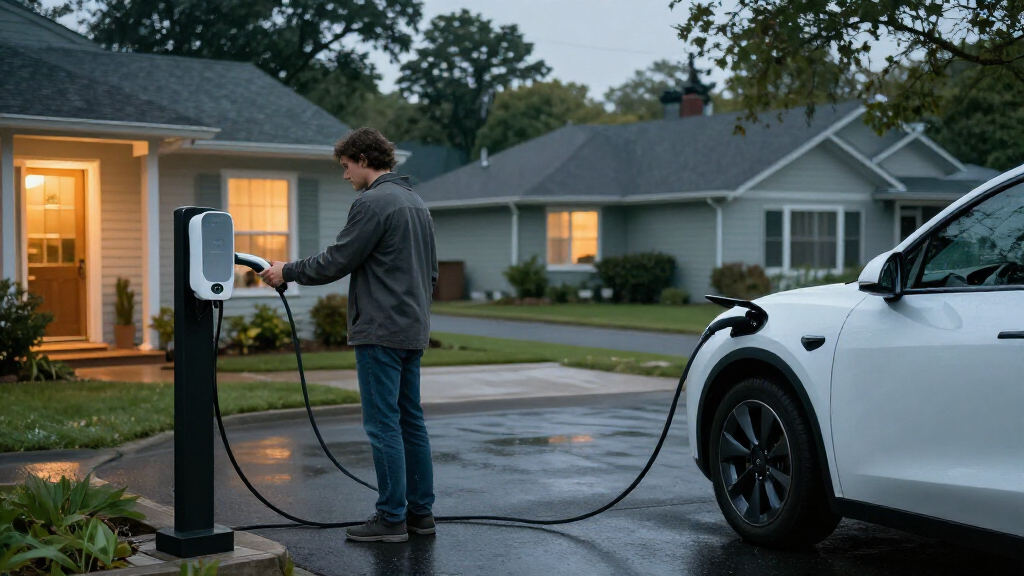
Kaufman’s report describes the desired arrangement: rooftop panels charge an EV when sunlight is available, and the vehicle supplies household electricity when solar output is not enough. That would let a car’s comparatively large battery serve as backup storage as well as transportation. But he says manufacturers generally treat V2H as a discharging-only outage mode, rather than a system that manages both vehicle charging and home power while the grid is unavailable.
As an example, Kaufman quotes GM Energy Home Hub documentation saying the system disconnects the home from the local grid and sends power from the GM Energy Inverter during an outage. The documentation also says the EV will stop discharging and begin charging once grid power is restored; Kaufman says it does not describe recharging the vehicle during the outage. He also writes that Ford’s Charge Station Pro, which was required for automatic home backup with the F-150 Lightning, is no longer for sale. He says the V2H arrangement he could identify for that vehicle would not allow it to charge during an outage.
Kaufman identifies Tesla Powershare with the Cybertruck as the option he found that can support outage-time solar charging, subject to system requirements. Tesla’s guidance, as quoted in the report, says a UL 1741-listed solar system must be included in the backup circuit, with capacity in the backup panel. Kaufman does not want a Cybertruck and says buying one would cost more than the stationary battery system he is considering. He expects to proceed with a smaller battery intended for emergencies.
Why Outage Charging Changes Backup Plans
The distinction between powering a home and recharging the EV during an outage affects how much backup a vehicle can provide over a prolonged interruption. A system that only discharges the car draws on energy already stored in its battery. If solar panels cannot recharge it while the grid is down, the household’s available vehicle-backed power is limited by that initial charge and by household consumption.
For homeowners deciding between an EV-based system and a stationary battery, compatibility and operating modes matter as much as battery capacity. Kaufman’s experience is a reminder that owning a vehicle marketed as capable of home backup does not by itself establish that it can also accept solar power during an outage. Buyers need to check the specific vehicle, charger, transfer equipment, solar configuration and utility or safety requirements before relying on a system for that purpose.
The report is an individual homeowner’s assessment, not a survey of every product or installation. Still, it illustrates a practical gap for people who want one battery to serve both transportation and emergency-power needs: the hardware and software must coordinate the house, solar array and vehicle while safely isolated from the grid.
Products Worth Considering

DEWALT 20V MAX 1/4-Inch Impact Driver Kit with Battery and Charger (DCF787D1)

Autel MaxiCharger AC Home Level 2 EV Charger, 50A, Hardwired J1772, Wi-Fi, 25-Foot Cable

DEWALT 20V MAX XR Hammer Drill and Impact Driver Combo Kit with Two 4Ah Batteries and Charger
As an affiliate, we earn on qualifying purchases.
Systems and Compatibility Kaufman Reviewed
Kaufman’s report began with a question from a reader about whether an electric car’s battery could replace a small home battery bought mainly for emergencies. The idea depends on bidirectional charging: electricity can flow from the grid or solar equipment into a vehicle, and then from the vehicle back to the home. V2H systems also need to disconnect a house from the grid during an outage so that backup power does not flow onto lines being repaired.
The report discusses GM’s home-backup equipment, Ford’s discontinued Charge Station Pro availability, and Wallbox’s Quasar 2. Kaufman says Wallbox describes V2H capability, but he found customer difficulties and says the product does not work with current models he considered. He also cites a limitation that solar charging cannot be used simultaneously with V2H. These are Kaufman’s findings and cited product information; the report does not establish a complete, independently verified list of all compatible products or installations.
Enphase announced on February 2, 2026, that it was targeting volume production of a bidirectional EV charger in Q4 2026. The company said vehicle compatibility and bidirectional functionality would depend on automaker enablement, vehicle software, applicable standards and final product specifications. Kaufman suspects availability could slip into 2027 and arrive later in Massachusetts, but those are his expectations, not an announced schedule.
“During a power outage, the GM Energy Home Hub safely disconnects your home from the local power grid and enables backup power to flow from the GM Energy Inverter throughout your home.”
— GM Energy Home Hub documentation, quoted by Jeff Kaufman
Compatibility and Launch Dates Remain Open
The report does not independently verify every vehicle, charger and home configuration, and its account of product availability is Kaufman’s assessment. Compatibility can vary by vehicle model, software, charger, inverter, transfer equipment and local rules. The source material does not establish that every current GM or Ford installation lacks outage-time solar charging; it describes the documentation and products Kaufman reviewed.
Enphase’s Q4 2026 production target is a target, not a confirmed retail date. The company’s own caveat leaves vehicle compatibility and functions subject to automaker support, software, standards and final specifications. It is not clear from the report when a compatible system would be available to Massachusetts customers or which EV models would work with it. Wallbox’s reported customer problems and model limitations also are not quantified.
Homeowners Await Compatible Equipment
Kaufman says he will likely move ahead with a stationary battery designed for emergency backup rather than wait for a bidirectional EV charger. For other homeowners, the next practical step is to confirm the exact supported vehicle and system configuration with the manufacturer and installer, including whether solar charging can continue while the home is islanded from the grid.
Enphase’s stated milestone is targeted volume production in Q4 2026; the company has not, in the material cited, confirmed a final launch date or a complete list of supported vehicles. Any assessment of the market will depend on those details, as well as product availability and applicable standards.
Key Questions
What does bidirectional charging mean during a grid outage?
It means electricity can flow in both directions: solar or grid power can charge an EV, and the EV can send power back to a home. During an outage, the system must safely isolate the home from the grid. The issue in Kaufman’s report is that many V2H setups can power a house but do not also recharge the car from solar before grid service returns.
Can an electric vehicle power a house during an outage?
Some vehicles and home equipment support V2H backup, but capability depends on the specific vehicle and installation. A system that can discharge a vehicle to supply a home may not be able to recharge it from solar during the same outage.
Which system did Kaufman identify for solar charging during an outage?
Kaufman identifies Tesla Powershare with a Cybertruck as the option he found. Tesla’s quoted guidance calls for a suitable solar system connected to the backup circuit and adequate capacity in the backup panel. This is not a claim that the setup works with every home or configuration.
When might Enphase’s bidirectional charger be available?
Enphase said it was targeting volume production in Q4 2026. That is a target rather than a confirmed customer-availability date, and the company says vehicle compatibility and functions will depend on automaker support, software, standards and final specifications.
Source: jefftk.com