
TL;DR

Get business pricing on garage and car supplies
- Business-only prices and quantity discounts
- Tax-exempt purchasing
- Multiple users, one account, clear invoices
A Robot Cantina YouTube video tests traditional hot-rod modifications on a Harbor Freight 212cc Predator engine, including a tunable carburetor, improved intake and exhaust flow, and advanced ignition timing. The report says the modified engine produced 4,800 watts of continuous power versus 3,600 watts in its stock configuration, while also running longer on a stated fuel quantity; the results are from this setup and test, not an independent comparison.
A Robot Cantina YouTube video tests a modified Harbor Freight 212cc Predator engine, reporting 4,800 watts of continuous power compared with 3,600 watts from the factory setup. The changes use familiar small-engine hot-rodding methods rather than electronic tuning, and the report also describes a longer run on the stated amount of fuel.
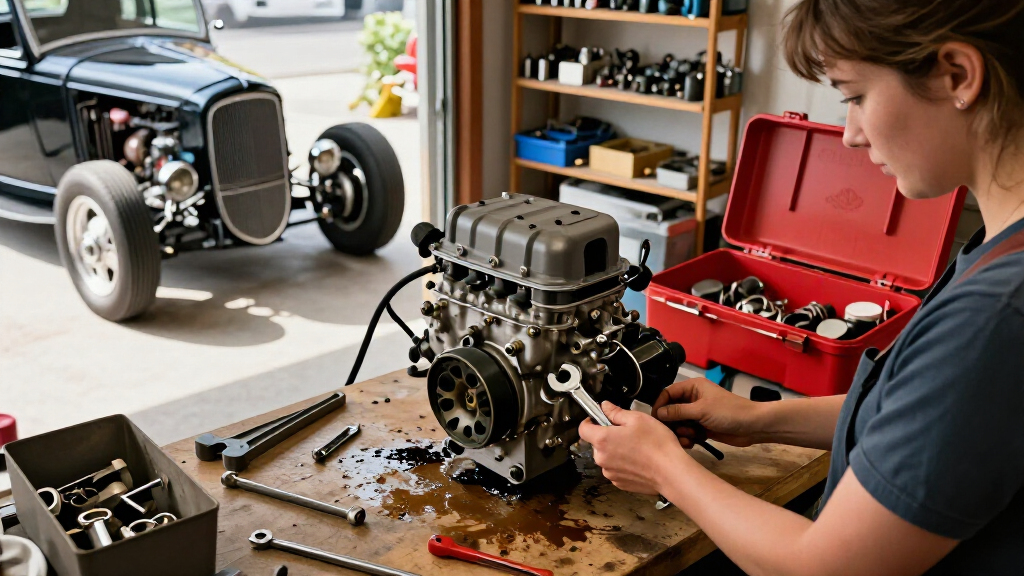
According to The Drive’s report on the video, Jimbo of Robot Cantina recreated an earlier project using a Predator 212 with a hemispherical cylinder head. He fitted an adjustable carburetor, a larger air filter over a billet velocity stack, and a short exhaust header in place of the stock muffler. Those changes were intended to adjust fuel delivery and improve airflow into and out of the engine.
The final change was advancing the ignition timing to 29 degrees before top dead center. Jimbo used an upgraded ignition setup with a 12-volt coil borrowed from a General Motors LS engine. The video’s reported figures put the modified engine at 4,800 watts of continuous output, against 3,600 watts in an initial run with the factory engine. The report also cites an earlier dyno figure of 9.3 horsepower for the modified configuration, compared with the engine’s stated stock rating of 6.5 horsepower.
The fuel test, as described by The Drive, used 700 milliliters of fuel: the modified engine ran for an hour and 15 minutes, while the standard engine stopped after an hour and eight minutes. The supplied report does not detail the full testing protocol, operating load, or whether the two runs were repeated under identical conditions, so these numbers describe the video’s test rather than a general performance guarantee.
What the Modifications Changed
The project is a practical demonstration of how basic changes to fuel mixture, airflow and ignition timing can affect a small, mechanically simple engine. Unlike many modern vehicle performance projects, the Predator setup described here does not depend on an engine computer or an electronic control-unit tune. That makes the work accessible to hobbyists who want to experiment with a common utility engine, though carburetor and timing changes still require careful setup.
The reported increase matters mainly as a measured result from one build. The Drive says output rose from 3,600 to 4,800 watts in the tests described, but the article does not establish that other engines will see the same result or that the modifications are suitable for every application. The longer reported runtime is also specific to the described fuel test. Readers should treat both as project results, not manufacturer ratings or independently verified performance claims.
Products Worth Considering

DEWALT 20V MAX Cordless Drill and Impact Driver Combo Kit (DCK277D2)

DEWALT 20V MAX XR Hammer Drill and Impact Driver Combo Kit with Two 4Ah Batteries and Charger

DEWALT 20V MAX XR 3-Speed Cordless Impact Driver Kit (DCF845P1)
As an affiliate, we earn on qualifying purchases.
A Simple Engine, Familiar Tuning
The Predator 212 is a small utility engine sold by Harbor Freight and used in equipment and do-it-yourself projects. The Drive’s report distinguishes the hemispherical-head version by its thick, rectangular cast-aluminum valve cover; it says other versions have a stamped, octagonal steel cover. Jimbo selected the Hemi model for this recreation, according to the report.
The approach follows long-used performance principles: tune the carburetor to control the fuel mixture, reduce restrictions to airflow, and alter ignition timing. The report contrasts this low-tech project with more elaborate Predator builds involving turbochargers or electronic fuel injection. It does not provide a full parts list, total project cost, or a comparison with those more complex builds.
Limits of the Reported Test
The supplied account does not specify the dyno equipment, test conditions, engine temperature, load, or repeatability of the wattage and fuel-use runs. It is also not clear whether the reported horsepower figure and the 4,800-watt continuous-power measurement came from the same test setup. Those figures should not be treated as directly interchangeable without further detail.
The report does not say how the modifications affect engine durability, emissions, noise, or warranty coverage, nor does it establish that the longer runtime would persist under different loads. Jimbo’s comment about the ignition coil also leaves its contribution uncertain. The results are attributed to the video and are not presented in the source material as independent laboratory findings.
Further Testing Could Clarify Results
The immediate next step for viewers is to consult the Robot Cantina video for the build and test presentation. The supplied source gives no announced follow-up test, independent verification, or planned comparison, so it is not clear whether Jimbo will publish additional measurements or durability results.
A more complete comparison would report repeated runs under matched loads, explain the measurement methods, and separate the effect of each modification. Until such information is available, the reported figures remain a useful account of one modified Predator 212 project rather than a promise of results for other engines.
Key Questions
What modifications were made to the Predator 212?
The report lists an adjustable carburetor, a larger air filter and billet velocity stack, a shorty exhaust header, and ignition timing advanced to 29 degrees before top dead center. The engine also used an upgraded ignition setup with a 12-volt coil.
How much power did the modified engine produce?
The video’s figures, as reported by The Drive, show 4,800 watts of continuous power, compared with 3,600 watts in an initial run with the stock engine. The report also cites 9.3 horsepower for the modified setup and a 6.5-horsepower stock rating.
Did the modifications improve fuel economy?
The report says the modified engine ran for one hour and 15 minutes on 700 milliliters of fuel, while the standard engine stopped after one hour and eight minutes. The source does not provide enough testing detail to establish how the result would vary under other conditions.
Are these results guaranteed for every Predator 212?
No. The figures describe one build and test. The source does not show repeated or independent testing, and results may depend on the engine, tuning, parts, load, and test conditions.
What remains unknown about the build?
The supplied report does not give the full test protocol, project cost, long-term reliability data, or the individual contribution of each part. Jimbo also said the upgraded ignition may offer little benefit over the stock magneto.
Source: rss