
TL;DR

Get business pricing on garage and car supplies
- Business-only prices and quantity discounts
- Tax-exempt purchasing
- Multiple users, one account, clear invoices
In the early 20th century, electric-car companies marketed their vehicles to women, emphasizing that they were easy to start and did not produce exhaust. IEEE Spectrum’s account highlights early adopter Fannie Goodnow and the charging technology she used, while noting that battery limits and the rise of the Model T helped shape the market’s direction.
Early electric-car makers promoted their vehicles to women by stressing their simple operation and lack of exhaust fumes, according to an IEEE Spectrum report on the first decades of automobile development. The marketing reflected a period when electric, gasoline and steam vehicles were all competing, rather than a settled market dominated by one technology.
Before the electric starter arrived in 1911, gasoline cars generally had to be started with a hand crank. Once running, their engines were noisy and produced fumes. Electric cars, by comparison, could be started by switching on the battery, often with a key, and did not emit exhaust at the point of use. The report says manufacturers used those features to present electric vehicles as appealing options for women. Electric cars were also marketed to doctors, who could make nighttime house calls without disturbing neighbors.
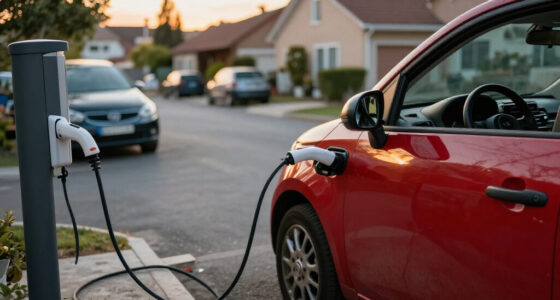
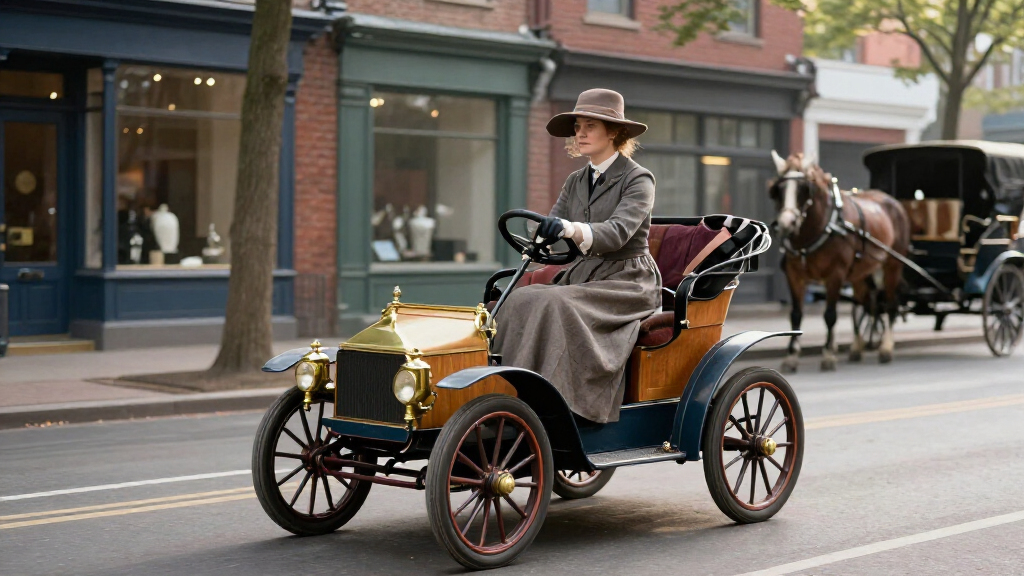
General Electric, which made chargers using mercury-arc rectifiers, ran advertisements showing stylishly dressed women plugging in electric cars and posing beside charging equipment. One early owner was Fannie Goodnow, a Boston-area woman who drove a 1908 Bailey Victoria Phaeton. She charged it with a GE rectifier, according to the report. It says no records were found explaining why Goodnow chose an electric car.
The charger converted alternating current from the power grid into direct current for the vehicle’s battery. The report describes a unit that took about 12 hours to charge a drained battery. Goodnow’s car used a 30-cell lead-acid battery, housed in a wooden box beneath the chassis, with a reported standard range of 64 to 80 kilometers. A larger battery offering 50 percent more capacity was available at extra cost.
How Marketing Reflected Early EV Design
The story shows that early electric-car marketing was shaped by practical differences between vehicle technologies, not just by assumptions about who might buy a car. The absence of a hand crank and exhaust gave electric models qualities manufacturers could promote to customers who valued straightforward starting and quieter operation. The ads also offer evidence of how companies framed women as potential drivers during a period of rapid change in transport.
Those advantages did not remove the limits of early electric vehicles. Charging could take many hours, and drivers faced a sparse network for charging and long-distance travel. The source gives a specific range for Goodnow’s Bailey, but that figure should not be treated as a measure for every early electric car. The episode matters today because it complicates the idea that electric cars are a new entrant: they competed with gasoline and steam vehicles more than a century ago, but ultimately lost market ground as technology and infrastructure developed.
Products Worth Considering

DEWALT 20V MAX XR Hammer Drill and Impact Driver Combo Kit with Two 4Ah Batteries and Charger

DEWALT 20V MAX 1/4-Inch Impact Driver Kit with Battery and Charger (DCF787D1)

Autel MaxiCharger AC Home Level 2 EV Charger, 50A, Hardwired J1772, Wi-Fi, 25-Foot Cable
As an affiliate, we earn on qualifying purchases.
A Carriage Maker Enters the Market
The U.S. automobile industry was expanding quickly around the turn of the 20th century. IEEE Spectrum reports that the country had about 50 carmakers in 1898, a figure that had increased fivefold a decade later. Production rose from 7,000 vehicles in 1901 to 181,000 in 1910. Electric, steam and gasoline cars were all part of this unsettled market.
Bailey’s company began as a carriage and sleigh maker. According to Galen Handy, who maintains the Early Electric Vehicles website, Samuel Robinson Bailey entered the carriage business as a teenager and later became known for his inventions and manufacturing methods. After the carriage industry began to decline, S.R. Bailey & Co. announced in December 1906 that it would make electric vehicles.
Bailey’s first Victoria Phaeton used an alkaline battery designed by Thomas Edison. The report says the battery leaked and failed to hold a charge, prompting Edison to continue development. Bailey then shifted to batteries made by Gould Storage Battery Co.; Goodnow’s 1908 car used a Gould lead-acid battery. By 1910 Edison had a better battery in production, but Henry Ford’s Model T was setting the stage for gasoline vehicles to dominate the market.
““You just turned on the main battery switch, often with a key.””
— IEEE Spectrum report
What the Historical Record Leaves Open
The available material does not establish why Goodnow chose an electric car, how she used it day to day, or how often she charged it. The report also does not provide sales figures that would show how many women bought electric cars or how effectively the advertisements changed consumer behavior. Its examples document a marketing strategy, not the size or composition of the vehicles’ customer base.
Range and charging figures in the account apply to the Bailey model and equipment described; they do not establish typical performance across all electric vehicles of the era. The report explains why gasoline cars gained advantages, including improvements to batteries and the arrival of the Model T, but it does not quantify the separate effect of price, manufacturing scale or charging access on the electric car’s decline.
The Market’s Shift to Gasoline
The historical sequence described in the report points to the next major change: gasoline vehicles became increasingly practical as starting technology improved and mass production expanded. The 1911 electric starter reduced one of gasoline cars’ earlier inconveniences. Meanwhile, Edison improved his battery, but the Model T was already helping internal-combustion vehicles gain ground.
There is no new product launch or policy decision attached to this historical report. The next useful step for readers seeking a fuller account would be comparison with additional records—such as vehicle sales, contemporary advertisements and ownership data—to establish how widespread women’s use of electric cars was and how it changed over time.
Key Questions
Why did early electric-car makers advertise to women?
According to IEEE Spectrum, makers emphasized that electric cars were easy to start and did not produce exhaust. The report describes this as a marketing strategy; it does not show that women were the only or main customers.
What electric car did Fannie Goodnow own?
Goodnow owned a 1908 Bailey Victoria Phaeton, an open two-seat electric vehicle. The report says it used a Gould 30-cell lead-acid battery and a GE mercury-arc rectifier for charging.
How long did the early charger take?
The mercury-arc rectifier described in the report took about 12 hours to charge a drained battery. That detail applies to the charging unit discussed, not necessarily every early electric car or charger.
Why did gasoline cars gain ground?
The report points to the improvement of gasoline-car starting technology, Edison’s early battery problems and the growing market for Henry Ford’s Model T. It does not assign a precise share of the market shift to any one cause.
Source: spectrum.ieee.org