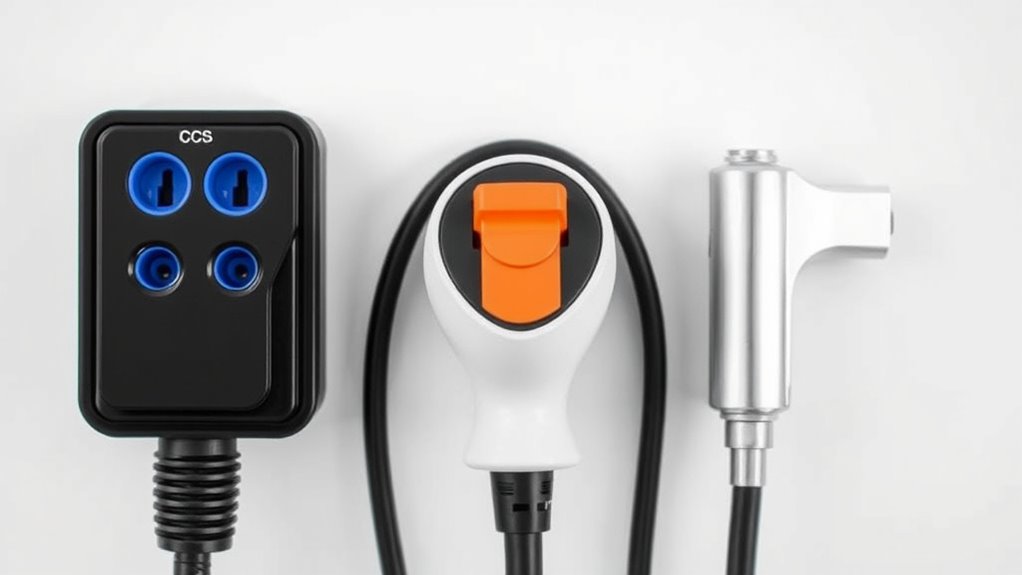
When comparing EV charging plug types, you’ll find CCS is the most common in Europe and North America for rapid charging, combining AC and DC options. CHAdeMO, mainly used in Japan, supports fast-charging but is less widespread outside Japan. Tesla has a proprietary connector that works only with Tesla vehicles or via adapters at Superchargers. Understanding these differences helps you choose compatible chargers, and exploring further reveals how charging infrastructure varies across regions and models.

Get business pricing on garage and car supplies
- Business-only prices and quantity discounts
- Tax-exempt purchasing
- Multiple users, one account, clear invoices
Key Takeaways
- CCS is the most widely adopted fast-charging standard in Europe and North America, combining AC and DC charging in one connector.
- CHAdeMO, developed in Japan, primarily supports Japanese EVs like Nissan and Mitsubishi for fast charging.
- Tesla uses a proprietary connector exclusive to its vehicles, with Superchargers offering rapid charging within its network.
- Compatibility depends on vehicle support and regional infrastructure, with CCS gaining popularity globally.
- Adapters are available to connect non-native EVs to Tesla Superchargers or other charging standards.
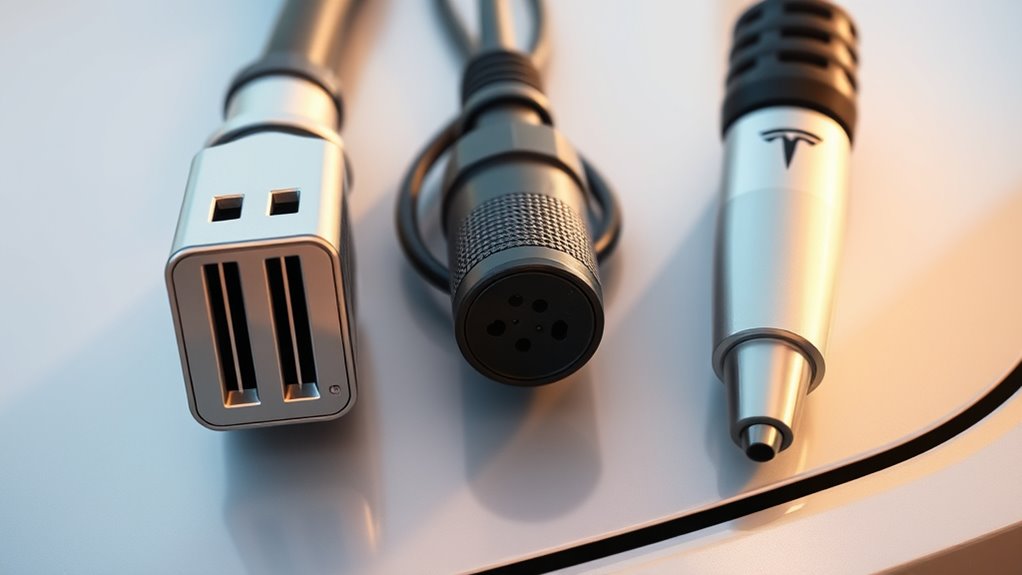
Ever wondered what types of charging plugs your electric vehicle (EV) might use? The world of EV charging is diverse, and understanding the different plug types can seem overwhelming at first. One of the main factors influencing this diversity is the charging infrastructure, which varies by region, station, and vehicle manufacturer. As a driver, it’s important to know that compatibility standards govern which plugs work with your EV and where you can charge. These standards ensure that chargers and vehicles communicate properly, providing safe and efficient charging experiences.
The most common plug types you’ll encounter are CCS (Combined Charging System), CHAdeMO, and Tesla’s proprietary connector. CCS is widely adopted across Europe and North America, especially for fast charging stations. It combines the traditional Type 1 or Type 2 AC connector with two additional DC pins, enabling rapid charging and broad compatibility with many electric vehicles. If your car supports CCS, you’ll find it easy to use a growing network of fast chargers designed to deliver high power levels quickly. Compatibility standards like CCS ensure that your vehicle can connect seamlessly with these chargers, but it’s worth double-checking whether your specific model supports this standard.
CHAdeMO, developed in Japan, is another prevalent fast-charging standard. It uses a different connector design and has historically been favored by certain Japanese automakers like Nissan and Mitsubishi. While CHAdeMO stations may be less common outside Japan, they still provide fast charging and are compatible with many EV models that support this standard. If your EV supports CHAdeMO, you’ll need to seek stations equipped with this plug type, which are often found in specific regions or along dedicated charging corridors. The key here is understanding which standard your vehicle supports, as compatibility standards differ among manufacturers and regions.
Tesla’s charging plug is unique. Tesla vehicles come with their own proprietary connector, which allows for fast charging at Tesla Supercharger stations. Although Tesla has started opening its Supercharger network to other EVs in some regions, most Tesla owners primarily use the Tesla plug. If you own a Tesla, you benefit from the extensive, reliable charging infrastructure built around this connector. However, if you own a different EV, you’ll need an adapter to connect to Tesla chargers, which adds an extra layer of compatibility considerations.
As an affiliate, we earn on qualifying purchases.
Frequently Asked Questions
Can I Use a CCS Charger for a Tesla?
You can’t directly use a CCS charger for your Tesla because of connector standard differences and charging station compatibility. Tesla uses its own proprietary connector, although some newer models can employ adapters. To charge at a CCS station, you’ll need a compatible adapter designed for your Tesla. Always check the station’s compatibility and ensure your adapter supports the charging power level you need to avoid issues.
Are CHADEMO Chargers Faster Than CCS?
Sure, because who wouldn’t want to wait longer? Chademo chargers aren’t necessarily faster than CCS; it really depends on the specific station and your vehicle’s capabilities. Sometimes, charging speed is limited by compatibility issues, making the supposed speed difference a moot point. So, don’t assume one is always better—check your car’s specs and the station’s output to truly know which will charge faster.
Do All Tesla Models Use the Same Charging Port?
Not all Tesla models use the same charging port. Older Teslas have Tesla-specific charging ports, which can cause compatibility issues with non-Tesla chargers. However, newer models, like the Model 3 and Model Y, are equipped with Tesla charging ports that are compatible with the standard CCS Type 2 connector in North America, reducing compatibility issues. Always check your Tesla’s charging port type to make certain of proper charging options.
Is There an Adapter for CHADEMO to CCS?
Imagine you’re on a road trip and find a charging station with a CHAdeMO port, but your EV uses CCS. Luckily, an adapter exists that makes charging standards compatible. Yes, there are CHAdeMO to CCS adapters available, ensuring you can connect your vehicle to different charging stations. Just check the adapter’s compatibility with your car model to avoid surprises, and you’ll keep your trip smooth.
Which Charging Plug Type Is Most Future-Proof?
You should choose CCS for the most future-proof charging infrastructure, as it’s becoming the global standard and offers broad technology compatibility. CCS supports fast charging and is adopted by many automakers, ensuring access to widespread charging stations. While CHAdeMO and Tesla connectors are still relevant, CCS’s growing infrastructure and compatibility make it a smarter choice for long-term EV use.
CCS fast charger for electric vehicles
As an affiliate, we earn on qualifying purchases.
As an affiliate, we earn on qualifying purchases.
Conclusion
Now that you know the differences between CCS, CHAdeMO, and Tesla plugs, you’re practically a charging superhero! With this knowledge, you’ll never be stranded or left behind on your electric journey. Imagine confidently charging anywhere, anytime—your EV adventures just got effortless and unstoppable. Don’t let confusing plugs hold you back; embrace the future and charge with power, passion, and clarity. You’re ready to conquer the road like a true EV charging master!
As an affiliate, we earn on qualifying purchases.
As an affiliate, we earn on qualifying purchases.
Fall Picks
fall essentials
As an affiliate, we earn on qualifying purchases.