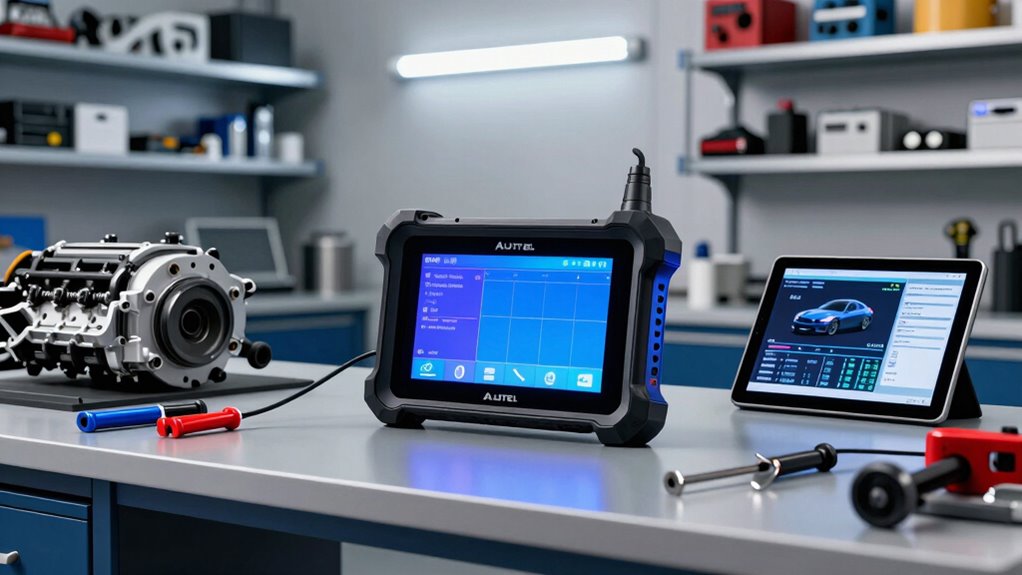

For most professional mechanics, the Autel MK900BT is the best overall fit in this roundup, pairing bidirectional diagnostics with CAN-FD and DoIP support. The MaxiSys MS906 Pro is a stronger match for shops that need broader advanced service capability, while the MaxiSys Ultra S2 targets teams that want premium topology, DVI, and EV functions. The main tradeoff is between an affordable scanner that covers common jobs and a higher-tier platform with more specialized capabilities and complexity. I compare all 10 options by diagnostic breadth, workflow fit, and the features that matter at shop level. Read on for the full breakdown and help matching a scanner to your work.

Get business pricing on garage and car supplies
- Business-only prices and quantity discounts
- Tax-exempt purchasing
- Multiple users, one account, clear invoices
Complete the kit


Key Takeaways
- The MK900BT stands out as the most balanced shop choice because it combines bidirectional testing with CAN-FD and DoIP support.
- The MS906 Pro and Ultra S2 sit above the midrange tools for mechanics who need broader capabilities, with the Ultra S2 adding topology, DVI, and EV-focused functions.
- The MK808Z, MK808S, MX808S, and MX900 overlap in everyday shop use; buyers should compare exact functions and vehicle coverage rather than assume similar model names mean identical tools.
- The MK900TS is the specialist pick for shops that want a scanner with top-tier TPMS functions alongside diagnostic work.
- The KM100E has a narrower key and immobilizer focus, so it is a better fit as a purpose-specific tool than as a shop’s only all-system scanner.
| Autel MK808Z All-System Diagnostic Scanner with Bidirectional Control |  | Best Balanced Shop Scanner | Vehicle coverage: 180+ brands, including 2026 models | Operating system: Android 11 | Memory: 4GB RAM, 64GB storage | VIEW ON AMAZON | See Our Full Breakdown |
| Autel MaxiCOM MK900BT Bidirectional Scan Tool – 40+ Services, CAN-FD & DoIP |  | Best for High-Volume General Diagnostics | Display: 8-inch | Active tests: 3,000+ | Service functions: 40+ across 150+ makes | VIEW ON AMAZON | See Our Full Breakdown |
| Autel MaxiCOM MK808S Diagnostic Scanner |  | Best for Stable Wired Workflow | Vehicle coverage: 200+ brands | Active tests: 3,000+ | Display: 7-inch touchscreen | VIEW ON AMAZON | See Our Full Breakdown |
| Autel MaxiCOM MK900TS Scanner, Bidirectional Scan Tool with TPMS Function |  | Best for TPMS-Heavy Repair Shops | Display: 8-inch, 1280 × 800 | Operating system: Android 11 | Memory: 4GB RAM, 64GB storage | VIEW ON AMAZON | See Our Full Breakdown |
| Autel Scanner MaxiIM KM100E Diagnostic Tool |  | Best Compact Key-Service Specialist | Operating system: Android 9.0 | Processor: PX30 | Display: 5.5-inch HD | VIEW ON AMAZON | See Our Full Breakdown |
| Autel MaxiSys MS906 Pro Diagnostic Scanner |  | Best for Advanced Shop Diagnostics | Display: 8 inches, 1920 × 1200 | Operating system and processor: Android 10, 8-core CPU | Memory and storage: 4GB RAM, 128GB storage | VIEW ON AMAZON | See Our Full Breakdown |
| Autel MaxiCOM MK900BT Scanner |  | Best for Wireless Shop Flexibility | Display: 8 inches, 1280 × 800 | Operating system: Android 11 | Processor: Rockchip RK3566, 4-core, 1.8GHz | VIEW ON AMAZON | See Our Full Breakdown |
| Autel Scanner MaxiCheck MX900 |  | Best Wired Value for Full-System Work | Display: 8 inches, 1280 × 800 | Operating system: Android 11 | Processor: Rockchip RK3566, 4-core | VIEW ON AMAZON | See Our Full Breakdown |
| Autel MaxiCheck MX808S |  | Best Entry Point for Core Bidirectional Diagnostics | Processor: Rockchip RK3566, 4-core | Memory and storage: 4GB RAM, 64GB ROM | Operating system: Android 11 | VIEW ON AMAZON | See Our Full Breakdown |
| Autel MaxiSys Ultra S2 AI Scanner |  | Best Premium Platform for Complex Shop Work | Model: MaxiSys Ultra S2 | Topology mapping: 3.0 | Vehicle coverage: 15,000 models, as listed | VIEW ON AMAZON | See Our Full Breakdown |
| top rated autel diagnostic scanners for professional mechanic | Active tests | Operating system | Display | Service functions |
|---|---|---|---|---|
| Autel MK808Z All-System Diagno | — | Android 11 | — | 28+ resets, including Oil, EPB, SAS, SRS, Injector, BMS, and DPF |
| Autel MaxiCOM MK900BT Bidirect | 3,000+ | — | 8-inch | 40+ across 150+ makes |
| Autel MaxiCOM MK808S Diagnosti | 3,000+ | Android | 7-inch touchscreen | — |
| Autel MaxiCOM MK900TS Scanner | 3,000+ | Android 11 | 8-inch, 1280 × 800 | 40+ |
| Autel Scanner MaxiIM KM100E Di | — | Android 9.0 | 5.5-inch HD | — |
| Autel MaxiSys MS906 Pro Diagno | 3,000+ | — | 8 inches, 1920 × 1200 | — |
| Autel MaxiCOM MK900BT Scanner | 3,000+ | Android 11 | 8 inches, 1280 × 800 | 40+ |
| Autel Scanner MaxiCheck MX900 | 3,000+ | Android 11 | 8 inches, 1280 × 800 | 40+ |
| Autel MaxiCheck MX808S | 3,000+ | Android 11 | — | — |
| Autel MaxiSys Ultra S2 AI Scan | 3,000+ | — | — | 48+ |
More Details on Our Top Picks
Autel MK808Z All-System Diagnostic Scanner with Bidirectional Control
The MK808Z is a strong fit for independent shops that need all-system diagnostics and component actuation without stepping up to a more specialized platform. Its bidirectional controls let a technician command supported components during diagnosis, while 28+ service functions cover common maintenance work such as EPB, oil, battery, and DPF resets. Support for CAN FD and DoIP also gives it reach across newer vehicles. Compared with the MK900BT, it has fewer listed service functions and no stated 8-inch screen, but it still offers a useful professional feature set in a less elaborate package. The tradeoffs are the annual renewal consideration and registration required for FCA SGW bypass; buyers should also verify vehicle-specific functions before relying on them in a workflow.
Pros:- Bidirectional control and active tests support hands-on fault isolation
- CAN FD and DoIP coverage addresses newer vehicle networks
- 28+ service functions cover common workshop maintenance tasks
- Auto-VIN and auto-scan can reduce setup steps
Cons:- FCA SGW bypass requires registration
- Annual renewal fees may matter to shops that want ongoing software updates
- Listed coverage is limited to OBD2 vehicles, so unusual or non-standard vehicles may fall outside its scope
Best for: Independent mechanics who want all-system scans, active tests, and common service resets across a broad mix of OBD2 vehicles.
Not ideal for: Shops that need dedicated TPMS programming or the MK900BT’s larger screen and broader listed service-function set.
- Vehicle coverage:180+ brands, including 2026 models
- Operating system:Android 11
- Memory:4GB RAM, 64GB storage
- Wi-Fi:Dual-band
- Service functions:28+ resets, including Oil, EPB, SAS, SRS, Injector, BMS, and DPF
- Protocols:CAN FD and DoIP
- Additional functions:FCA SGW bypass, Auto-VIN, and auto-scan
Our verdict“Choose the MK808Z for a capable general-purpose shop scanner if you do not need the MK900BT’s added service breadth or the MK900TS’s TPMS specialization.”
Autel MaxiCOM MK900BT Bidirectional Scan Tool – 40+ Services, CAN-FD & DoIP
For a shop that scans a varied vehicle queue, the MK900BT pairs a broad service menu with more than 3,000 active tests and support for CAN FD and DoIP. That combination can help technicians move from reading faults to checking whether a component responds, while its 8-inch display gives live data and test results more room than the MK808S’s 7-inch screen. It also supports Wi-Fi printing of pre- and post-scan reports, a practical advantage when documenting repairs for customers. The 40+ service functions exceed the MK808Z’s listed 28+, but this is not a complete all-in-one package: battery testing requires the BT506 accessory, and some advanced functions depend on vehicle compatibility. The included update period is one year; buyers should check ongoing software terms for their shop’s needs.
Pros:- More than 3,000 active tests support detailed component checks
- 40+ service functions span more than 150 makes
- 8-inch display gives diagnostic information more viewing space
- Wi-Fi printing supports pre- and post-repair reporting
Cons:- Battery testing requires the separate BT506 accessory
- Some advanced functions require VIN-level compatibility checks
- Software updates are free for one year, so continued update access needs consideration
Best for: Busy general repair shops that need broad make coverage, extensive active tests, and customer-ready scan reports.
Not ideal for: Technicians seeking built-in battery testing or shops unwilling to check vehicle-specific coverage and ongoing software terms.
- Display:8-inch
- Active tests:3,000+
- Service functions:40+ across 150+ makes
- Protocols:CAN FD and DoIP
- Wireless range:33 ft with V150
- Software updates:One year included; listed diagnostic features remain after subscription expiration
- Battery testing:Requires BT506 accessory
Our verdict“Pick the MK900BT for broad, report-friendly diagnostics across a busy general repair workload, provided its accessory and update requirements suit your shop.”
Autel MaxiCOM MK808S Diagnostic Scanner
The MK808S is the straightforward pick for mechanics who value a dependable wired connection over the freedom of a wireless interface. It provides full-system diagnostics and more than 3,000 active tests across over 200 vehicle brands, giving it substantial diagnostic reach for its class. Its 7-inch touchscreen is smaller than the MK900BT’s 8-inch display, and the USB connection means the tablet stays tethered during a scan, but a wired setup avoids managing a separate wireless link. Against the MK808Z, the MK808S lists wider brand coverage, while the MK808Z specifies CAN FD and DoIP support and a newer Android version. The MK808S’s annual upgrade fee and lack of Bluetooth are real workflow costs, so it suits shops with a stable bay setup better than mobile technicians.
Pros:- Full-system diagnostics and 3,000+ active tests
- Coverage listed for more than 200 vehicle brands
- Wired USB connection provides a stable link
- 7-inch touchscreen and 21-language support
Cons:- No Bluetooth connection, which limits movement around the vehicle
- Annual firmware upgrade fee applies
- Some functions require vehicle compatibility checks
Best for: Shop technicians who work primarily at fixed bays and prefer a wired scanner with broad brand coverage and active tests.
Not ideal for: Mobile mechanics who need wireless freedom, or buyers who specifically need stated CAN FD and DoIP support.
- Vehicle coverage:200+ brands
- Active tests:3,000+
- Display:7-inch touchscreen
- Connectivity:Wired USB
- Operating system:Android
- Memory:4GB RAM
- Processor:RK3566
- Languages:21
Our verdict“Choose the MK808S if broad brand coverage and a reliable tethered workflow matter more than wireless convenience or newer-protocol support.”
Autel MaxiCOM MK900TS Scanner, Bidirectional Scan Tool with TPMS Function
The MK900TS earns its place for shops where tire and sensor work is a regular part of the job, not an occasional add-on. Alongside full-system diagnostics, 3,000+ active tests, and 40+ service functions, it adds TPMS activation, relearn, and MX-Sensor programming. That makes it a more focused choice than the general-purpose MK900BT, while its 8-inch display, CAN FD, and DoIP support keep it useful for broader diagnostic work. The listed toolkit also covers remote-key signal checks and selected sensor functions, though vehicle and sensor compatibility should be confirmed before purchase. Battery testing needs a BT506 accessory, and the supplied listing describes a one-year update period followed by a recurring renewal cost. Buyers should verify the exact model, included accessories, and support terms with the seller.
Pros:- TPMS sensor activation, relearn, and MX-Sensor programming
- More than 3,000 active tests and 40+ service functions
- CAN FD and DoIP support for newer vehicle networks
- Wi-Fi printing and pre- and post-scan reporting
Cons:- Battery testing requires the BT506 accessory
- Vehicle, sensor, and individual function compatibility should be verified
- Continued software updates may involve a renewal fee after the included period
Best for: Tire and general repair shops that regularly diagnose TPMS faults, program sensors, and perform relearns alongside broader vehicle scans.
Not ideal for: Mechanics who rarely handle TPMS work and would rather choose a simpler general-purpose scanner such as the MK808Z.
- Display:8-inch, 1280 × 800
- Operating system:Android 11
- Memory:4GB RAM, 64GB storage
- Active tests:3,000+
- Service functions:40+
- Protocols:CAN FD and DoIP
- TPMS functions:Sensor activation, relearn, and MX-Sensor programming
- Battery:7,700mAh
- Wireless:Dual-band 2.4GHz and 5GHz Wi-Fi
Our verdict“Choose the MK900TS if TPMS diagnosis and sensor programming are frequent shop tasks; otherwise, the MK900BT is the less specialized fit.”
Autel Scanner MaxiIM KM100E Diagnostic Tool
The KM100E is the outlier in this lineup: its strongest case is compact, guided key-related work rather than the all-system repair coverage offered by the MK808Z or MK900BT. The supplied description highlights a 60-second guided workflow, support for 700+ vehicle models, and lifetime software updates without an extra update fee. Its 5.5-inch screen and 2GB of RAM also make it a smaller, more modestly equipped device than the larger diagnostic tablets here. There is a serious fit limitation: the listing names several excluded makes and warns that some functions may require a VSP credential. Its conflicting coverage claims make a VIN check particularly important. I would treat this as a specialist companion tool, not as a primary professional scanner for broad mechanical diagnosis.
Pros:- Lifetime software updates are listed without extra update fees
- Guided workflow is designed to make supported procedures quicker to follow
- Compact 5.5-inch device with 64GB storage
- Stated coverage includes more than 700 vehicle models, subject to compatibility
Cons:- The listing excludes several major makes and gives conflicting coverage information
- Some vehicle functions may require a VSP credential
- Its described specialization does not replace the broader all-system toolset of the MK808Z or MK900BT
Best for: Technicians whose work centers on compatible vehicle key services and who want a compact device with guided workflows and included software updates.
Not ideal for: General repair shops needing dependable all-system diagnostics across common makes, especially those servicing the vehicle brands excluded in the listing.
- Operating system:Android 9.0
- Processor:PX30
- Display:5.5-inch HD
- Memory:2GB RAM, 64GB storage
- Battery:4,950mAh
- Vehicle coverage:Claimed 700+ models; compatibility restrictions are listed
- Software updates:Lifetime updates listed with no extra update fee
Our verdict“Consider the KM100E as a compact key-service specialist only after confirming your makes and procedures by VIN, not as your shop’s main diagnostic scanner.”
Autel MaxiSys MS906 Pro Diagnostic Scanner
The MS906 Pro is the strongest fit here for mechanics who need broad system access plus hands-on actuator testing, rather than a scanner focused mainly on routine service work. Its ECU coding and 3,000-plus active tests can help isolate faults by commanding components directly, while full-system diagnostics and scan reports support a more structured workflow. Compared with the MaxiCheck MX900, this model is positioned for more advanced coding and shop-level diagnostic demands; the MX900 offers many of the same broad functions in a more streamlined package. The tradeoff is a steeper learning curve, and some functions and software updates depend on internet access. Its Android 10 platform is also older than the Android 11 systems listed for the MK900BT and MX900, so buyers should weigh diagnostic depth against newer platform hardware.
Pros:- ECU coding supports repair workflows beyond code reading and clearing
- More than 3,000 active tests allow direct checks of supported components
- Full-system diagnostics and scan reports help organize fault-finding
- 8-inch high-resolution display and 11,600mAh battery suit extended shop sessions
Cons:- Advanced functions can take time and training to use effectively
- Android 10 is older than the Android 11 platform listed for the MK900BT and MX900
- Software updates and some functions require internet access
Best for: Experienced independent-shop technicians who regularly diagnose multiple vehicle systems and need ECU coding alongside bidirectional tests.
Not ideal for: Technicians who mainly perform basic service resets or want a simpler, newer-platform tool without advanced coding complexity.
- Display:8 inches, 1920 × 1200
- Operating system and processor:Android 10, 8-core CPU
- Memory and storage:4GB RAM, 128GB storage
- Battery:11,600mAh
- Active tests:3,000+
- Supported protocols:CAN FD, DoIP
- Vehicle functions:OE full-system diagnostics, 40+ services
- Cameras:16MP rear, 5MP front
Our verdict“Choose the MS906 Pro if your shop will use ECU coding and extensive active tests often enough to justify its added complexity.”
Autel MaxiCOM MK900BT Scanner
The MK900BT brings a substantial diagnostic feature set into a wireless workflow: it pairs an 8-inch tablet with a Bluetooth VCI specified for up to 33 feet of range. That can make checking a vehicle from outside the cabin more convenient than using the wired MaxiCheck MX900, which lists similar core functions but keeps the connection tethered. The MK900BT also lists 3,000+ active tests, 40-plus service functions, CAN FD and DoIP, and FCA and Renault gateway access. For a professional bay that values movement and broad system coverage, that combination is compelling. Its tradeoffs are practical: the 7,700mAh battery is smaller than the MS906 Pro’s, and the advertised functions still depend on vehicle compatibility. The Android 11 hardware and 4GB/64GB configuration are capable, but this is not the same coding-focused proposition as the MS906 Pro.
Pros:- Bluetooth VCI supports a stated working range of up to 33 feet
- 3,000+ active tests and 40+ service functions cover varied shop tasks
- CAN FD and DoIP expand protocol support for newer vehicles
- Lists FCA and Renault security-gateway access
Cons:- 7,700mAh battery capacity is lower than the MS906 Pro’s 11,600mAh
- Wireless functions and vehicle coverage vary by make, model, and system
- Its listed 4GB RAM and 64GB storage are more limited than the MS906 Pro’s 128GB
Best for: Independent mechanics who need broad bidirectional diagnostics and want to move around the vehicle without a cable tether.
Not ideal for: Shops that prioritize ECU coding depth, need a larger battery for long sessions, or prefer a wired connection with fewer wireless components.
- Display:8 inches, 1280 × 800
- Operating system:Android 11
- Processor:Rockchip RK3566, 4-core, 1.8GHz
- Memory and storage:4GB RAM, 64GB storage
- Battery:7,700mAh
- Active tests:3,000+
- Service functions:40+
- Connectivity and protocols:Bluetooth VCI, stated range up to 33 feet; CAN FD, DoIP
- Vehicle diagnostics:OE all-system diagnostics; FCA and Renault gateway access listed
Our verdict“Pick the MK900BT if cable-free movement matters more to your workflow than the MS906 Pro’s greater storage and coding emphasis.”
Autel Scanner MaxiCheck MX900
The MX900 makes a strong case for a shop that wants current-generation diagnostics without needing a wireless VCI. Its listed feature set includes 3,000+ active tests, 40-plus service functions, OE all-system diagnostics, CAN FD and DoIP, and pre- and post-scan reporting. That places it close to the MK900BT in diagnostic breadth, but the MX900 is the wired option; choose it if a direct connection suits your bays and you would rather not rely on a wireless link. Compared with the MS906 Pro, the MX900 has a newer Android 11 platform listed but less storage and no stated emphasis on ECU coding. Its narrower language support—English with Spanish or Portuguese options as described—may also matter for multilingual teams. Compatibility and individual functions still need checking against the vehicles you service.
Pros:- 3,000+ active tests support component-level troubleshooting
- 40+ service functions and OE all-system diagnostics cover common shop needs
- CAN FD and DoIP support access to newer vehicle architectures
- Pre- and post-scan reports can help document diagnostic work
Cons:- Wired connection offers less freedom than the MK900BT’s Bluetooth VCI
- 4GB RAM and 64GB storage are below the MS906 Pro’s listed storage capacity
- Listed language options are limited compared with the MK900BT’s stated 21+ languages
Best for: Independent repair shops that want broad all-system scans, active tests, and service functions through a wired connection.
Not ideal for: Technicians who need wireless movement around the vehicle, deeper ECU coding capabilities, or broad language selection.
- Display:8 inches, 1280 × 800
- Operating system:Android 11
- Processor:Rockchip RK3566, 4-core
- Memory and storage:4GB RAM, 64GB storage
- Active tests:3,000+
- Service functions:40+
- Protocols:CAN FD, DoIP
- Diagnostic functions:OE all-system diagnostics, pre- and post-scan reports, Wi-Fi printing
- Connection type:Wired vehicle connection
Our verdict“Choose the MX900 if you want broad, wired diagnostics and reporting, but skip it if wireless operation or advanced coding is a priority.”
Autel MaxiCheck MX808S
The MX808S is the more restrained pick for a workshop that wants bidirectional tests and broad system checks without moving up to the MX900’s expanded protocol and service list. It offers 3,000+ active tests, Android 11 hardware, and diagnostics across systems such as engine, transmission, ABS, SRS, and TPMS. That gives technicians useful scope for routine fault isolation and maintenance work. Compared with the MX900, however, the supplied data does not list CAN FD, DoIP, or 40-plus service functions, so the newer model is the better match for shops handling a wider spread of late-model vehicles. Vehicle compatibility and Auto VIN availability can vary, and the MX808S still calls for diagnostic know-how; it is not a substitute for understanding test results or confirming coverage before a job.
Pros:- 3,000+ active tests provide bidirectional diagnostic capability
- Android 11 and RK3566 processor support a current hardware platform
- Covers key systems including engine, transmission, ABS, SRS, TPMS, and battery
- Supports maintenance tasks such as oil reset and ABS bleeding
Cons:- Vehicle and function compatibility varies, so coverage should be checked by VIN
- Auto VIN is not universal across vehicles
- Supplied specifications do not list CAN FD or DoIP support
Best for: Smaller repair shops and independent technicians who need bidirectional testing and common system diagnostics for a known mix of vehicles.
Not ideal for: Shops frequently working on newer CAN FD or DoIP vehicles, or technicians who need the MX900’s listed 40-plus service functions.
- Processor:Rockchip RK3566, 4-core
- Memory and storage:4GB RAM, 64GB ROM
- Operating system:Android 11
- Active tests:3,000+
- Supported vehicle years:Pre-2000 and newer; check vehicle compatibility
- Vehicle systems:Engine, transmission, ABS, SRS, TPMS, battery
- Connectivity:OBD2
- Version:2026 US version
Our verdict“The MX808S suits shops seeking core bidirectional diagnostics, while late-model protocol coverage points toward the MX900 instead.”
Autel MaxiSys Ultra S2 AI Scanner
The MaxiSys Ultra S2 is the specialist choice in this group: its feature set goes beyond tablet-based code diagnosis with topology mapping, ECU programming, EV testing, and integrated electrical test functions. Topology 3.0 can help technicians trace communication faults across vehicle modules, while the oscilloscope, multimeter, waveform generator, and CAN-Bus tester support deeper electrical diagnosis. Compared with the MS906 Pro, the Ultra S2 is a much broader workshop platform, listing J2534 programming and additional test equipment rather than focusing chiefly on coding and active tests. That breadth comes with a real cost in complexity and likely makes less sense for shops that mostly perform routine service work. The provided information also gives limited detail about software updates, so buyers should clarify update arrangements and vehicle-specific coverage before relying on it for a shop’s workflow.
Pros:- Topology 3.0 mapping supports tracing faults across connected vehicle modules
- ECU programming and coding include J2534 connectivity
- Integrated oscilloscope, multimeter, waveform generator, and CAN-Bus tester broaden electrical diagnostics
- EV testing and 48+ service functions suit varied specialist workflows
Cons:- Complex setup and capabilities require substantial technical expertise
- The wide feature set may be unnecessary for shops focused on routine service
- Available product information gives limited detail on software update arrangements
Best for: Established repair facilities handling complex network, electrical, programming, and EV jobs that can make use of a multi-function diagnostic platform.
Not ideal for: Small shops or general service technicians who mainly need code reading, common resets, and bidirectional checks without advanced programming or electrical test tools.
- Model:MaxiSys Ultra S2
- Topology mapping:3.0
- Vehicle coverage:15,000 models, as listed
- Programming and connectivity:ECU J2534 programming and coding; D-PDU, SAE J2534, RP1210
- Active tests:3,000+
- Service functions:48+
- Electrical test functions:Oscilloscope, multimeter, waveform generator, CAN-Bus tester
- Additional functions:EV test, Motor TruSpeed Repair, Remote Expert
Our verdict“Choose the Ultra S2 when advanced network, electrical, EV, and programming work justifies a more demanding platform than the MS906 Pro.”

How We Picked
I ranked these scanners by how well their stated capabilities fit professional repair work: all-system coverage, active tests, service functions, newer communication protocols, and workflow utility. I also weighed whether a model serves a broad mix of repair jobs or a narrower specialty, since the right tool for a general repair bay may not be the right one for TPMS or key work. The list distinguishes models with similar names by their advertised functions rather than treating them as interchangeable.
Ranking favors useful breadth and shop versatility, then gives specialist tools credit when they solve a distinct need. A large feature count alone does not make a scanner a stronger purchase if a shop will rarely use those functions. I also considered usability, connectivity, and the tradeoff between a focused midrange tool and a more capable platform. Exact vehicle coverage, included accessories, update terms, and regional functions can vary, so buyers should confirm those details for their own fleet.
| top rated autel diagnostic scanners for professional mechanic | Operating system | Processor |
|---|---|---|
| Autel MK808Z All-System Diagno | Android 11 | — |
| Autel MaxiCOM MK900BT Bidirect | — | — |
| Autel MaxiCOM MK808S Diagnosti | Android | RK3566 |
| Autel MaxiCOM MK900TS Scanner | Android 11 | — |
| Autel Scanner MaxiIM KM100E Di | Android 9.0 | PX30 |
| Autel MaxiSys MS906 Pro Diagno | — | — |
| Autel MaxiCOM MK900BT Scanner | Android 11 | Rockchip RK3566, 4-core, 1.8GHz |
| Autel Scanner MaxiCheck MX900 | Android 11 | Rockchip RK3566, 4-core |
| Autel MaxiCheck MX808S | Android 11 | Rockchip RK3566, 4-core |
| Autel MaxiSys Ultra S2 AI Scan | — | — |
Factors to Consider When Choosing Top Rated Autel Diagnostic Scanners For Professional Mechanics
Before choosing a model, I would start with the work orders that fill your bays, not the longest feature list. A scanner can be technically capable yet a poor fit if it lacks coverage for common vehicles, adds complexity your staff will not use, or duplicates tools already in the shop. These factors help separate a practical daily driver from a specialty or premium purchase.
Match coverage to the vehicles you actually service
Build a short list of the makes, model years, and systems that appear most often in your shop. Broad all-system claims do not guarantee equal depth across every manufacturer or function, so check compatibility for your regular vehicles before buying. This matters especially for newer models and less common systems, where a scanner may read codes but lack a needed active test or service routine. Shops working on mixed fleets should favor breadth; a specialist working on a narrower group can prioritize depth. A common mistake is to buy based on a single vehicle compatibility example and assume the same support across an entire brand. Confirm coverage against the exact jobs that create lost time or outside-tool referrals.
Separate code reading from repair capability
A scanner that reads and clears diagnostic trouble codes is not automatically suited to diagnosis. Bidirectional controls let a technician command components and observe responses, which can narrow down faults without swapping parts by guesswork. Before paying extra, list the active tests your team would use, such as actuating a pump, fan, or valve. Service resets matter too, but they do not replace live data, system scans, or component testing. Check whether the advertised functions apply to the makes you service, since capability can vary by vehicle. If the tool will support several technicians, prioritize the tests that appear repeatedly in your actual workflow.
Check protocol support against your newer vehicles
CAN-FD and DoIP support can matter when a shop works on newer vehicles that use these communication methods. Their presence is not a guarantee of full coverage, but their absence may limit access on some newer platforms. Review your current fleet and expected vehicle mix over the next few years before treating these protocols as either mandatory or irrelevant. A shop focused on older vehicles may get more value from broad service functions than from paying for newer-vehicle connectivity it rarely uses. Verify that the scanner, cable, and any required adapters support the intended connection. Do not rely on a model-family name alone to confirm protocol support.
Budget for software support and ownership details
The purchase decision includes more than the tablet or handheld unit. Check update coverage, renewal terms, supported regions, warranty conditions, and what accessories come in the box. Software support can affect access to newer vehicles and functions, so confirm how long updates are included and what happens afterward. Avoid assuming that two listings with similar names provide the same software package or hardware revision. For a professional shop, downtime and access to technical support can matter as much as the initial feature set. Compare the total ownership terms with your expected service life, not just the advertised capabilities.
Choose specialist tools only when the workflow justifies them
TPMS programming, key and immobilizer work, EV testing, topology views, and digital vehicle inspection can each support distinct shop services. A focused tool may be a better buy than a single premium platform if only one team handles that work or if the function is occasional. Conversely, a shop that regularly performs those jobs may save time by keeping the relevant capability close at hand. Confirm licensing, included accessories, and vehicle support for the specific task before committing. One frequent mistake is treating a specialist feature as a substitute for general diagnostic coverage. Decide whether the scanner will be a main bay tool, a dedicated specialty tool, or an addition to equipment you already own.
Frequently Asked Questions
Is the MK900BT a better shop choice than the MK808Z?
The MK900BT is the stronger fit when your shop needs the listed CAN-FD and DoIP support alongside bidirectional testing. The MK808Z remains worth comparing if its all-system diagnostics and active controls cover your regular work and you do not need those newer protocols. Do not choose solely by model number: verify the exact hardware version, included functions, and vehicle coverage in the listing. For a mixed fleet that includes newer vehicles, the MK900BT’s protocol support may make it the safer fit. For a shop focused on familiar models, the MK808Z may cover the required work without the same emphasis on newer connections.
Do I need CAN-FD and DoIP for a professional shop?
Those protocols matter most if you diagnose vehicles that rely on them, especially newer models. They are not a substitute for checking manufacturer-specific coverage, active tests, or service functions. A shop that mostly sees older vehicles may get more day-to-day value from broad system access and dependable support for its common jobs. If newer vehicles are becoming a larger part of your workload, protocol support can help avoid connection limitations. Check the models and years you service before paying for a feature that may sit unused.
Should I buy the MK900TS if I already own a TPMS tool?
Only if its TPMS functions fill a real gap or reduce tool switching in your shop. Compare the MK900TS’s supported TPMS jobs and vehicle coverage with the capabilities of your existing equipment. If your current tool handles your routine sensor work reliably, a general-purpose scanner may be a better addition. If TPMS service is frequent and you want diagnostic and TPMS capability in one platform, the MK900TS has a clearer role. Confirm the exact included sensors, accessories, and functions before purchase.
Can the KM100E replace an all-system diagnostic scanner?
The KM100E is presented as a key and immobilizer-oriented diagnostic tool, so I would not treat it as a replacement for a general all-system scanner without confirming its full functions. A shop that handles key work may value it as a dedicated addition. For routine engine, ABS, airbag, and body-system diagnosis, compare its coverage against the all-system models in this lineup. Check support for the exact vehicles and key procedures you perform, since these functions are vehicle-dependent. If you need one primary scanner for varied repair work, a broader model is the safer starting point.
When does the Ultra S2 make more sense than the MS906 Pro?
The Ultra S2 is the more specialized premium direction when topology, multi-point DVI, or EV testing features match your shop’s work. The MS906 Pro may be the more practical choice if you want advanced diagnostic capability without making those particular functions central to the purchase. Higher capability has little value if technicians will not use it or the shop does not service the relevant vehicles. Compare supported functions, vehicle coverage, accessories, and update terms before deciding. Choose the Ultra S2 for a documented workflow need, not simply because it sits at the top of a product family.
Conclusion
For a broad professional workload, I would start with the MK900BT as best overall, especially when CAN-FD and DoIP support matter. The MK808S or MK808Z are the value-oriented choices for shops whose regular vehicles and procedures fit their coverage; compare the exact listing and functions before choosing between them. For beginners or smaller teams, an MK808-series model offers a more focused entry into all-system diagnostics than a premium platform, provided it supports the vehicles in the shop. The MS906 Pro is my premium general-purpose pick, while the Ultra S2 makes sense for shops that will use its topology, DVI, or EV functions. Choose the MK900TS for TPMS-focused work and the KM100E for key and immobilizer tasks; neither should be mistaken for the best single scanner for every repair bay.