The best Level 2 home EV chargers balance charging speed, connector compatibility, installation needs, and useful controls. My best overall pick is the ChargePoint HomeFlex J1772 NEMA 14-50 for buyers who want a recognizable smart charger with a plug-in setup; the EVIQO 48A hardwired model stands out for higher-power installations, while the EVDANCE 32A offers a simpler lower-amperage alternative. The main tradeoffs are plug-in convenience versus hardwired power, J1772 versus NACS compatibility, and paying for smart features you may not use. A higher amp rating only helps when your vehicle and home electrical circuit can support it. Read on for the full comparison and a guide to choosing the right charger for your parking space and charging routine.

Get business pricing on garage and car supplies
- Business-only prices and quantity discounts
- Tax-exempt purchasing
- Multiple users, one account, clear invoices
Complete the kit


Key Takeaways
- The lineup splits into clear installation paths: several 40A models use a NEMA 14-50 plug, while the 48A and 50A hardwired options call for a more involved electrical setup.
- Connector choice can narrow the field quickly: most listed chargers use J1772, while the Tesla-branded unit and ChargePoint NACS version serve vehicles with a NACS inlet or a compatible charging setup.
- More amperage is not automatically more useful: 32A and 40A chargers may suit overnight charging, while 48A and 50A models make more sense when the vehicle and home circuit can take advantage of their output.
- Portable plug-in models trade some installation permanence for flexibility: EVDANCE offers both 32A and 40A choices with 25-foot cables, giving buyers a way to match output to their electrical capacity.
- Smart features vary in practical value: Wi-Fi and app control appear on some models, but buyers who mainly need reliable overnight charging may prefer to prioritize connector fit, circuit capacity, and cable reach.




| level 2 home ev charger | Cable length | Voltage | Connector |
|---|---|---|---|
| Level 2 EV Charger | 25 ft | 240 volts | — |
| ChargePoint HomeFlex Level 2 E | — | 240 volts | — |
| Level 2 EV Charger | 25 ft | 240 V | — |
| EVDANCE Level 2 EV Charger 40A | 25 ft | 240 V | — |
| EVDANCE Level 2 EV Charger | 25 ft | 240 V | — |
| EVIQO Level 2 EV Charger J1772 | 25 ft | 240V | J1772 |
| EVIQO Level 2 EV Charger J1772 | 25 ft | 240V | J1772 |
| Level 2 EV Charger | 25 ft | — | J1772 |
| ChargePoint HomeFlex Level 2 E | — | — | J1772 |
| ChargePoint HomeFlex Level 2 E | — | — | NACS (Tesla) |
| Tesla Level 2 Charger NACS 48A | 25 ft | 240 V | — |
| Level 2 EV Charger | 25 ft | 240 V | SAE J1772 |
| Aimiler Level 2 Electric Vehic | 25 ft | — | J1772 |
| Upgraded 40 Amp Level 2 EV Cha | 25 ft | 240 V | SAE J1772 |
| EMPORIA Pro Level 2 EV Charger | — | — | J1772 |
More Details on Our Top Picks
Level 2 EV Charger, 40A, 25ft, 9.6kW, LED Display, J1772 EV/PHEVs
This charger suits drivers who want 40A Level 2 output and straightforward controls rather than app-based features. Its adjustable current and programmable schedule let owners tailor charging to their vehicle and routine, while the 25-foot cable can help reach a driveway parking spot that is awkwardly placed relative to the outlet. Compared with the IYILO 40A Wi-Fi charger, this model emphasizes scheduling and basic operation instead of remote app control and energy tracking. Its listed IP65 rating and over-voltage and short-circuit protections also support outdoor use. The tradeoff is that programming may take some getting used to, and the 240V setup needs an appropriate dedicated circuit. Tesla drivers need an adapter, and the listed 30-day return guarantee is not a substitute for a longer parts warranty.
Pros:- Adjustable current and programmable scheduling support different charging routines.
- 25-foot cable offers useful reach from a 240V outlet to the vehicle.
- IP65 weather rating and listed electrical protections suit outdoor home charging.
- J1772 compatibility covers a broad range of EVs and plug-in hybrids.
Cons:- Optimal 40A operation requires an appropriate dedicated 240V circuit.
- Programming may be less intuitive for buyers who want simple plug-and-charge operation.
- Tesla vehicles require a separate adapter, and the listed guarantee is only 30 days.
Best for: J1772 EV or plug-in hybrid owners who want adjustable charging and scheduled starts without relying on Wi-Fi or a mobile app.
Not ideal for: Tesla owners without a J1772 adapter, or buyers who want app-based remote monitoring or a longer stated warranty.
- Maximum output:9.6 kW
- Voltage:240 volts
- Amperage:40 A
- Cable length:25 ft
- Vehicle connector compatibility:SAE J1772 EVs and plug-in hybrids
- Outlet connectors:NEMA 14-50, NEMA 5-15
- Certifications:CE, FCC
- Listed guarantee:30-day return guarantee
Our verdict“Choose this model if you want a weather-rated, adjustable 40A J1772 charger with scheduling but do not need smart-app controls.”
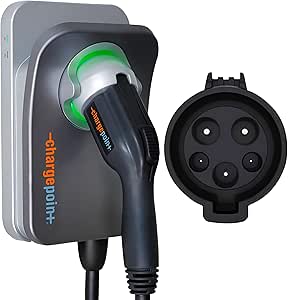
ChargePoint HomeFlex Level 2 EV Charger J1772 – NEMA 14-50 Plug
The HomeFlex is the app-focused choice in this group, pairing a 50A maximum rating with mobile controls and a stated charging rate of up to 45 miles of range per hour. That makes it a stronger fit than the EVDANCE 40A portable charger for drivers who prioritize connected home charging over portability and an on-device display. Its NEMA 14-50 plug offers a plug-in installation route, while the product is described as suitable for indoor or outdoor placement. The three-year parts warranty is also longer than the one-year term listed for the 32A EVDANCE. The main caveat is vehicle fit: this version has a J1772 connector, so Tesla owners need an adapter. Buyers should also confirm their circuit and vehicle can make use of its higher current; the 50A rating alone does not dictate charging speed.
Pros:- Mobile app provides connected control for home charging.
- 50A maximum rating supports higher-capacity charging when the circuit and vehicle allow it.
- Described as suitable for indoor or outdoor installation.
- Three-year parts warranty is longer than the one-year term listed for the 32A EVDANCE.
Cons:- J1772 connector means Tesla vehicles require a separate adapter.
- Higher output depends on compatible electrical installation and vehicle acceptance rate.
- At 13.8 pounds, it is less suited to buyers prioritizing a lightweight travel charger.
Best for: J1772 EV owners who want app-based charging controls, a plug-in setup, and a longer stated parts warranty.
Not ideal for: Tesla drivers who do not want to use an adapter, or households seeking a lightweight portable charger for travel.
- Voltage:240 volts
- Maximum amperage:50 A
- Installation connection:NEMA 14-50 plug
- Vehicle connector:J1772
- Claimed charging rate:Up to 45 miles of range per hour
- Ports:1
- Weight:13.8 lb
- Warranty:3 years parts warranty
Our verdict“Pick the HomeFlex if app controls and a higher current ceiling matter more than portability or native Tesla compatibility.”
Level 2 EV Charger, 40Amp/9.6KW/240V, NEMA 14-50P, Wi-Fi (2.4 GHz)
The IYILO stands out for buyers who want more control than the simpler 40A LED-display charger provides. Its app offers remote operation and energy tracking, while adjustable output from 6A to 40A gives owners flexibility to match charging with household needs. The product also lists dynamic load sharing and utility-program support, features that can help coordinate charging with other electrical demands when the home setup supports them. Unlike the ChargePoint HomeFlex, its maximum output is 40A rather than 50A, so it is not the higher-current pick here. On the other hand, it supplies useful connectivity at that lower ceiling and lists UL 2594, ETL, Energy Star, and CSA credentials. The tradeoffs are a 2.4 GHz-only Wi-Fi connection, professional installation with a 50A breaker, and no included Tesla adapter.
Pros:- App control and energy tracking add remote visibility over charging.
- Adjustable 6A–40A output gives more control than a fixed-current charger.
- Lists dynamic load sharing and utility-program support.
- UL 2594, ETL, Energy Star, and CSA certifications are specified.
Cons:- Wi-Fi supports 2.4 GHz only, not 5 GHz.
- Professional installation with a 50A breaker is specified.
- Tesla models need a separate adapter.
Best for: Tech-minded J1772 EV owners who want app monitoring, adjustable current, and charging features that can work with utility programs.
Not ideal for: Buyers who need 5 GHz Wi-Fi, want a simpler installation, or expect a Tesla adapter to come in the box.
- Maximum power:9.6 kW
- Voltage:240 V
- Current range:6A–40A
- Vehicle connector:SAE J1772
- Cable length:25 ft
- Wi-Fi:2.4 GHz
- Dimensions:9.8 x 8.7 x 4.4 in
- Weight:13.45 lb
- Certifications and warranty:UL 2594, ETL, Energy Star, CSA; 3 years
Our verdict“Choose the IYILO if connected controls and adjustable current matter more than a higher 50A ceiling or a simpler setup.”
EVDANCE Level 2 EV Charger 40Amp, 240V, 9.6KW Portable Electric Vehicle Charging Station with NEMA 14-50P, 25FT Cable, Adjustable Current, Delay Timer, J1772 Compatibility
This EVDANCE is the strongest fit for drivers who want a portable 40A charger with a clear readout rather than app-led monitoring. Its large TFT display shows charging information at the unit, and the delay timer lets owners set a later start without depending on the IYILO’s Wi-Fi connection. Compared with the EVDANCE 32A model, this version raises the maximum output to 9.6 kW, making it the more capable option when the vehicle and circuit support 40A charging. Its 25-foot cable and carrying accessories also suit owners who may move the charger between locations. The cost of that portability is a setup that may feel more involved for less experienced users, and Tesla drivers need an adapter. The listed IP66 rating and operating temperature range support varied conditions, but the product data does not specify a warranty.
Pros:- 40A and 9.6 kW maximum output exceed the 32A EVDANCE model’s listed capacity.
- Large TFT display provides charging information at the unit.
- 25-foot cable and included carrying accessories support portable use.
- IP66 rating and a stated temperature range suit varied operating conditions.
Cons:- Setup may be challenging for buyers unfamiliar with EV charging equipment.
- Tesla vehicles require a separate adapter.
- No warranty term is provided in the product data.
Best for: J1772 EV owners who want a portable 40A unit, an on-device display, and delayed charging without relying on an app.
Not ideal for: Buyers who prefer app-based remote tracking, need native Tesla compatibility, or want a stated warranty term.
- Maximum amperage:40 A
- Voltage:240 V
- Maximum power:9,600 W (9.6 kW)
- Cable length:25 ft
- Vehicle connector:J1772
- Display:TFT
- Operating temperature:-22°F to +122°F
- Weight:11.64 lb
Our verdict“Choose this EVDANCE if you want a portable 40A charger with a built-in display and delay timer rather than app features.”
EVDANCE Level 2 EV Charger (32Amp, 240V, NEMA 14-50P), 7.68kW Portable Home Electric Car Charger with 25ft Cable and Adjustable Current
With a maximum of 32A and 7.68 kW, this EVDANCE gives up some speed compared with the 40A EVDANCE above, but that lower ceiling can suit drivers whose vehicle, circuit, or charging routine does not call for the added capacity. Its current adjustment from 16A to 32A lets owners reduce the draw when needed, and the 25-foot cable helps with parking flexibility at home or on the road. The LED display provides local charging information, unlike an app-centered option such as the IYILO 40A charger. The product is described as portable and includes a carrying case, though the listed weather guidance is more cautious: it is not recommended for direct sunlight or heavy rain. Tesla owners also need an adapter, and the one-year warranty is shorter than ChargePoint HomeFlex’s stated three-year parts coverage.
Pros:- Adjustable 16A–32A output accommodates different charging needs.
- 25-foot cable and carrying case make it practical to move between locations.
- LED display gives local charging information without an app.
- J1772 compatibility covers most North American EVs using that connector.
Cons:- 7.68 kW maximum output is lower than the 9.6 kW 40A options in this group.
- Not recommended for direct sunlight or heavy rain exposure.
- One-year warranty is shorter than the ChargePoint HomeFlex’s listed three-year parts warranty.
Best for: J1772 EV owners who want a portable, adjustable 32A charger and do not need the faster 40A models’ maximum output.
Not ideal for: Drivers who need the highest available charging capacity, app-based monitoring, or a charger intended for prolonged exposure to direct sun or heavy rain.
- Maximum power:7.68 kW
- Voltage:240 V
- Current range:16A–32A
- Cable length:25 ft
- Vehicle connector compatibility:J1772
- Installation plug:NEMA 14-50P
- Display:LED
- Warranty:1 year
Our verdict“Pick this model if a portable 32A charger meets your daily needs and you value adjustable output over the extra capacity of a 40A unit.”
EVIQO Level 2 EV Charger J1772 48A – Hardwired 240V Wall Charging Station
The EVIQO 48A is a strong fit for drivers who want a hardwired J1772 charger with room to adjust charging current. Its up-to-48A output can support faster home charging when the vehicle and household electrical setup allow it, while the 25-foot cable helps reach cars parked farther from the unit. Compared with the plug-in EVIQO 40A, this model trades outlet-based installation for a higher potential output and a fixed connection. WiFi app controls add scheduling and remote start or stop, but those features depend on a stable 2.4 GHz network. The weatherproof design supports indoor or outdoor placement; the main compromise is that installation requires a licensed electrician, so it is less convenient to relocate than a NEMA 14-50 charger.
Pros:- Adjustable charging output up to 48A
- 25-foot cable offers useful reach across a garage or driveway
- Weatherproof design supports indoor and outdoor installation
- App supports remote start, stop, and scheduling
Cons:- Requires hardwired installation by a licensed electrician
- Smart features rely on a stable 2.4 GHz WiFi connection
Best for: J1772 EV owners who want a hardwired outdoor-capable charger, a long cable, and charging current above 40A where their electrical service permits it.
Not ideal for: Renters or drivers who need a portable, outlet-connected unit, or homes without the electrical capacity and electrician access for hardwired installation.
- Connector:J1772
- Maximum current:48A
- Voltage:240V
- Cable length:25 ft
- WiFi:2.4 GHz
- Installation:Hardwired
- Warranty:3 years
Our verdict“Choose this EVIQO if you want a high-output hardwired J1772 charger with flexible placement, and skip it if plug-in portability matters more.”
EVIQO Level 2 EV Charger J1772 40A NEMA 14-50 – 240V Wall Charging Station
This EVIQO makes the most sense for buyers who want smart controls but prefer a NEMA 14-50 plug over hardwiring. Its 40A output and 25-foot J1772 cable suit many home charging routines, while app scheduling can help fit charging around household plans. Against the hardwired EVIQO 48A, it gives up some maximum output but is easier to disconnect or move if the outlet is already available. It also has a useful nighttime detail: the glow-in-the-dark holster makes the connector easier to find in a dim garage. The tradeoff is the need for a dedicated 50A outlet; this is not a workaround for an ordinary household receptacle. WiFi-dependent app features may also be less useful where the signal is weak.
Pros:- Plug-in NEMA 14-50 connection avoids a permanently hardwired charger
- 25-foot J1772 cable supports flexible parking positions
- WiFi app provides remote control and scheduling
- UL, ETL, FCC, and Energy Star certifications are listed
Cons:- Requires a dedicated 50A NEMA 14-50 outlet
- Maximum current is lower than the hardwired EVIQO 48A
- App functions depend on a stable WiFi connection
Best for: Homeowners with a dedicated NEMA 14-50 outlet who want app scheduling, J1772 compatibility, and a plug-in unit they can disconnect more readily than a hardwired charger.
Not ideal for: Drivers without a properly installed 50A NEMA 14-50 outlet, or buyers who need the higher output available from the hardwired EVIQO 48A.
- Maximum current:40A
- Voltage:240V
- Connector:J1772
- Cable length:25 ft
- Plug:NEMA 14-50
- WiFi:2.4 GHz
- Certifications:UL, ETL, FCC, Energy Star
- Weight:21 lb
Our verdict“Pick this EVIQO if you already have a suitable 14-50 outlet and value smart plug-in charging over the extra output of a hardwired unit.”
Level 2 EV Charger, 40 Amp 240V, 25ft Cable, LED Display
For buyers who want adjustable current and delayed charging without making WiFi the centerpiece, this 40A unit offers a simpler feature set than either EVIQO charger. Its programmable delay timer lets owners set charging to begin later, while the 25-foot J1772 cable gives flexibility in how a car is parked. The listed NEMA 14-50 plug makes it a plug-in option, unlike the hardwired ChargePoint HomeFlex J1772, but the description calls for a properly grounded outlet and a dry environment. That limits where it is suited to operate compared with weatherproof outdoor-rated options in this group. Tesla drivers also need an adapter, which is not included. It is a practical choice for a covered, indoor charging spot, not a smart-home or all-weather pick.
Pros:- Adjustable current settings offer flexibility for different home circuits
- Programmable delay timer supports scheduled charging
- 25-foot cable provides generous reach
- NEMA 14-50 plug supports plug-in installation
Cons:- Requires a properly grounded outlet and dry operating environment
- Tesla adapter is needed and is not included
- No WiFi app control is listed
Best for: J1772 EV owners with a grounded NEMA 14-50 outlet in a dry garage who want adjustable current and a built-in delay timer.
Not ideal for: Drivers needing outdoor weather protection, WiFi app controls, or a charger that connects directly to a Tesla without an adapter.
- Output voltage:240V
- Input voltage:240V
- Maximum current:40A
- Connector:J1772
- Cable length:25 ft
- Plug type:NEMA 14-50
- Charging controls:Adjustable current and programmable delay timer
Our verdict“Choose this charger for timer-based charging in a dry garage, but favor a weatherproof EVIQO model for outdoor placement.”
ChargePoint HomeFlex Level 2 EV Fast Charger, J1772, Smart, Hardwired, 50A
The ChargePoint HomeFlex J1772 is suited to drivers who want a hardwired smart charger from a familiar charging-system brand and need a connector for non-Tesla EVs. The listed 50A rating and stated charging rate of up to 45 miles of range per hour put it ahead of the 40A EVIQO plug-in on maximum listed output, though actual charging speed depends on the vehicle and electrical installation. Its app adds connected control, and the cold-resistant cable plus indoor/outdoor suitability make it more adaptable to changing conditions than the dry-environment-only 40A charger in this lineup. The tradeoffs are practical: installation needs an electrician, full smart functionality relies on WiFi, and Tesla owners need an adapter. Buyers seeking a NACS connector should choose the other ChargePoint HomeFlex variant instead.
Pros:- 50A rating and stated charging rate up to 45 miles per hour
- Mobile app supports smart connectivity
- Cold-resistant cable and indoor/outdoor suitability
- UL-certified with a 3-year manufacturer warranty
Cons:- Hardwired installation requires an electrician
- Full smart functionality depends on WiFi
- Tesla vehicles require an adapter
Best for: Non-Tesla J1772 EV owners seeking a hardwired, app-connected charger for indoor or outdoor installation, especially where cold-weather cable flexibility matters.
Not ideal for: Tesla drivers who want a native connector, or households that prefer a plug-in charger and do not want electrician-installed equipment.
- Output voltage:240V
- Input voltage:240V
- Amperage:50A
- Connector:J1772
- Installation:Hardwired
- Ports:1
- Dimensions:7.06 in D x 11.19 in W x 7.07 in H
- Weight:13.8 lb
- Warranty:3 years
Our verdict“Choose the J1772 HomeFlex for a connected hardwired setup serving non-Tesla EVs, and select the NACS HomeFlex if you want a Tesla connector.”
ChargePoint HomeFlex Level 2 EV Charger, Hardwired NACS Charging Station – Tesla Compatible, Fast Charge Solution for Electric Vehicles
This HomeFlex variant is the clearest choice here for Tesla owners who want a native NACS connector rather than relying on an adapter for a J1772 charger. It shares the ChargePoint name and stated charging rate of up to 45 miles per hour with the J1772 HomeFlex, but its connector makes the key difference: Tesla drivers can connect directly, while owners of J1772 vehicles should compare it with the other ChargePoint model. App controls support remote management, and the unit is listed for indoor or outdoor installation. The product data does not specify an amperage rating for this variant, so I would not use the listed charging-rate claim alone to compare its electrical capacity with the 50A J1772 version. Hardwiring also calls for professional installation, and compatibility is focused on Tesla/NACS vehicles.
Pros:- Native NACS connector avoids an adapter for compatible Tesla vehicles
- Stated charging rate is up to 45 miles of range per hour
- App supports charger control and management
- Listed for indoor or outdoor installation
Cons:- Professional hardwired installation is required
- Compatibility is focused on Tesla/NACS vehicles
- Amperage is not specified in the provided product data
Best for: Tesla owners who want a hardwired home charger with a native NACS connector, app control, and indoor or outdoor installation capability.
Not ideal for: Drivers with J1772-only EVs, or buyers who need a clearly stated amperage rating before comparing electrical capacity with other chargers.
- Output voltage:240V
- Input voltage:240V
- Connector:NACS (Tesla)
- Compatible vehicles:Tesla vehicles
- Installation:Hardwired
- Ports:1
- Dimensions:7.06 in D x 11.19 in W x 5.2 in H
- Warranty:3 years
Our verdict“Choose this HomeFlex for direct NACS charging at home, but select the J1772 HomeFlex if your EV uses a J1772 inlet.”
Tesla Level 2 Charger NACS 48A – Hardwired 240V Wall EV Charger
The main reason I’d shortlist this charger is its native NACS connector: Tesla owners and drivers of other NACS vehicles can plug in directly, without the adapter step required by the J1772-based EMPORIA Pro or IYILO. Its 48A output and 25-foot cable suit a permanent home setup, while WiFi control adds remote monitoring and scheduling. Weatherproofing, listed UL and ETL certifications, and a glow-in-the-dark holster also make outdoor docking easier to manage after dark. The tradeoff is installation flexibility: this unit is hardwired, so a licensed electrician must install it, unlike the plug-in Aimiler. Non-Tesla drivers with J1772 ports will need to source a compatible adapter separately. I’d rank it for NACS households, not buyers seeking a plug-and-play J1772 option.
Pros:- Native NACS connector works with Tesla vehicles and other EVs with NACS ports.
- 48A output and a 25-foot cable fit higher-capacity home charging setups.
- WiFi app supports remote start, stop, and monitoring.
- Weatherproof design and glow-in-the-dark holster suit outdoor use and nighttime docking.
Cons:- Hardwired installation requires a licensed electrician.
- NACS-to-J1772 adapter is not included for J1772 vehicles.
Best for: Tesla owners and drivers of other NACS-equipped EVs who want a hardwired outdoor charger with app control.
Not ideal for: J1772-only EV owners who want a charger that connects without a separately sourced adapter, or renters who cannot arrange hardwired installation.
- Amperage:48 A
- Voltage:240 V
- Cable length:25 ft
- Connectivity:WiFi (2.4 GHz)
- Installation:Hardwired
- Weatherproof:Yes
- Certifications:UL, ETL, FCC, Energy Star
- Compatibility:Tesla NACS and other EVs with NACS ports
Our verdict“Choose this hardwired charger if your EV has a NACS port and you want a long-reach outdoor setup without relying on an adapter.”
Level 2 EV Charger, 48Amp/11.5KW/240V, UL 2594, ETL & Energy Star
I’d pick the IYILO for households that want to adjust charging current from 6A to 48A, rather than commit to a single setting. That range can help match charging to a home’s electrical capacity or a lower-output charging schedule; at its maximum, the unit is rated for 11.5 kW. Compared with the 48A EMPORIA Pro, IYILO makes its current adjustment range explicit, while the EMPORIA offers PowerSmart load balancing and both plug-in and hardwired installation options. IYILO instead uses a J1772 connector and requires professional installation with a 60A breaker, so it is not the choice for renters or Tesla drivers without an adapter. Its 2.4GHz-only WiFi also limits network compatibility. The listed safety and efficiency certifications add reassurance, but the installation demands make this a better fit for planned home setups.
Pros:- Adjustable current from 6A to 48A lets buyers select a lower charging setting when needed.
- Rated 11.5 kW at 240V for high-output home charging.
- App features include energy tracking and scheduling.
- UL 2594, ETL, and Energy Star certifications are listed.
Cons:- Requires professional installation with a 60A breaker.
- WiFi supports 2.4GHz only, not 5GHz.
- Tesla adapter is not included.
Best for: Homeowners with a suitable 60A circuit who want a J1772 charger whose current can be adjusted to suit different charging needs.
Not ideal for: Renters, buyers who need 5GHz WiFi, or Tesla owners who want to charge without obtaining a separate adapter.
- Power:11.5 kW
- Voltage:240 V
- Current:6A to 48A adjustable
- Cable length:25 ft
- Connector:SAE J1772
- Certifications:UL 2594, ETL, Energy Star
- Weight:13.45 lb
- Dimensions:9.8 x 8.7 x 4.4 in
Our verdict“Choose the IYILO if adjustable current and high maximum output matter more than flexible installation or 5GHz WiFi.”
Aimiler Level 2 Electric Vehicle (EV) Charger, 32A, 25ft Cable, Wi-Fi App Control, NEMA 14-50P Plug, ETL Certified, 220V-240V, Portable Home Charging Station
The Aimiler takes a more modest approach than the 40A Upgraded charger or 48A IYILO: it tops out at 32A and 7.68 kW, which can be a sensible match for drivers who do not need the lineup’s highest charging output. Its NEMA 14-50P plug makes it a portable-style alternative to hardwired units such as the Tesla NACS charger, though the outlet and circuit still need to suit the charger. A 25-foot cable offers useful reach, and NEMA Type 4 protection plus ETL certification support its stated outdoor use. App controls cover remote operation and scheduling, but setup may take more troubleshooting than a straightforward basic charger. Like the IYILO and EMPORIA, it uses J1772, so Tesla drivers need an adapter. I’d favor it for flexible, lower-output charging, not for buyers prioritizing maximum amperage.
Pros:- 32A output and 7.68 kW rating provide a lower-output alternative to the 40A and 48A models.
- NEMA 14-50P plug supports a portable-style setup.
- 25-foot cable gives room to park farther from the outlet.
- NEMA Type 4 protection and ETL certification are listed.
Cons:- Lower maximum output than the Upgraded 40A charger and the 48A options.
- Tesla vehicles require a compatible adapter, which is not included.
- App setup and connectivity troubleshooting may be involved.
Best for: Drivers with a compatible NEMA 14-50 outlet who want a portable-style J1772 charger with app controls and do not need more than 32A.
Not ideal for: Drivers seeking 40A or 48A charging, or Tesla owners who do not want to obtain a J1772 adapter.
- Output voltage:240 V
- Amperage:32 A
- Maximum output:7.68 kW
- Connector:J1772
- Plug:NEMA 14-50P
- Cable length:25 ft
- Protection:NEMA Type 4
- Certifications:ETL, FCC
Our verdict“Pick the Aimiler if a 32A plug-in charger meets your routine and you value portability over higher charging output.”
Upgraded 40 Amp Level 2 EV Charger, NEMA 14-50P, 9.6kW J1772 Home Charging
This charger lands between the 32A Aimiler and the 48A IYILO, giving buyers 40A output and 9.6 kW without stepping up to a 48A unit. That middle ground suits drivers who want more capacity than the Aimiler provides but do not need the IYILO’s maximum output. Its NEMA 14-50P plug avoids the hardwired installation required by the Tesla NACS charger, and the 25-foot cable can make garage placement less restrictive. App control, adjustable current, and stated weatherproofing add everyday flexibility. The tradeoffs are that app features depend on WiFi or Bluetooth, and Tesla charging requires an adapter that is not included. The supplied details do not identify specific certification standards, so buyers who prioritize named listings may prefer a model such as IYILO, which specifies its certifications.
Pros:- 40A and 9.6 kW output sit above the 32A Aimiler while staying below the 48A options.
- NEMA 14-50P plug offers an alternative to hardwired installation.
- 25-foot cable helps accommodate different parking positions.
- Adjustable current and app control support more tailored charging.
Cons:- App features rely on WiFi or Bluetooth connectivity.
- Tesla adapter is not included.
- Specific certification standards are not identified in the supplied product details.
Best for: J1772 EV and plug-in hybrid owners who want a 40A charger with a NEMA 14-50 plug rather than a hardwired installation.
Not ideal for: Buyers who need 48A output, want app-free controls, or require a Tesla adapter or clearly named certification standards in the product details.
- Power:9.6 kW
- Current:40 A
- Voltage:240 V
- Cable length:25 ft
- Connector:SAE J1772
- Plug:NEMA 14-50P
- Warranty:3 years
- Dimensions:12 x 7 x 3 in
Our verdict“Choose this model if you want a plug-in 40A J1772 charger and do not need the higher output or named certification details of other picks.”
EMPORIA Pro Level 2 EV Charger with PowerSmart – 48 Amp Fast Home Charging Station with J1772 Connector
The EMPORIA Pro earns its place for buyers who want 48A charging plus PowerSmart load balancing, rather than maximum output alone. That load-management feature is the key distinction from the IYILO: it can help coordinate charger demand with a home’s electrical load, while IYILO emphasizes a broad adjustable-current range. The EMPORIA also gives buyers a choice between hardwired and NEMA 14-50 installation, a flexibility the hardwired Tesla NACS model lacks. App scheduling and real-time energy insights add control beyond simply plugging in. Its J1772 connector suits many North American EVs, but Tesla drivers need an adapter, and hardwired installation calls for a professional. The product description also places it above basic chargers in cost and lists only black as a color option. I’d rank it highest for load-conscious households, not for buyers seeking the simplest or least feature-rich setup.
Pros:- 48A output supports high-capacity home charging.
- PowerSmart load balancing distinguishes it from chargers focused mainly on adjustable amperage.
- Hardwired and NEMA 14-50 installation options provide setup flexibility.
- App provides scheduling, monitoring, and real-time energy insights.
Cons:- Hardwired installation requires a professional electrician.
- J1772 connector means Tesla drivers need a separate adapter.
- Only black is listed as a color option.
Best for: Homeowners with multiple electrical demands who want a 48A J1772 charger with load balancing, app controls, and a choice of installation style.
Not ideal for: Buyers seeking a basic charger without smart features, or Tesla owners who do not want to use a separate adapter.
- Input voltage:240 V
- Amperage:48 A
- Connector:J1772
- Installation options:Hardwired or NEMA 14-50 plug
- Dimensions:3 x 8.25 x 12.25 in
- Color:Black
- Warranty:3 years
Our verdict“Choose the EMPORIA Pro if you want 48A charging with load balancing and installation flexibility in a J1772 charger.”

How We Picked
I compared these 15 Level 2 home EV chargers around the decisions that shape everyday use: connector type, maximum amperage, plug-in or hardwired installation, cable length, portability, and stated smart or safety features. I gave more weight to compatibility and a plausible installation fit than to a high output figure on its own, since a charger cannot exceed the limits of the vehicle or the home’s electrical circuit.
The ranking favors models with a clear use case and a useful balance of features rather than treating every higher-powered charger as automatically better. ChargePoint HomeFlex ranks well for buyers seeking a smart, established plug-in option; the EVIQO and ChargePoint hardwired models better suit buyers planning a permanent higher-output installation. Portable EVDANCE models and app-equipped alternatives serve shoppers who value flexibility, while simpler 40A units remain relevant when basic charging is the priority. Product details supplied for this roundup do not establish the same independent performance evidence for every model, so buyers should confirm current specifications, certification, compatibility, and installation requirements before purchase.
Factors to Consider When Choosing Level 2 Home Ev Chargers
Choosing among Level 2 home EV chargers is less about chasing the largest number on the label and more about matching the charger to your vehicle, electrical service, and parking routine. I would settle the installation and connector questions before comparing app features or cable extras.
Match Charger Output to the Circuit and Vehicle
A charger’s amperage is only one part of its real-world charging capability. The vehicle’s onboard charger sets a limit, and a home circuit must be sized for the charger’s continuous load by a qualified electrician. A 48A or 50A unit may call for a hardwired circuit with greater capacity than a plug-in 40A model, so the advertised output can bring installation work along with it. Buyers often pay for extra amperage that their car cannot use or their panel cannot support. If you charge overnight and your daily driving is modest, a lower-output charger may already cover your routine. Ask an electrician to check panel capacity, wiring, and local requirements before selecting a high-amperage model.
Choose the Connector for Your Current Car and Future Plans
Connector compatibility is a first-pass filter, not a minor detail. Most chargers in this roundup use J1772, while the Tesla-branded model and a ChargePoint NACS version are aimed at NACS connections. Some drivers can use an adapter, but that adds another item to manage and requires checking that the vehicle, charger, and adapter support the intended charging setup. If you expect to change vehicles, consider which connector will suit the next car as well as the one in your garage today. Do not assume a connector label alone settles compatibility; confirm the vehicle’s inlet and the manufacturer’s guidance. This check can prevent buying a capable charger that is inconvenient to use.
Decide Between a Plug-In Charger and a Hardwired Installation
A NEMA 14-50 plug-in charger can be appealing when a suitable outlet is already installed, and it may be easier to relocate than a permanently wired unit. That convenience depends on the outlet being properly rated and installed for EV charging; an existing outlet should not be treated as proof of suitability. Hardwired models can support higher output and avoid a plug connection, but installation is more permanent and usually needs an electrician. Think about whether you may move, change parking locations, or want the cleanest fixed setup. A common mistake is choosing the charger first and discovering that the outlet or circuit does not match its requirements. Compare the full installation plan, not just the charger connection.
Measure Cable Reach Before You Buy
A cable that reaches comfortably makes routine charging easier and reduces strain on the cable and connector. Measure from the proposed mounting point to the vehicle’s charge port with the car parked in its usual position, including the path around walls or other obstacles. The 25-foot cables listed on several models may suit many garages, but a nominal length does not account for bends, mounting height, or where the inlet sits on the vehicle. If two cars use one charger, check the reach for both parking positions rather than planning around only one. Avoid stretching a cable across a driveway where it could become a trip or vehicle hazard. A shorter, well-placed cable can be more practical than a longer one mounted in the wrong spot.
Pay for Smart Controls Only If They Change Your Routine
Wi-Fi and app features can help with scheduling, monitoring, and adjusting charging, especially when you want charging to follow household energy habits. They add little if you already control charging through the vehicle and rarely check charging status remotely. Before paying for connectivity, confirm the specific functions offered and whether they depend on a stable wireless signal where the charger will be mounted. A garage with weak Wi-Fi can make app-based controls less dependable than expected. Also check whether the vehicle can schedule charging directly, since duplicate schedules can cause confusion. For a straightforward overnight routine, connector fit, circuit compatibility, and cable management may matter more than a long feature list.
Check Certification, Weather Exposure, and Installation Details
Installation location affects the kind of enclosure and cable handling your setup needs. A charger mounted outdoors faces exposure that an indoor garage unit may not, so check the manufacturer’s stated environmental ratings and installation instructions rather than assuming all home chargers suit every location. Certifications named for a product can help buyers identify evaluated safety requirements, but verify the exact model and listing before purchase. Have a qualified installer review grounding, breaker sizing, wiring, and local permitting rules. Avoid choosing based on a display or portability feature while overlooking the parts that determine safe installation. Keeping the manual and installation records also makes later troubleshooting and household changes easier.
Frequently Asked Questions
Will a 48A or 50A charger charge my EV faster than a 40A model?
Only if both the vehicle’s onboard charger and the home electrical installation can accept the higher output. If either sets a lower limit, the car will charge below the charger’s maximum rating. A higher-amperage hardwired unit may also require a larger circuit and more installation work than a plug-in 40A charger. Compare the vehicle’s AC charging limit with the electrician’s assessment of your panel before paying for additional capacity. If overnight charging already covers your driving, the extra output may not change your daily routine.
Can I plug a NEMA 14-50 charger into an outlet I already have?
Do not assume an existing NEMA 14-50 outlet is suitable just because its shape matches the charger’s plug. EV charging is a sustained load, so the outlet, wiring, breaker, grounding, and installation condition all matter. Ask a qualified electrician to inspect it and confirm the circuit supports the charger’s specified current. The electrician can also identify whether the outlet or circuit needs replacement or adjustment. This check is a better basis for choosing a plug-in model than relying on the outlet label alone.
Should I choose J1772 or NACS if I may replace my car soon?
Start with the inlet on your current vehicle, then check what connector is likely to suit the replacement you have in mind. J1772 remains the connector on most models in this roundup, while the NACS options may be a more direct fit for vehicles with that inlet. An adapter can bridge some combinations, but it introduces compatibility checks and another piece of equipment. Confirm the carmaker’s guidance for the exact vehicle and charging setup before buying. If you expect to keep the charger longer than the car, connector flexibility deserves more weight in your decision.
Is a portable 32A charger enough for regular home charging?
For many drivers, a 32A Level 2 charger can meet routine overnight needs, but the answer depends on daily distance, the vehicle’s charging limit, and how long the car sits at home. The EVDANCE 32A model in this lineup offers a lower-output plug-in option than its 40A counterpart, which may suit a circuit with less available capacity. A 40A or hardwired charger may be preferable if you need more charging in a shorter parking window and your electrical system supports it. Compare your usual energy use with your available charging hours rather than relying on the amp number alone. An electrician can help confirm what your circuit can safely handle.
Do I need Wi-Fi or an app for a home Level 2 charger?
No; a connected charger is useful when you want remote status checks, scheduling, or other app controls, but it is not required for basic charging. Many drivers can set a charging schedule through the vehicle, making charger-side connectivity less valuable. Consider whether the charger location has reliable Wi-Fi and whether the app functions match a real need in your household. If connectivity is unreliable, a feature-rich charger may be less convenient than a simpler model. Prioritize safe installation and vehicle compatibility first, then decide whether app control adds enough value for your routine.
Conclusion
For most buyers seeking a capable plug-in setup with smart features, my best overall recommendation is the ChargePoint HomeFlex J1772 NEMA 14-50. The EVDANCE 32A is my best value-style fit for drivers whose circuit and overnight routine favor a simpler, lower-output portable unit, while the best premium choice is the EVIQO 48A hardwired charger for a planned higher-capacity installation. Beginners may find a 40A NEMA 14-50 option easier to match to a suitable outlet, though an electrician should check the circuit before use. For Tesla or other NACS setups, compare the Tesla Level 2 charger and ChargePoint HomeFlex NACS model against the vehicle’s exact compatibility needs. Choose by connector, circuit, and cable reach first; then pay for extra output or app controls only when they solve a real problem for your home.