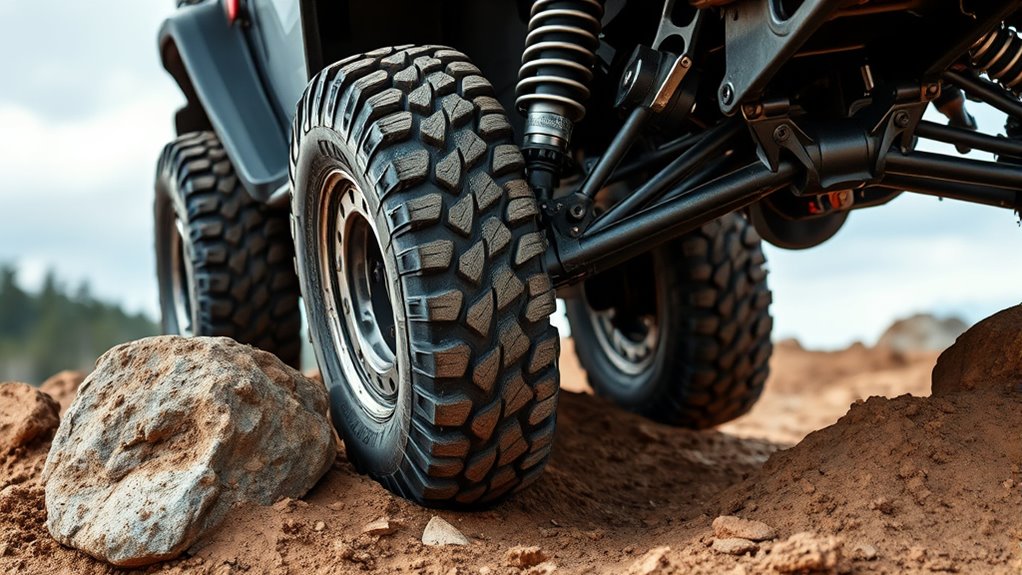

Suspension articulation is how well your suspension allows your wheels to move independently over uneven terrain, keeping contact with the ground for better traction and stability. Flexibility in articulation helps your vehicle clear obstacles and respond smoothly to rough surfaces. However, lifts can reduce this flexibility by changing suspension angles, limiting wheel travel and axle movement. Understanding how lifts impact articulation can improve off-road performance—stick with us to find out more about maintaining ideal suspension flex.
Key Takeaways
- Suspension articulation allows wheels to move independently, maintaining contact and traction on uneven off-road terrain.
- Greater flex enables vehicles to traverse obstacles like rocks and roots more effectively.
- Lifts change suspension angles, often reducing articulation and limiting wheel movement.
- Upgrades like longer control arms help preserve or improve articulation after lifting.
- Proper suspension flex enhances off-road stability, traction, and overall vehicle performance.

Have you ever wondered how vehicles smoothly navigate uneven terrain or sharp turns? It all comes down to suspension articulation—the way your vehicle’s suspension components move to keep wheels in contact with the ground. At the core of this process are concepts like wheel travel and axle articulation. Wheel travel refers to how far a wheel can move up and down relative to the vehicle’s chassis, allowing it to absorb bumps and dips without losing contact. Axle articulation, on the other hand, describes the ability of the axle to pivot or bend as the suspension moves, maintaining tire contact on uneven surfaces. When these elements work in harmony, your vehicle can traverse rough terrain smoothly and with better control.
Suspension articulation keeps wheels in contact, ensuring smooth, controlled off-road and sharp turn navigation.
In off-road situations, maximizing wheel travel is essential. It lets a wheel climb over obstacles, like rocks or roots, without lifting the opposite wheel off the ground. If your suspension doesn’t allow enough wheel travel, your tires lose contact, reducing traction and making it harder to keep moving forward. Axle articulation plays a significant role here because it determines how well the axle can adapt to the terrain’s irregularities. More axle articulation means your vehicle can handle steeper inclines or uneven ground without sacrificing stability. It’s like giving your vehicle more flexibility to bend and stretch, enabling each wheel to find its ideal grip point. This flexibility translates into better off-road performance and increased safety because your vehicle maintains better contact with the surface.
When you lift your vehicle, the suspension geometry changes, which can influence both wheel travel and axle articulation. Many lifts, especially larger ones, tend to reduce articulation because they alter the angles of suspension components. For example, a taller lift may cause the control arms or CV joints to operate at more extreme angles, limiting how far the suspension can move and, consequently, reducing wheel travel. This means fewer obstacles can be tackled effectively, and your vehicle might experience more body roll or instability. However, with proper upgrades like longer control arms or adjustable components, you can mitigate these effects. These modifications help preserve or even enhance wheel travel and axle articulation despite the lift, keeping your off-road capabilities intact. Additionally, innovative suspension designs can help maintain optimal articulation even in lifted vehicles.
In essence, suspension articulation—through wheel travel and axle articulation—is what allows your vehicle to adapt to challenging terrains. While lifts can sometimes compromise these features, they can also be tailored to maintain or improve your vehicle’s off-road performance. Understanding how these elements work together helps you make smarter choices about upgrades and driving techniques, ensuring your vehicle remains capable and confident whether you’re tackling rocky trails or navigating tight turns on the road.
Frequently Asked Questions
How Does Suspension Articulation Impact Vehicle Safety Off-Road?
Suspension articulation improves your off-road safety by allowing your vehicle to better adapt to uneven terrain, reducing rollover risk and maintaining stability. When articulation is limited, your vehicle might become unstable or tip over on steep slopes or rocky paths. Proper flexibility helps distribute weight evenly, lowering stability concerns. By understanding how suspension flex works, you can choose lifts and modifications that enhance safety without compromising your vehicle’s balance and control off-road.
What Are the Best Modifications to Improve Articulation?
To improve articulation, you should upgrade your suspension with longer coilovers or adjustable links, increasing wheel travel and joint flexibility. Installing high-quality heims or ball joints allows smoother movement and better flexibility. Consider adding sway bar disconnects for increased wheel articulation when off-road. These modifications help your vehicle adapt to uneven terrain, providing enhanced traction and stability by maximizing joint flexibility and wheel travel.
How Do Different Tire Sizes Influence Articulation?
They say, “bigger isn’t always better,” and when it comes to tire sizes, that’s true for articulation. Larger tires increase tire diameter and sidewall height, which can reduce your vehicle’s flex by limiting wheel travel. Smaller tires, with lower sidewall height, allow more articulation since they flex more easily. So, choosing the right tire size balances off-road capability with your vehicle’s suspension flexibility.
Can Increased Lift Kits Reduce Articulation Flexibility?
Yes, increased lift kits can reduce your articulation flexibility. As you add more lift height, the suspension geometry changes, often resulting in less downward travel and reduced wheel travel. This means your suspension can’t articulate as freely over uneven terrain. To maintain flexibility, you may need adjustable or specialized suspension components that compensate for the altered geometry caused by higher lifts.
How Does Articulation Affect Vehicle Handling on Uneven Terrain?
Think of your vehicle as a dancer gracefully maneuvering uneven terrain. When wheel travel and axle articulation are optimized, your ride stays steady, gripping the ground like a tightrope walker. Better articulation allows each wheel to respond independently, maintaining traction and control. Conversely, limited articulation makes handling choppy, risking slips or body roll. So, the more your suspension flexes, the more confident you’ll feel on those rugged off-road adventures.
Conclusion
Understanding suspension articulation helps you see why flex is essential off-road—it keeps your tires in contact with uneven terrain for better traction. Some believe lifts compromise articulation, but with proper setup, you can enjoy increased ground clearance without sacrificing flexibility. The truth is, well-designed suspension systems allow you to lift your vehicle while maintaining excellent articulation. So, don’t let myths hold you back—trust in quality engineering to keep your off-road adventures smooth and confident.