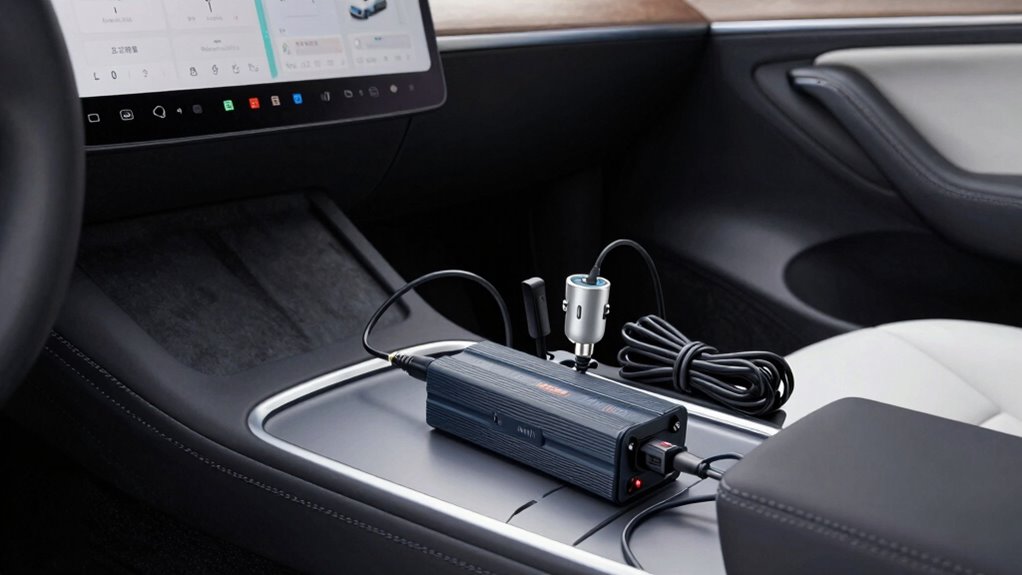

To avoid draining your main battery, incorporate auxiliary power options like solar panels mounted on your roof or dashboard, which provide steady trickle charges during parked or long drives. Use dedicated wiring, fuses, and voltage regulators to protect your system and prevent interference. Adding a secondary deep-cycle battery for accessories keeps your primary battery safe. Proper system design and regular power monitoring help maintain battery health, so you can keep your accessories powered reliably without overtaxing your vehicle.

Get business pricing on garage and car supplies
- Business-only prices and quantity discounts
- Tax-exempt purchasing
- Multiple users, one account, clear invoices
Key Takeaways
- Use a dual-battery system to isolate accessory loads from the main starting battery.
- Incorporate solar panels and charge controllers to supplement power and prevent overcharging.
- Wire accessories to dedicated circuits with proper fuses and voltage regulators for protection.
- Regularly monitor battery voltage and power consumption to avoid overuse.
- Optimize solar panel placement and system design for maximum efficiency and reliable energy input.
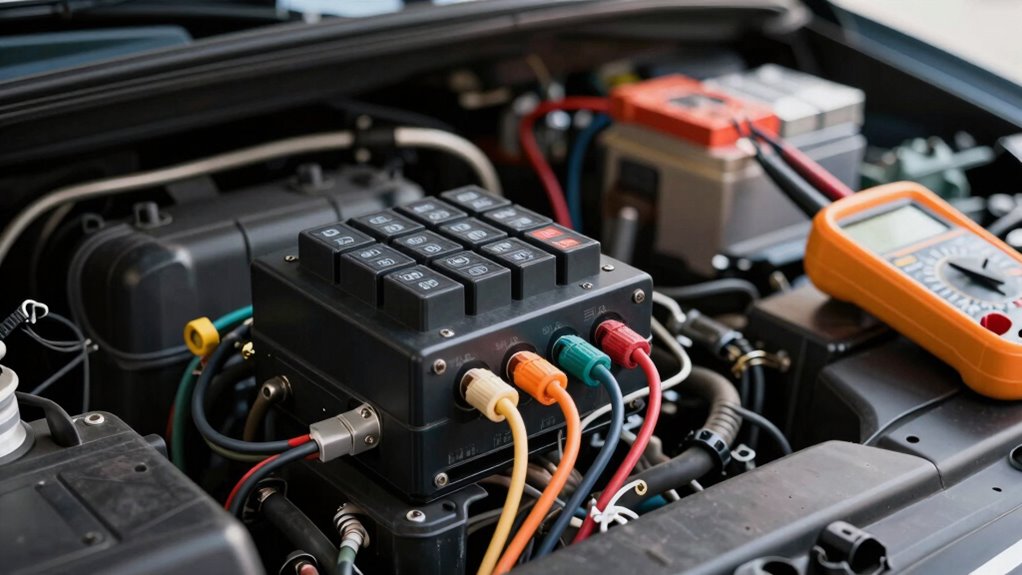
Planning an accessory power setup without depleting your vehicle’s battery requires careful consideration and proper wiring. To keep your battery healthy while powering devices like wireless chargers or small accessories, you need to think strategically about power sources and distribution. One effective approach is to incorporate auxiliary power options such as solar panels, which can supplement your vehicle’s electrical system without overtaxing the battery. Solar panels can be mounted on your roof or dashboard and provide a steady trickle charge, especially when parked or during long drives, reducing the load on your main battery.
When integrating wireless charging devices, make sure they are wired to a dedicated circuit that doesn’t interfere with your vehicle’s primary electrical system. Using a separate fuse or relay ensures that if your wireless charger draws more power than expected, it won’t cause a drain on your battery or damage other components. Additionally, installing a voltage regulator helps keep the power supply stable, preventing sudden surges that could harm your accessories or drain your battery unexpectedly. Proper wire sizing is crucial to prevent voltage drops and ensure efficient power delivery.
To maximize efficiency, consider adding a dual-battery system. This setup involves installing a secondary, deep-cycle battery that handles accessory loads, while the main starting battery remains reserved for engine ignition. This way, your wireless charging stations and solar panel system can operate independently, preventing unnecessary drain on your vehicle’s primary battery. When wiring these components, use high-quality cables rated for your expected current and ensure all connections are secure and insulated to avoid shorts or corrosion.
Another key step is to incorporate a smart charge controller, especially when using solar panels. These controllers regulate the amount of energy sent to your batteries, ensuring they don’t become overcharged or depleted. They optimize your solar panel’s output and prolong battery life. When planning your system, consider the location and angle of your solar panels to maximize exposure to sunlight, enhancing their efficiency and reducing reliance on your vehicle’s battery. Proper system design is crucial to ensure all components work harmoniously and safely.
Finally, keep an eye on your overall power consumption. Regularly check your battery’s voltage to ensure it stays within safe limits, especially if you’re using multiple accessories or relying heavily on solar charging. Using a combination of solar panels, proper wiring, a dedicated power system, and efficient accessories like wireless chargers will help you enjoy your gear without risking a drained battery. With thoughtful planning and installation, your vehicle can support your accessories seamlessly and reliably.
dual battery system for vehicles
As an affiliate, we earn on qualifying purchases.
As an affiliate, we earn on qualifying purchases.
Frequently Asked Questions
What Is the Best Type of Fuse for Accessory Power?
The best type of fuse for accessory power is a blade fuse, as it provides reliable circuit protection. Choose a fuse with the correct ratings to match your accessory’s power requirements, ensuring it doesn’t blow unnecessarily or cause damage. Proper fuse ratings safeguard your wiring and components, preventing overloads. Always select a fuse that matches the circuit’s amperage needs, maintaining safe and efficient accessory power without risking battery drain or electrical issues.
How Can I Monitor My Battery’s Health Over Time?
Ever wondered how to keep tabs on your battery’s health? You can monitor it over time by using a battery monitor or a multimeter, which tracks voltage and capacity. Regularly check for signs of battery aging and capacity degradation, like reduced runtime or difficulty starting your vehicle. This proactive approach helps you catch issues early, ensuring your battery stays reliable and lasts longer. Wouldn’t you want peace of mind knowing your battery’s health?
Are There Specific Wiring Colors to Look For?
Wiring colors are essential for safe, correct connections. Typically, red wires indicate power or positive connections, while black or brown wires are for ground or negative. Some vehicles follow specific color coding schemes, but always double-check your vehicle’s wiring diagram. Look for consistent wiring colors that match their function, and avoid mixing colors to prevent miswiring. Proper wiring guarantees your accessory setup runs smoothly without risking electrical issues.
Can Accessory Power Be Used While the Engine Is Off?
Sure, you can use accessory power while the engine’s off—if your battery capacity is generous and the power draw remains light. Ironically, the more you rely on this, the faster your battery drains, risking a dead car. To avoid surprises, monitor your battery’s health and limit accessory use when engine is off. Otherwise, you might find yourself wishing you had planned for a more robust power setup.
What Are Common Mistakes to Avoid During Installation?
During installation, avoid common mistakes by prioritizing installation safety and following wiring best practices. Don’t ignore proper grounding, as it can cause shorts or electrical failures. Use the correct gauge wire for your setup, and secure all connections tightly to prevent loose wiring. Avoid cutting corners with cheap connectors or skipping fuse protection. Double-check your work, making sure everything is insulated and organized, to guarantee a safe, reliable accessory power system.
As an affiliate, we earn on qualifying purchases.
Conclusion
By carefully planning your accessory power setup, you prevent your battery from becoming a drained, lifeless husk. Think of your battery as the heart of your vehicle—pumping life into everything else. With mindful wiring, appropriate sizing, and smart power management, you’ll keep your system running smoothly without risking a dead engine. Remember, a well-designed setup is like a symphony—each part working harmoniously to keep your adventures alive and thriving.
As an affiliate, we earn on qualifying purchases.
As an affiliate, we earn on qualifying purchases.
Fall Picks
fall essentials
As an affiliate, we earn on qualifying purchases.