TL;DR

Get business pricing on garage and car supplies
- Business-only prices and quantity discounts
- Tax-exempt purchasing
- Multiple users, one account, clear invoices
Builder Peter Grieve has fitted an 18-liter Rolls-Royce Meteorite V8 to a 1956 Series I Land Rover. The twin-turbo engine is reported to be capable of 1,080 horsepower, but the dyno footage shows the project still has running and cooling problems, and does not establish a final power figure.
Peter Grieve has installed an 18-liter Rolls-Royce Meteorite V8 in a 1956 Series I Land Rover, and video from Practical Performance Car shows him attempting to test the twin-turbo build on a dynamometer. The engine is reported to be capable of 1,080 horsepower, but the footage ends before a successful full-power run: the engine runs unevenly and the cooling system struggles during testing.
The engine is a Rolls-Royce Meteorite V8, a design developed for the Mighty Antar tank transporter. The source report says the Antar entered service in the early 1950s and remained in use into the 1980s. The Meteorite was derived from Rolls-Royce’s 27-liter Meteor V12, which itself had roots in the Merlin aircraft engine. It shared many parts with the Meteor, according to Will of Practical Performance Car.
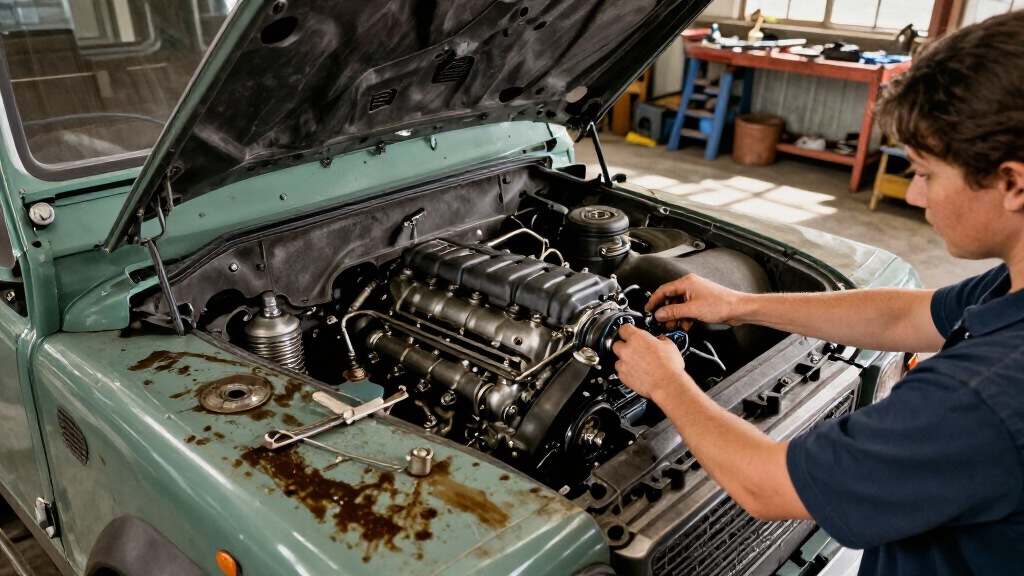
Grieve adapted the large engine to fit the Land Rover by redesigning its camshaft drive; the original assembly at the rear of the Meteor was too bulky for this installation. The build also uses electronic fuel injection and twin turbochargers concealed in the front wings. The report gives 15 pounds of boost as the setup associated with its stated 1,080-horsepower capability, while noting that the engine was running at roughly half that level during the filmed test.
In the video, Grieve adjusts fuel pressure and changes the exhaust plugs after the engine begins running roughly. On a subsequent attempt, the cooling system fails to keep the engine cool, with the report describing coolant heat being directed into the garage rather than adequately controlling engine temperature. The test stops there. The footage therefore documents a work in progress, not a verified peak-power result.
A Tank Engine in a Series I
The project pairs a 1950s utility vehicle with an engine conceived for a military transporter, making it an unusually direct meeting of automotive and military-engineering history. The original Series I Land Rover used a far smaller engine: The Drive reports that early examples had 1.6- or 2.0-liter four-cylinders producing about 50 horsepower. Grieve’s build is a radical departure from that specification, rather than a period-style restoration.
For readers, the dyno footage also shows the practical gap between quoting a headline power target and demonstrating it. A very large, turbocharged engine needs supporting systems that can cope with its output, and the test surfaced unresolved fueling and cooling issues. Until the vehicle completes a successful run, the reported 1,080 horsepower should be treated as the build’s stated capability, not a measured result from this session.
Products Worth Considering

Milwaukee M18 FUEL 1/2-Inch High Torque Impact Wrench with Friction Ring Kit

Milwaukee M12 Fuel 1/4 Hex Impact Driver Kit

Chemical Guys 17-Piece Car Detailing Kit for Interior, Wheels, and Exterior
As an affiliate, we earn on qualifying purchases.
From Antar Transporter to Land Rover
The Meteorite’s history helps explain why the engine is in the project. It was a V8 version derived from Rolls-Royce’s Meteor tank engine, designed to use many of the same parts despite having four fewer cylinders than the Meteor V12. According to the Practical Performance Car account, this commonality helped support the Antar fleet. The engine’s lineage runs through the Meteor to the Merlin aircraft engine.
The Land Rover is a 1956 Series I, part of the early generation that established the model as a working vehicle in postwar Britain. Its original four-cylinder power was modest by modern standards, but the mismatch between that design and a twin-turbo 18-liter V8 is the point of Grieve’s build. The source describes the finished vehicle as road-drivable, though the dyno footage itself concerns testing rather than a documented road evaluation.
“The engine is reported to make 1,080 horsepower with 15 pounds of boost.”
— The Drive, reporting on the Practical Performance Car video
Power and Cooling Still Unproven
The video does not show a successful full-power dyno run, and the source provides no measured horsepower figure from the test. It is not clear how much power the engine produced during the attempts shown, or whether Grieve later resolved the rough running and cooling problems. The report also does not provide detailed specifications for the engine’s final configuration beyond the twin turbos, electronic fuel injection, and stated 15 pounds of boost.
The source characterizes the vehicle as road-drivable, but offers no independent inspection, road-test results, or information about its legal status for public-road use. Those points should not be inferred from the dyno footage.
A Further Dyno Run Is Needed
The immediate next step is resolving the cooling and running issues before another dyno attempt. A later test would be needed to establish a measured output and show whether the engine can complete a sustained run. The source does not announce a schedule for that work, a target date for another video, or a confirmed plan to take the Land Rover to a drag strip.
Key Questions
What engine is in Peter Grieve’s Land Rover?
It uses a Rolls-Royce Meteorite 18-liter V8, originally developed for the Mighty Antar tank transporter. The Land Rover build adds twin turbochargers and electronic fuel injection.
Has the Land Rover made 1,080 horsepower?
The source reports 1,080 horsepower as the engine’s stated capability at 15 pounds of boost. The dyno footage does not show a successful run confirming that figure.
What went wrong during the dyno test?
The engine began running roughly, prompting adjustments to fuel pressure and the exhaust plugs. The cooling system then struggled, and the test ended without a full-power result.
What was the original Series I Land Rover’s engine output?
The Drive reports that typical early Series I models used 1.6- or 2.0-liter four-cylinder engines producing about 50 horsepower.
Is the modified Land Rover road legal?
The report describes it as drivable on the road, but does not provide documentation of its registration, inspection, or legal status. The dyno video does not establish those details.
Source: thedrive.com