TL;DR

Get business pricing on garage and car supplies
- Business-only prices and quantity discounts
- Tax-exempt purchasing
- Multiple users, one account, clear invoices
Mercedes-Benz High-Power Charging says its network has reached 100 locations in the United States and Canada after launching in November 2023. The company reports nearly 1,000 charging ports, coverage across 28 U.S. states and British Columbia, and a first-time session success rate above 90%—but it has not published detailed methodology for its performance figures.
Mercedes-Benz High-Power Charging has reached 100 locations across the United States and Canada, with nearly 1,000 charging ports, as the network marks three years since its November 2023 launch. The milestone gives EV drivers another multi-state fast-charging option, while the company says its stations now start more than 90% of charging sessions successfully on the first attempt.
The network operates across 28 U.S. states and British Columbia, according to InsideEVs. Mercedes-Benz says more than 245,000 customers have charged at its locations during the network’s first three years. The company describes uptime as near-perfect, but the report does not provide an exact uptime percentage or explain how that measure is calculated.
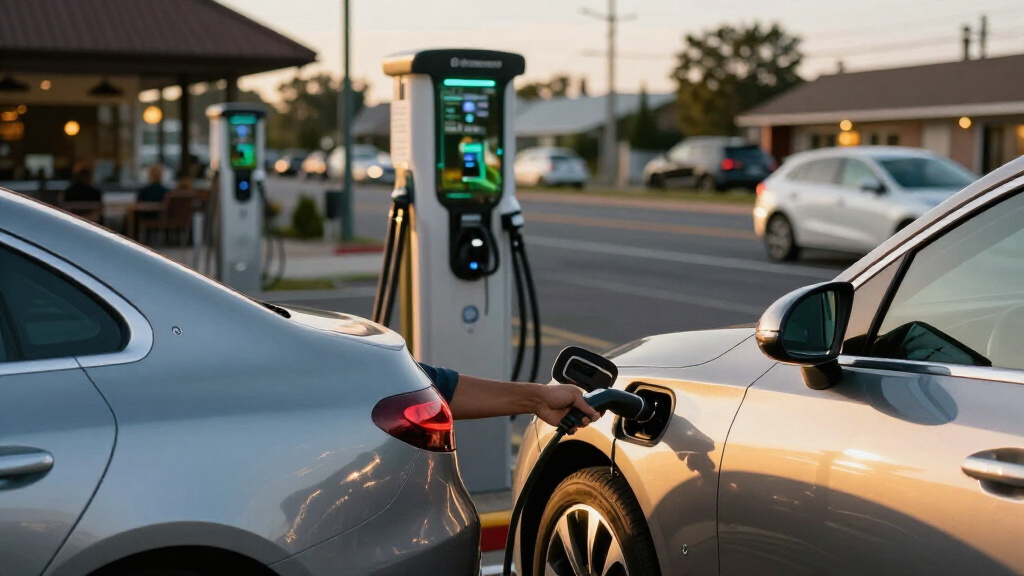
Its fast chargers can deliver up to 400 kilowatts. The company uses dispensers supplied by ChargePoint or Alpitronic, and locations are typically at or near premium shopping destinations. Most sites offer both CCS and NACS connectors; Mercedes-Benz says 3% have CCS connectors only. NACS-equipped vehicles can also use CCS chargers with an appropriate adapter, and the reverse is possible where a compatible adapter is available.
Drivers can pay with a credit card, charging apps, a Mercedes-Benz dealer-issued RFID card, or Plug & Charge, the report says. Listed prices vary by location from $0.35 to $0.60 per kilowatt-hour. A temporary $25 authorization hold verifies available funds; after charging, the driver pays for the electricity used and the remainder is released. DCFC Tracker identifies the largest reported site as a 20-stall location in Orlando, Florida. Two four-stall sites, in Conyers, Georgia, and Red Bluff, California, are among the network’s smallest.
More Fast-Charging Options for Drivers
For EV owners, the milestone offers a measure of the network’s current scale: 100 locations spread across a substantial U.S. footprint, with additional coverage in British Columbia. Connector availability matters as automakers and charging providers support both CCS and NACS vehicles. Mercedes-Benz’s report that most locations have both types could reduce the need for some drivers to carry an adapter, though the 3% of sites with CCS-only connectors may require one for certain vehicles.
The claimed increase in first-time charging success—from about 84% in 2023 to more than 90% now—also speaks to a common practical concern: whether a charger starts reliably. Mercedes-Benz presents that figure as a key performance measure. Without published definitions, sample sizes or independent comparisons, however, it cannot establish how the network performs relative to competitors or every driver’s experience.
Products Worth Considering

Autel Home EV Charger up to 50A, J1772 Hardwired Level 2 Charger, 25ft Cable

Autel MaxiSYS MS906 MAX Automotive Diagnostic Scanner, 10.1-Inch

Autel MaxiCharger Level 2 80A Hardwired EV Charger
As an affiliate, we earn on qualifying purchases.
From 2023 Launch to 100 Sites
Mercedes-Benz introduced its U.S. charging network in November 2023, initially with a limited number of locations in a few states. Its expansion to 100 sites and nearly 1,000 ports marks the company’s third anniversary in North America. The source report says the network serves both the United States and British Columbia; it does not give a separate count of Canadian locations.
Connector choices have become a more visible part of public charging as automakers have adopted NACS, the plug format used by Tesla. The source report notes that Ford’s move to adopt NACS and Tesla’s decision to open access to its Supercharger network helped prompt wider industry change. Mercedes-Benz’s mix of NACS and CCS connectors reflects the need to serve vehicles with different charging inlets.
The U.S. network’s status differs from the company’s European charging business: the source report says Mercedes-Benz sold its EV charging network in Europe, while its North American operation continues. It also reports that Madeline Ebert was appointed CEO of Mercedes-Benz High-Power Charging North America last month.
“The first-time success rate has become the company’s “guiding star.””
— Mercedes-Benz, as reported by InsideEVs
Performance Figures Lack Detail
Several operating claims remain difficult to assess from the information provided. Mercedes-Benz describes uptime as near-perfect, but no exact percentage, measurement period or definition appears in the report. The company’s first-time success figure also lacks a published sample size and details about how failed or retried sessions are counted.
The report does not break down the 100 locations by country or state, identify how many sites are planned next, or give a timetable for further expansion. It also does not say whether the reported customer total represents unique people, accounts or another measure. The figures are attributed to the company and should not be treated as an independent audit of network performance.
Expansion Plans and New Leadership
Madeline Ebert’s appointment as CEO of Mercedes-Benz High-Power Charging North America is the next reported management development. The source material provides no further details about her priorities or a new expansion target. Drivers and competing charging providers will be able to track whether the network adds locations, ports and connector options, and whether its reported session-start and uptime measures are published with clearer definitions over time.
Key Questions
How many locations are in the Mercedes-Benz charging network?
Mercedes-Benz says the network has 100 locations across 28 U.S. states and British Columbia, with nearly 1,000 ports in total.
How fast can the chargers deliver power?
The network’s chargers can deliver up to 400 kilowatts. A vehicle’s actual charging speed can vary; the source report does not give vehicle-specific charging rates.
Do the locations support both CCS and NACS?
Mercedes-Benz says the vast majority of locations have both connector types. It reports that 3% of locations have CCS connectors only.
What does charging cost?
Reported prices range from $0.35 to $0.60 per kilowatt-hour, depending on the location. A temporary $25 authorization hold is released after the session, minus the actual charge.
How reliable is the network?
Mercedes-Benz describes uptime as near-perfect and says more than 90% of sessions start on the first attempt. The source report does not include an exact uptime rate or enough methodology to independently compare those claims.
Source: insideevs.com