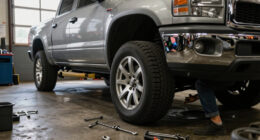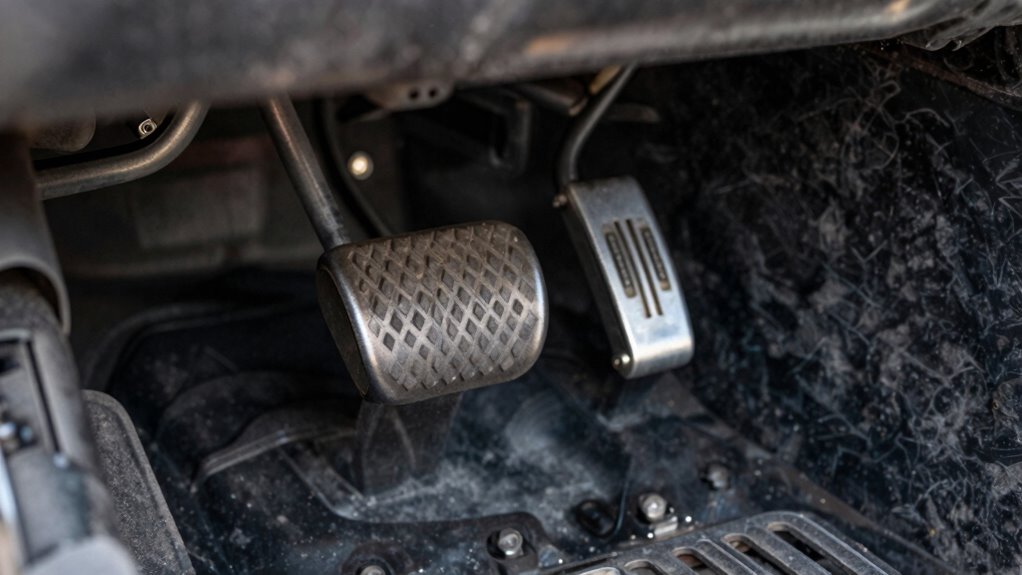

To improve brake feel before upgrading to a big brake kit, start by choosing high-quality, performance-oriented brake pads suited to your driving style for better bite and modulation. Upgrade to a high-temperature brake fluid to prevent fade and flush out any old, moisture-laden fluid. Regularly inspect and maintain your brake system, including bleeding lines and checking rotors and calipers for wear. Focusing on these foundational steps can markedly enhance responsiveness—learn more about preparing your brakes for that big upgrade here.
Key Takeaways
- Upgrade to high-quality, performance-oriented brake pads suited to your driving style.
- Use high-temperature brake fluid and perform a thorough system flush to prevent brake fade.
- Regularly inspect and maintain rotors and calipers to ensure even wear and optimal response.
- Bleed the brake system to remove air bubbles, ensuring a firm, responsive pedal feel.
- Establish a solid baseline with proper maintenance and fluid quality before considering big brake kit upgrades.
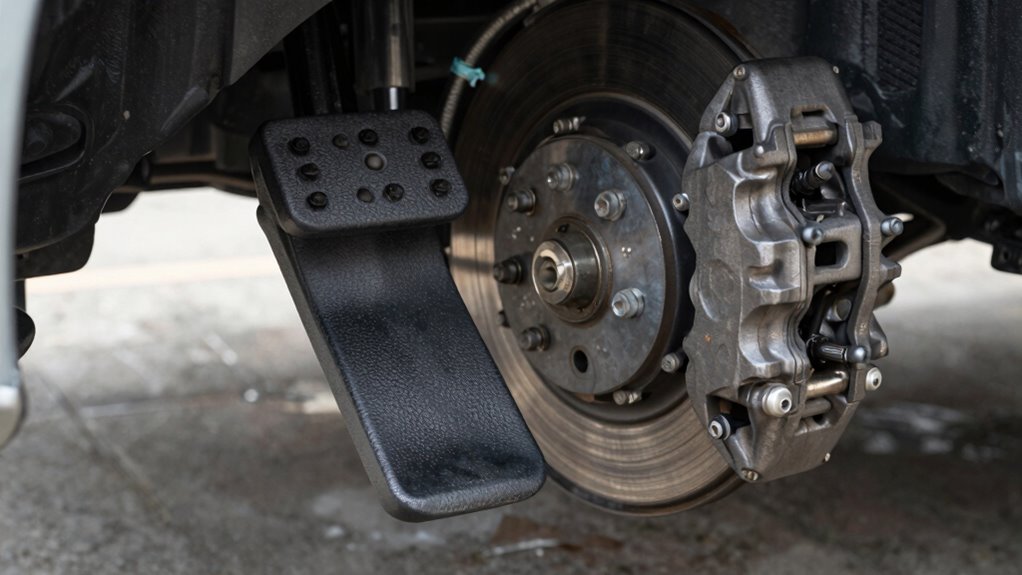
Ever wondered how to make your brakes feel more responsive and predictable? Improving brake feel isn’t about rushing into a big brake kit just yet. Instead, start with some simple adjustments and upgrades that can make a noticeable difference. One of the most critical factors is brake pad selection. Not all brake pads are created equal—some are designed for maximum grip, while others focus on smoothness or reduced dust. Choosing the right brake pads for your driving style can dramatically improve pedal feel and stopping power. If you’re after more immediate feedback and better modulation, look for high-quality, performance-oriented brake pads. These often have better friction characteristics and a more linear response, making it easier to judge your stopping distance and pressure. Keep in mind that softer compounds may bite harder initially, but they might wear faster, so balance your options based on your needs.
Along with brake pad selection, the condition and type of brake fluid you use play a vital role in brake feel. Brake fluid types vary primarily between DOT 3, DOT 4, and DOT 5.1, each with different boiling points and compressibility. If your brake fluid is old or of a lower-quality type, it can lead to spongy or inconsistent pedal feel because it absorbs moisture over time, which lowers its boiling point. Upgrading to a high-quality, high-temperature brake fluid can reduce the chance of brake fade and give you more immediate, firm pedal feedback. Flushing your brake system and replacing old fluid with a suitable DOT fluid enhances the overall responsiveness of your brakes. Additionally, understanding the importance of brake system maintenance can prevent issues that compromise brake feel and safety. Proper maintenance also involves checking for fluid contamination, which can significantly affect brake performance.
Beyond parts, ensure your brake system is properly maintained. Check for any air in the brake lines, as trapped air can cause a soft, unresponsive pedal. Bleeding the brakes correctly removes air bubbles, restoring proper hydraulic pressure. Also, inspect your brake rotors and calipers for uneven wear or damage, as these can negatively impact brake pedal feel. Sometimes, simple adjustments like tightening caliper bolts or replacing worn-out components can dramatically improve responsiveness. Remember, the goal is to create a consistent, predictable brake pedal that reacts quickly and smoothly to your inputs.
Before upgrading to a big brake kit, focus on these foundational elements. By carefully selecting the right brake pads, upgrading your brake fluid type, and maintaining your brake system, you’ll notice a significant improvement in brake feel. This prepares you for the enhanced performance of a big brake kit later on, ensuring you get the most out of your upgrades and have confidence in your stopping power every time you hit the pedal.

Bendix Premium SBC1363 Ceramic Front Brake Pads for select Cadillac Escalade, ESV, EXT, XTS, Chevrolet Avalanche, Cheyenne, Express 1500, Silverado, Suburban, Tahoe, GMC Savana, Sierra Classic, Yukon
- OE Replacement Part Number: 22742382
- High-Quality Durable Material: Resistant to wear and corrosion
- Enhanced Safety and Performance: Reduces brake fade for consistent braking
As an affiliate, we earn on qualifying purchases.
As an affiliate, we earn on qualifying purchases.
Frequently Asked Questions
Can Brake Fluid Type Affect Brake Feel?
Yes, brake fluid type can affect brake feel. Using fluid with the right viscosity guarantees smooth, responsive pedal feel, while a higher boiling point prevents vapor lock during heavy braking. If your brake fluid has a low boiling point, it can lead to spongy brakes and reduced responsiveness. Upgrading to a high-quality brake fluid with ideal viscosity and boiling point helps maintain consistent brake feel, especially during demanding driving conditions.
How Does Brake Pad Material Influence Pedal Response?
Brake pad compounds directly impact pedal response by affecting grip and heat dissipation. Softer compounds offer quick initial bite, giving you more immediate response, while harder compounds provide durability but might feel less responsive initially. Proper pad bedding ensures consistent performance by evenly seating the pad against the rotor, which improves pedal feel. Regular bedding and choosing the right brake pad compounds can greatly enhance your pedal response for better braking control.
Does Wheel Alignment Impact Brake Performance?
You’re spot on—wheel alignment can make or break your brake performance. Proper alignment optimizes tire grip and guarantees even brake pad contact, giving you confident pedal feel. When your suspension stiffness is just right, it prevents unnecessary flexing, enhancing responsiveness. If your wheels are out of alignment, you’ll notice less braking power and uneven wear. Keep your alignment in check to stay on top of your braking game—don’t let it be a loose cannon.
Can Brake Line Routing Improve Pedal Feel?
Yes, brake line routing can improve pedal feel by reducing unnecessary flex and ensuring consistent brake pressure. Proper routing minimizes hose movement during braking, enhancing pedal modulation and responsiveness. When lines are arranged efficiently, you’ll experience a more direct, firm pedal feel, giving you better control and confidence. Regularly check and optimize your brake line routing to maximize braking performance and feel before upgrading to a big brake kit.
What Role Does Caliper Piston Size Play?
Your brake pedal feels like a whisper because caliper piston size dramatically affects brake feel. Larger pistons increase piston volume, providing more force transfer and better modulation, making braking feel more responsive. Conversely, smaller pistons might cause a spongy pedal. The caliper design directly influences piston size, so choosing the right design guarantees ideal piston volume, ultimately improving your brake pedal feedback and control, especially before upgrading to a big brake kit.

Motul RBF 600 Brake Fluid DOT 4 – Racing & High Performance 100% Synthetic Brake Fluid for Cars & Motorcycles, Track Day, Street & Performance Applications 500ml
- Suitable for brake and clutch systems: For hydraulic brake and clutch systems
- Synthetic, silicone-free formula: Non-silicone synthetic fluid
- High thermal resistance: Extreme thermal stability
As an affiliate, we earn on qualifying purchases.
As an affiliate, we earn on qualifying purchases.
Conclusion
So, before you toss money at a big brake kit, maybe try a little magic trick called “brake feel.” Adjust your brake fluid, bleed those lines like a pro, and check your pads—who knew that simple stuff could turn your squeaky, spongy brakes into a confidence-inspiring machine? Save your wallet for something fun, like a racing weekend. After all, why buy new brakes when you can just pretend yours actually work?

CHUMXINY Brake Bleed Kit for SHIMANO, TEKTRO Hydraulic Disc Brakes, Including High Performance Mineral Brake Fluid (120ml)
- Fluid Capacity: Two 60ml bottles of mineral oil
- Complete Bleed Kit: Includes gloves, fasteners, adapters, funnel, and injectors
- Wide Compatibility: Suitable for brake models from 2000 to 2021
As an affiliate, we earn on qualifying purchases.
As an affiliate, we earn on qualifying purchases.

VINCA Digital Rotor Gauge, DRGA-0605 0-6 Inch/150mm, Inch/Metric/Fraction Conversion, Stainless Steel, Large LCD Screen
- Designed for Brake Rotor Measurement: Measures brake rotor thickness accurately
- Multi-Unit Conversion: Supports inch, millimeter, and fraction readings
- High Precision and Resolution: 0-6 inch range with 0.0005 inch resolution
As an affiliate, we earn on qualifying purchases.
As an affiliate, we earn on qualifying purchases.