For most two-car garages, I’d put the ChargePoint HomeFlex Hardwired first for its higher-power setup and smart controls, while the Autel 50A stands out for app connectivity and the EVIQO 40A plug-in for a simpler installation path. The key tradeoff is not just charging speed: it’s whether your electrical panel can support one or two chargers, and whether your cars can use the same connector. A higher-amp unit may charge one vehicle faster, but it does not automatically coordinate charging between two vehicles. I also weigh cable reach, installation type, weather protection, and how much control the app provides. Read on for the full breakdown and help matching a charger to your garage, vehicles, and electrical capacity.

Get business pricing on garage and car supplies
- Business-only prices and quantity discounts
- Tax-exempt purchasing
- Multiple users, one account, clear invoices
Complete the kit


Key Takeaways
- The strongest picks are not automatically two-car load-sharing systems. The lineup includes powerful single chargers, but buyers should verify whether a model supports coordinated power sharing before planning to run two at once.
- Hardwired 48A options prioritize output over installation simplicity. ChargePoint HomeFlex Hardwired, Autel 50A, EVIQO 48A, and the other 48A units suit homes with adequate electrical capacity and a professional installation plan.
- Plug-in units can simplify replacement or relocation. The AIMILER 32A, EVIQO 40A, Sapphire Pro 40A, and ChargePoint HomeFlex plug-in avoid hardwiring, but still need a correctly rated 240V receptacle and circuit.
- Connector compatibility can narrow the field quickly. Most listed chargers use J1772; the Tesla NACS 48A is the direct-fit choice for compatible NACS vehicles, while other drivers may need an adapter.
- Portable chargers trade output for flexibility. WOLFBOX 32A and the 16A Level 1/2 unit can be useful when portability matters, but they are less compelling as the main high-throughput solution for a busy two-car household.



| top rated home ev charging stations for two car garage | Connector | Cable length | Voltage | Warranty |
|---|---|---|---|---|
| AIMILER Level 2 Electric Vehic | J1772 | 25 ft | — | — |
| ChargePoint HomeFlex Level 2 E | J1772 | 23 ft | — | 3 years |
| EVIQO Level 2 EV Charger J1772 | J1772 | 25 ft | — | 3 years |
| Level 2 EV Charger | J1772 | 25 ft | — | — |
| Level 2 EV Charger with J1772 | SAE J1772 | 25 ft | 240 V | — |
| Level 2 EV Charger | SAE J1772 | 25 ft | — | 30-day return guarantee |
| WOLFBOX 32Amp Portable Level 2 | — | 25 ft | 208–240V | — |
| Autel Level 2 EV Charger up to | J1772 | 25 ft | 240V | 3 years |
| Lectron J1772 Level 2 EV Charg | — | 23 ft | 240V | 3 years |
| Sapphire Pro Level 2 EV Charge | J1772 version specified in title; listing also describes a NACS version | 25 ft | 240V | — |
| ChargePoint HomeFlex Level 2 E | J1772 | — | 240 V | 3-year parts warranty |
| 16A Portable Level 1 & 2 EV Ch | SAE J1772 | — | 110–240 V | — |
| Level 2 EV Charger | SAE J1772 | 25 ft | 240 V | — |
| EVIQO Level 2 EV Charger J1772 | J1772 | 25 ft | 240 V | 3 years |
| Tesla Level 2 Charger NACS 48A | NACS | 25 ft | 240 V | 3 years |
More Details on Our Top Picks
AIMILER Level 2 Electric Vehicle (EV) Charger with Wi-Fi App, 32A, 25ft Cable, ETL Certified, 220V-240V, NEMA 14-50P Plug, J1772 Connector, Portable Home Charging Station
For a two-car garage where outlet access or parking positions may change, the AIMILER’s portable, plug-in setup is its main advantage. Its 25-foot cable gives more reach than the ChargePoint HomeFlex’s 23-foot lead, and the NEMA 14-50P plug avoids hardwiring the unit. At 32 amps, it offers less charging output than the 40A EVIQO or 50A ChargePoint, so it suits overnight charging better than buyers chasing the fastest turnaround. Wi-Fi scheduling and adjustable current can help fit charging around household routines, but app setup may take patience, and a single J1772 connector still serves only one vehicle at a time. I’d choose it for one EV in a shared garage, not as a two-car load-sharing solution.
Pros:- 25-foot cable offers useful reach across a garage
- NEMA 14-50 plug makes the unit portable rather than permanently hardwired
- Adjustable current and Wi-Fi app controls support scheduled charging
- NEMA Type 4 protection suits indoor and some outdoor installations
Cons:- 32A output is lower than the 40A EVIQO and 50A ChargePoint options
- Wi-Fi connection and app setup may be difficult for some owners
- One J1772 connector cannot charge two cars simultaneously
Best for: Households with one J1772 EV that need a portable charger and a long cable to reach different parking spots in a two-car garage
Not ideal for: Drivers who need the highest charging output, dependable app setup without troubleshooting, or a single station that charges two cars at once
- Output voltage:240 V
- Current:32 A
- Connector:J1772
- Cable length:25 ft
- Connection:NEMA 14-50P plug
- Protection:NEMA Type 4
- Certification:ETL, FCC
Our verdict“Choose the AIMILER if flexible placement and a plug-in connection matter more than maximum charging speed or two-car simultaneous charging.”
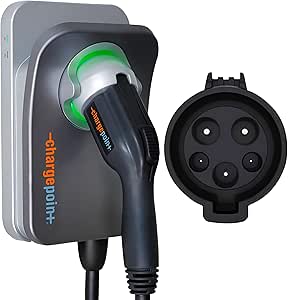
ChargePoint HomeFlex Level 2 EV Fast Charger, J1772, Smart, Hardwired, 50A
The ChargePoint HomeFlex is the strongest fit here for a household that wants one high-output, permanently installed charger to serve a frequently used EV. Its 50A rating and stated charging speed of up to 45 miles per hour outpace the 32A AIMILER and 40A EVIQO, which can matter when the car needs a shorter charging window between trips. The tradeoff is a hardwired installation: it is less portable than those plug-in alternatives and may call for professional electrical work. Its 23-foot cable is also shorter than the AIMILER’s and EVIQO’s 25-foot leads, so map the parking position before choosing a wall location. App control is useful for remote management, but full smart functionality depends on Wi-Fi. Like every single-port pick here, it does not charge two cars at once.
Pros:- 50A output and stated charging speed up to 45 miles per hour
- Hardwired design suits a fixed indoor or outdoor charging location
- Wi-Fi app supports remote management
- Three-year warranty is specified
Cons:- Hardwired installation may require a professional electrician
- 23-foot cable is shorter than the 25-foot leads on AIMILER and EVIQO
- Full smart features depend on Wi-Fi, and Tesla vehicles need an adapter
Best for: Households with one high-mileage J1772 EV, a suitable electrical circuit, and a fixed charging location in a two-car garage
Not ideal for: Renters, owners who need to move the charger between locations, or households seeking one unit to charge two vehicles simultaneously
- Output voltage:240 V
- Current:50 A
- Connector:J1772
- Cable length:23 ft
- Installation:Hardwired
- Dimensions:7.06 × 11.19 × 7.07 in
- Weight:13.8 lb
- Warranty:3 years
Our verdict“Pick the HomeFlex for a fixed, high-use charging spot where higher output matters more than portability or extra cable reach.”
EVIQO Level 2 EV Charger J1772 40A NEMA 14-50 – 240V Wall Charging Station
The EVIQO 40A balances charging output, smart controls, and a plug-in installation, making it a practical middle ground for a two-car garage with one EV. Unlike the ChargePoint HomeFlex, it plugs into a NEMA 14-50 outlet instead of requiring hardwiring; compared with the 32A AIMILER, it provides more current while retaining a 25-foot cable. The app supports adjustable charging from 6–40A, scheduling, and energy tracking, so owners can adapt charging to household routines. Its IP66/NEMA 4 housing and included glow-in-the-dark holster are useful touches for a garage or driveway. The tradeoff is that it still needs a dedicated 50A circuit and a suitable outlet, and its Wi-Fi features require 2.4 GHz service. One connector means no simultaneous charging for two cars.
Pros:- 40A output offers a middle ground between AIMILER’s 32A and ChargePoint’s 50A
- NEMA 14-50 plug avoids hardwiring when the correct outlet is already available
- 25-foot cable and adjustable app controls support flexible parking and scheduling
- IP66/NEMA 4 protection and a glow-in-the-dark holster support outdoor use and nighttime docking
Cons:- Requires a dedicated 50A circuit and a compatible NEMA 14-50 outlet
- Smart app features require 2.4 GHz Wi-Fi
- Single J1772 port cannot charge two vehicles at the same time
Best for: Owners with a NEMA 14-50 outlet who want more output than a 32A portable charger and app-based scheduling without hardwiring
Not ideal for: Drivers without a dedicated 50A circuit or NEMA 14-50 outlet, and households expecting one station to charge two cars together
- Output voltage:240 V
- Maximum current:40 A
- Connector:J1772
- Cable length:25 ft
- Input connection:NEMA 14-50 plug
- Wi-Fi requirement:2.4 GHz
- Weather protection:IP66 / NEMA 4
- Certifications:UL, ETL, FCC, Energy Star
- Warranty:3 years
Our verdict“Choose the EVIQO if you have the required outlet and want a smart 40A charger without committing to hardwiring.”
Level 2 EV Charger, 48A Hardwired, 25FT Cable, J1772 Wall Charger, 11.5kW
For a garage where one EV needs fast charging and the owner is ready for a permanent electrical installation, this 48A hardwired charger offers more output than the 40A EVIQO and AIMILER. Its 25-foot J1772 cable can help reach a vehicle parked farther from the charger, while the metal case and IP65 rating support indoor or outdoor placement. App control, RFID authentication, and multiple charging modes give households more control over who can start a session and how charging is managed. The main compromise is installation: unlike the plug-in EVIQO, this unit requires hardwiring and professional electrical work. Product data also does not specify a warranty or Wi-Fi requirements, so buyers should confirm those details before committing. It has one port, not two-car simultaneous charging.
Pros:- 48A output is higher than the 40A EVIQO and 32A AIMILER
- 25-foot cable reaches across many garage layouts
- RFID authentication adds access control beyond app-only operation
- Metal case and IP65 rating support indoor and outdoor installation
Cons:- Hardwired installation requires a licensed electrician
- Tesla vehicles need a J1772-to-Tesla adapter
- Provided product data does not specify warranty coverage or Wi-Fi requirements
Best for: Homeowners planning a permanent, professionally installed charging point for a high-use J1772 EV in a shared garage
Not ideal for: Renters, owners who want a plug-in charger they can relocate, or buyers who need confirmed warranty and connectivity details before purchase
- Input voltage:240 V
- Current:48 A
- Power:11.5 kW
- Connector:J1772
- Cable length:25 ft
- Installation:Hardwired
- Certifications:ETL, UL, FCC
Our verdict“Pick this model for a permanent 48A installation with RFID access control, provided you are comfortable confirming missing ownership details before buying.”
Level 2 EV Charger with J1772 25′ Cable
This 40A, 9.6kW J1772 charger is aimed at owners who want robust Level 2 output, adjustable current, and app monitoring in one station. Against the AIMILER, it offers higher stated power while matching its 25-foot cable reach; against the EVIQO, the supplied information highlights RFID access but gives less detail about outlet type and installation. That missing installation detail matters in a two-car garage, where the circuit, charger location, and parking reach need to be planned together. Its NEMA Type 4/IP65 enclosure is rated for indoor and outdoor use, and ETL certification is listed. The product is described as relatively heavy, and installation may require technical knowledge. Like the other options here, it has one J1772 connector, so it can charge only one vehicle at a time.
Pros:- 40A / 9.6kW output exceeds the AIMILER’s 32A rating
- Adjustable current and app monitoring allow more control over charging
- RFID access can restrict who starts a charging session
- NEMA Type 4/IP65 enclosure supports indoor and outdoor use
Cons:- Installation may call for technical knowledge, and the supplied data does not specify the connection method
- At 13.47 lb, it is heavier than a lightweight portable charger
- Single J1772 connector serves one car at a time
Best for: EV owners seeking an adjustable 40A charger with app monitoring and RFID access for one vehicle in a shared garage
Not ideal for: Buyers who need clearly specified plug-in versus hardwired installation, want a lightweight portable unit, or require simultaneous charging for two cars
- Power:9.6 kW
- Current:40 A
- Voltage:240 V
- Connector:SAE J1772
- Cable length:25 ft
- Certifications:ETL, FCC, CE
- Weight:13.47 lb
Our verdict“Consider this model for adjustable 40A charging and RFID access, but verify its installation requirements before planning a garage setup.”
Level 2 EV Charger, 40 Amp 240V 9.6kW, 25ft Cable, LED Display
For a two-car garage where the charger may need to reach either parking spot, this model’s 25-foot cable and adjustable current are its clearest advantages. Its 40A, 9.6 kW output is a practical middle ground: more charging capacity than the WOLFBOX 32Amp Portable Level 2, without moving up to the 48A hardwired class offered by the Lectron. That can suit a household that wants solid overnight charging but does not need the highest available output. The cable reach helps with varied parking positions, though one charger still means moving the connector between vehicles rather than charging both at once. It also requires proper grounding and a dry environment, and Tesla drivers need an adapter. I’d choose it for flexible placement, not for smart scheduling or a two-car simultaneous-charging setup.
Pros:- 40A output provides up to 9.6 kW charging capacity.
- Adjustable current supports different electrical circuit limits.
- 25-foot cable offers useful reach across a two-car garage.
- Built-in safety protections are included.
Cons:- Requires proper grounding and a dry installation environment.
- Tesla vehicles require a compatible adapter.
- One charging connector cannot charge two vehicles at the same time.
Best for: Households with two cars parked in different positions that want one 40A J1772 charger with a long cable and adjustable output.
Not ideal for: Drivers seeking app-based scheduling, a hardwired high-output station, or simultaneous charging for two vehicles.
- Output voltage:240V
- Input voltage:240V
- Amperage:40A
- Maximum power:9.6 kW
- Connector:SAE J1772
- Cable length:25 ft
- Warranty:30-day return guarantee
Our verdict“Choose this 40A J1772 charger if cable reach and adjustable current matter more than smart controls or charging two cars simultaneously.”
WOLFBOX 32Amp Portable Level 2 EV Charger for J1772 EVSE
The WOLFBOX PE32 is the most flexible choice here for someone who wants to take a charger off the wall or use an existing NEMA 14-50 outlet. In a two-car garage, its 25-foot cable can reach across a parking bay, and its portable format gives it an advantage over fixed hardwired choices such as the Lectron. The tradeoff is lower output: at 32A, it offers less charging capacity than the 40A model in this roundup and is not aimed at drivers who want the fastest home charging. Its ETL and NEMA 4 details support indoor or outdoor use, while adjustable current and delayed charging add useful control. At 13.47 pounds, though, it is portable in principle rather than especially light to carry. It also depends on having a suitable outlet available.
Pros:- Portable design works with a NEMA 14-50 outlet.
- 25-foot cable offers reach across a two-car garage.
- ETL certification and NEMA 4 rating support indoor and outdoor use.
- Adjustable current and delayed charging provide scheduling flexibility.
Cons:- 32A output is lower than the 40A and 48A options in this group.
- Requires access to a NEMA 14-50 outlet.
- Listed weight of 13.47 pounds makes frequent carrying less convenient.
Best for: EV owners with a NEMA 14-50 outlet who want a portable J1772 charger that can serve different parking spots or travel with them.
Not ideal for: Drivers without a NEMA 14-50 outlet, buyers prioritizing maximum charging power, or anyone wanting a lightweight travel charger.
- Model:PE32
- Amperage:32A
- Voltage:208–240V
- Plug type:NEMA 14-50
- Cable length:25 ft
- Weight:13.47 lb
- Dimensions:17 × 13 × 8 in
Our verdict“Pick the WOLFBOX if portability and outlet-based installation matter more than the higher output of the hardwired Lectron or 40A charger.”
Autel Level 2 EV Charger up to 50Amp, 240V, Indoor/Outdoor Car Charging Station with J1772 Connector, Wi-Fi and Bluetooth Enabled EVSE, 25-Foot Cable, Hardwired, Dark Gray
The Autel MaxiCharger is the strongest fit for a two-car garage where a permanently mounted station and app-based scheduling matter as much as charging speed. Its advertised 50A, 12 kW capability exceeds the 40A charger in this group, while the 25-foot cable helps reach a vehicle parked farther from the mounting point. Wi-Fi, Bluetooth, Ethernet access, and app controls give it more connected management than the simpler Lectron hardwired charger. That can help owners coordinate charging routines around their household’s electricity schedule, although it remains a single-port unit rather than a solution for charging both cars at once. Its hardwired format calls for an installation plan and electrician, and J1772 vehicles are its direct fit; Tesla owners may need an adapter. I’d favor it for connected features and weather protection, not for buyers who want plug-in portability.
Pros:- Up to 50A and 12 kW output provide high charging capacity.
- Wi-Fi, Bluetooth, Ethernet, and app controls support connected charging management.
- 25-foot cable offers flexible placement in a two-car garage.
- NEMA Type 4 and CSA specifications support indoor or outdoor installation.
Cons:- Hardwired installation is less flexible than the WOLFBOX plug-in option.
- A single connector cannot charge both garage vehicles at the same time.
- J1772 connection may require an adapter for Tesla vehicles.
Best for: Households ready for a permanent hardwired installation that want high output, app scheduling, and outdoor-rated protection.
Not ideal for: Renters, drivers who need a portable plug-in unit, or two-car households expecting one station to charge both vehicles simultaneously.
- Maximum amperage:50A
- Maximum power:12 kW
- Voltage:240V
- Installation:Hardwired
- Connector:J1772
- Cable length:25 ft
- Connectivity:Wi-Fi, Bluetooth, and Ethernet
- Warranty:3 years
Our verdict“Choose the Autel for a permanent, connected high-output setup; choose the WOLFBOX instead if you need a portable charger that plugs into an outlet.”
Lectron J1772 Level 2 EV Charger, UL2594 Certified, 48A 240V, 23ft Cable, Hardwired Only, Compatible with All J1772 Electric Vehicles
For drivers who put high charging output and specified safety certifications ahead of portability, the Lectron is a focused 48A hardwired choice. Its 11.5 kW rating is above the 40A model’s 9.6 kW, while sitting just below the Autel’s advertised 50A capacity. The 23-foot cable is a little shorter than the 25-foot leads on those alternatives, so garage layout and charger placement matter more when reaching two parking spaces. UL2594, UL 2231, and UL 2251 certifications, plus an IP66 rating, make the listed protections and weather suitability a central part of its appeal. Its hardwired-only format is the main compromise: it needs professional installation and cannot be moved to another outlet. It serves J1772 vehicles directly; Tesla owners need an adapter.
Pros:- 48A and 11.5 kW output support fast home charging.
- UL2594, UL 2231, and UL 2251 certifications are specified.
- IP66 weather rating supports indoor and outdoor use.
- Three-year warranty is listed.
Cons:- Hardwired-only installation requires a fixed setup and professional electrical work.
- 23-foot cable is shorter than the 25-foot leads on the Autel and 40A charger.
- Tesla vehicles require an adapter for the J1772 connector.
Best for: Owners with a fixed garage layout who want a high-output, professionally hardwired J1772 charger with listed safety certifications.
Not ideal for: Renters, people who need a plug-in or portable charger, or garages where a 23-foot cable cannot reach both parking positions.
- Charging power:11.5 kW
- Amperage:48A
- Voltage:240V
- Installation:Hardwired
- Connector compatibility:J1772 EVs
- Cable length:23 ft
- Certifications:UL2594, UL 2231, UL 2251
- Warranty:3 years
Our verdict“Choose the Lectron if you want a certified 48A hardwired J1772 station and your garage layout works with its 23-foot cable.”
Sapphire Pro Level 2 EV Charger, 240V 40A J1772 NEMA 14-50 Plug, ETL & Energy Star Certified Smart WiFi EV Charging Station for Home, Multi-Family & Workplaces, 25FT Cable, NEMA 4 Weatherproof
The Sapphire Pro stands apart by pairing a 40A NEMA 14-50 plug-in setup with app controls, a 25-foot cable, and a NEMA 4 enclosure. That combination suits a two-car garage where owners want smart scheduling and room to reposition the unit without committing to the Lectron’s hardwired installation. Its 40A plug-in configuration is less powerful than the charger’s separately described 48A hardwired mode and below the Autel’s advertised 50A output, so buyers should match the chosen configuration to their circuit and vehicle. The listing also describes native Tesla NACS and J1772 versions; the title specifies J1772, so Tesla owners should verify the exact connector before buying rather than assume compatibility without an adapter. App control, RFID access, and OTA updates add flexibility, but also mean this is a more feature-rich choice than a basic charger.
Pros:- 40A NEMA 14-50 configuration avoids hardwiring.
- 25-foot cable helps reach vehicles in different garage positions.
- Wi-Fi app controls, scheduling, RFID access, and OTA updates are specified.
- ETL, Energy Star, and NEMA 4 details are listed.
Cons:- 40A plug-in mode offers less output than the Lectron 48A and Autel 50A options.
- Requires a suitable NEMA 14-50 outlet for the plug-in configuration.
- Product information describes different connector versions, so buyers should confirm the exact SKU and vehicle fit.
Best for: Homeowners with a NEMA 14-50 outlet who want app scheduling, outdoor-rated construction, and a long cable for a shared garage.
Not ideal for: Buyers seeking the simplest basic charger, those without a suitable outlet, or Tesla owners who have not confirmed the connector version.
- Plug-in configuration:40A
- Hardwired configuration:48A
- Voltage:240V
- Plug type:NEMA 14-50
- Connector:J1772 version specified in title; listing also describes a NACS version
- Cable length:25 ft
- Connectivity and controls:Wi-Fi app, scheduling, RFID, OTA updates
- Certifications and warranty:ETL, Energy Star, FCC; 3 years
Our verdict“Choose the Sapphire Pro if you have a NEMA 14-50 outlet and want smart controls and long-cable reach without hardwiring.”
ChargePoint HomeFlex Level 2 EV Charger J1772 – NEMA 14-50 Plug
The plug-in HomeFlex suits a two-car garage where you want a capable charger without committing to a hardwired installation. Its listed output reaches up to 45 miles of range per hour, while app controls let you manage charging from your phone. Compared with the EVIQO 48A Hardwired, this model trades some maximum charging speed for a NEMA 14-50 connection that may fit an existing outlet setup. Its single J1772 port still serves one vehicle at a time, so households charging two EVs need to plan a schedule or install a second station. Outdoor installation is supported, and UL certification adds a safety credential. The main limitation is connector reach across the garage: cable length isn’t provided here, and Tesla owners need an adapter.
Pros:- NEMA 14-50 plug offers an alternative to a hardwired installation
- App-based smart controls
- Rated for indoor and outdoor installation
- UL certification and a three-year parts warranty
Cons:- One charging port means vehicles must share the station by schedule
- Tesla vehicles require an adapter
- Cable length is not listed, making garage reach harder to evaluate
Best for: Households with a suitable NEMA 14-50 outlet that want app-controlled Level 2 charging for one J1772 vehicle in a two-car garage.
Not ideal for: Two-EV households that need simultaneous charging, or Tesla owners who want to connect without an adapter.
- Voltage:240 V
- Amperage:50 A
- Connector:J1772
- Power connection:NEMA 14-50 plug
- Ports:1
- Weight:13.8 lb
- Installation:Indoor or outdoor
- Warranty:3-year parts warranty
Our verdict“Choose the HomeFlex if you have a compatible outlet and want a smart, plug-in J1772 charger rather than a higher-output hardwired model.”
16A Portable Level 1 & 2 EV Charger – ETL Certified, 110V-240V Car Charger
Outlet flexibility is the main reason to pick this portable charger: it supports Level 1 and Level 2 use with NEMA 5-15 and 6-20 plugs. That makes it more adaptable than the fixed-install EVIQO 48A Hardwired when you need a charger you can move or use with different available outlets. At 16 A and 3.84 kW, though, it sits well below the faster 48A options in this roundup, so a large battery may take a long time to replenish—especially on a household outlet. The J1772 connector covers compatible EVs and plug-in hybrids, but using the 5-15 plug requires manual current adjustment. In a two-car garage, it works best as a flexible charger for one car, not as a shared high-throughput setup for two vehicles.
Pros:- Supports Level 1 and Level 2 charging
- Portable format works with specified 5-15 and 6-20 outlets
- J1772 compatibility covers compatible EVs and plug-in hybrids
- Includes multiple safety protections
Cons:- 16A output is slower than the 48A hardwired chargers in this roundup
- Charging speed depends heavily on the available outlet and vehicle
- Manual current adjustment is required with the NEMA 5-15 plug
Best for: New EV owners with compatible 5-15 or 6-20 outlets who want one portable charger for home use and occasional travel.
Not ideal for: Two-EV households needing rapid overnight charging, or buyers who want a permanently mounted station with app controls.
- Charging levels:Level 1 and Level 2
- Amperage:16 A
- Maximum power:3.84 kW
- Voltage:110–240 V
- Connector:SAE J1772
- Supported plugs:NEMA 5-15 and 6-20
- Dimensions:12 x 16 x 5 in
- Color:Black
Our verdict“Pick this portable model for outlet flexibility and backup charging, not for fast, routine charging of two garage vehicles.”
Level 2 EV Charger, 48Amp/11.5KW/240V, UL 2594, ETL & Energy Star
For a two-car garage where electrical capacity needs careful management, this IYILO 48A charger stands out for power sharing and dynamic load balancing. Those features can help coordinate charging demand rather than simply adding a high-output station to the household load. It also offers adjustable current from 6A to 48A, app scheduling and energy tracking, plus a 25-foot cable that can reach across many garage layouts. Compared with the plug-in ChargePoint HomeFlex, IYILO is a more configurable hardwired choice, but it calls for professional installation and a 60A breaker. Its J1772 connector needs an adapter for Tesla vehicles, and its Wi-Fi is limited to 2.4 GHz. The sharing features are useful for planning a two-car setup, but the listing does not specify two built-in charging ports.
Pros:- Adjustable current from 6A to 48A
- Power sharing and dynamic load balancing support managed electrical demand
- 25-foot cable offers useful reach across a garage
- UL 2594, ETL, Energy Star, and CSA certifications are listed
Cons:- Requires professional installation and a 60A breaker
- Wi-Fi supports 2.4 GHz only
- Tesla vehicles require an adapter, which is not included
Best for: EV households coordinating charging loads, especially buyers planning a professionally installed system with adjustable current and app-based scheduling.
Not ideal for: Renters, buyers without capacity for a 60A circuit, or homes that require a charger with two integrated vehicle ports.
- Charging power:11.5 kW
- Current:6–48 A, adjustable
- Voltage:240 V
- Cable length:25 ft
- Connector:SAE J1772
- Certifications:UL 2594, ETL, Energy Star, CSA
- Dimensions:9.8 x 8.7 x 4.4 in
- Weight:13.45 lb
Our verdict“Choose IYILO if smart load management and adjustable output matter more than plug-in convenience or native Tesla compatibility.”
EVIQO Level 2 EV Charger J1772 48A – Hardwired 240V Wall Charging Station
The EVIQO 48A Hardwired is a strong fit when a two-car garage needs a wall-mounted station that can also handle an exposed outdoor location. Its weatherproof design, 25-foot cable and 48A maximum give you flexibility in where you park and how you route the connector. Compared with the ChargePoint HomeFlex plug-in, EVIQO avoids relying on a NEMA 14-50 outlet but requires a licensed electrician and a fixed hardwired connection. The J1772 plug suits most non-Tesla EVs and plug-in hybrids; Tesla drivers need an adapter. App control adds remote management, though Wi-Fi is limited to 2.4 GHz. For two vehicles, this remains a one-car-at-a-time station, so it makes the most sense when the cars can be charged on alternating schedules rather than simultaneously.
Pros:- 48A maximum charging current
- 25-foot cable supports flexible parking positions
- Weatherproof design supports indoor and outdoor use
- App control and listed UL, ETL, FCC, and Energy Star certifications
Cons:- Requires professional installation by a licensed electrician
- Hardwired setup offers no plug-in option
- Tesla vehicles require a separate adapter
Best for: Homeowners with a planned hardwired installation who need a weatherproof J1772 station and a long cable for garage or driveway parking.
Not ideal for: Renters, buyers who need a plug-in unit, or households seeking simultaneous charging from one station.
- Maximum current:48 A
- Voltage:240 V
- Connector:J1772
- Cable length:25 ft
- Installation:Hardwired
- Wi-Fi:2.4 GHz
- Certifications:UL, ETL, FCC, Energy Star
- Warranty:3 years
Our verdict“Choose EVIQO for a permanent, weather-ready J1772 installation when the household can schedule one vehicle at a time.”
Tesla Level 2 Charger NACS 48A – Hardwired 240V Wall Level 2 EV Charger
For a garage centered on Tesla vehicles, the native NACS connector removes the adapter step and includes a button to open the charge port. Its 25-foot cable, hardwired 48A output and indoor/outdoor-rated housing suit installations where the car may park on either side of the garage or in a driveway. Compared with the EVIQO 48A J1772, this model is the more direct match for Tesla drivers, while non-Tesla J1772 vehicles need a separate NACS-to-J1772 adapter. App scheduling, current adjustment and energy tracking provide useful control, but installation requires a licensed electrician and a dedicated 60A, 240V circuit for 48A operation. The listing describes a 50A setting with a 70A circuit, which calls for even greater electrical capacity. This is a one-vehicle charging point, not a dual-port solution.
Pros:- Native NACS connector works with compatible Tesla vehicles without an adapter
- 25-foot cable provides reach across a garage or driveway
- App supports scheduling, current settings, and energy tracking
- IP66/NEMA 4 housing and listed UL, ETL, FCC, and Energy Star certifications
Cons:- Requires licensed-electrician installation and a dedicated circuit
- J1772 vehicles need a separate adapter
- The listed 50A setting calls for a 70A circuit
Best for: Tesla-owning households that want native NACS charging, a long cable, and app scheduling in a hardwired garage or driveway installation.
Not ideal for: Homes with limited electrical panel capacity, or mixed-EV households that want J1772 charging without buying an adapter.
- Connector:NACS
- Maximum current:48 A; adjustable 6–48 A
- Voltage:240 V
- Cable length:25 ft
- Installation:Hardwired
- Circuit requirement:Dedicated 60A circuit for 48A operation
- Wi-Fi:2.4 GHz
- Warranty:3 years
Our verdict“Pick this charger for a Tesla-led garage with the electrical capacity for hardwiring; choose a J1772 model for adapter-free charging of non-Tesla vehicles.”

How We Picked
I ranked these chargers for the specific demands of a two-car garage, not just by maximum amperage. I compared listed output, hardwired versus plug-in installation, cable length, connector type, smart controls, certification claims, and indoor/outdoor suitability where provided. I also separated features that help one vehicle charge faster from features that actually help a household serve two vehicles; a high-output charger alone does not prove that it can distribute power between two units.
The order favors products with a clear combination of useful output, practical installation details, and household-friendly controls, while accounting for drawbacks such as a single connector standard, hardwired installation, or lower amperage. Product names and specifications supplied for this roundup do not establish that every model supports power sharing, so I treat that capability as something buyers must confirm with the manufacturer. I give lower priority to sparse listings where the available details make it harder to judge fit, and I avoid treating certification labels or app features as substitutes for a suitable panel and circuit.
| top rated home ev charging stations for two car garage | Connector |
|---|---|
| AIMILER Level 2 Electric Vehic | J1772 |
| ChargePoint HomeFlex Level 2 E | J1772 |
| EVIQO Level 2 EV Charger J1772 | J1772 |
| Level 2 EV Charger | J1772 |
| Level 2 EV Charger with J1772 | SAE J1772 |
| Level 2 EV Charger | SAE J1772 |
| WOLFBOX 32Amp Portable Level 2 | — |
| Autel Level 2 EV Charger up to | J1772 |
| Lectron J1772 Level 2 EV Charg | — |
| Sapphire Pro Level 2 EV Charge | J1772 version specified in title; listing also describes a NACS version |
| ChargePoint HomeFlex Level 2 E | J1772 |
| 16A Portable Level 1 & 2 EV Ch | SAE J1772 |
| Level 2 EV Charger | SAE J1772 |
| EVIQO Level 2 EV Charger J1772 | J1772 |
| Tesla Level 2 Charger NACS 48A | NACS |
Factors to Consider When Choosing Top Rated Home Ev Charging Stations For Two Car Garages
Choosing a charger for a two-car garage starts with the home’s electrical limits and daily charging routine, not the biggest amperage on a product page. I’d map where each car parks, what each vehicle accepts, and whether both might need energy on the same night before choosing equipment.
Decide Whether You Need One Charger or Two
Many two-car households can use one charger by alternating vehicles overnight, especially if daily driving is modest and the cable reaches both parking spots. Two charging points are more convenient, but they can require additional wiring and panel capacity. If both cars may charge together, ask whether the proposed units support dynamic load management or power sharing; two independent chargers do not necessarily coordinate their electrical draw. A common mistake is buying two high-amp units before an electrician checks the service and panel. Compare the cost and complexity of a second charger against a simple routine of plugging in the car that needs energy most. Leave room in the plan for a future EV, rather than sizing around only today’s driving.
Match Charging Output to the Car and Circuit
A charger’s advertised amperage describes its capability, not a guaranteed charging rate for every vehicle. The car’s onboard charger may accept less power, and the branch circuit must be sized for the EVSE’s continuous load under applicable electrical rules. Higher-output models such as the 48A and 50A units in this lineup call for a suitable installation and can place greater demands on a home electrical system. A 32A or 40A charger may be a better fit if it meets overnight needs without a panel upgrade. Ask an electrician to assess available capacity before selecting a unit; choosing the highest number first can create avoidable installation work. Compare real overnight driving needs with the vehicle’s charging limit, not just the charger’s maximum rating.
Plan Cable Reach Around Both Parking Positions
Measure from the likely mounting point to each vehicle’s charge port with both cars parked normally. A 25-foot cable can work well in many garages, but the route around bumpers, shelves, and doors matters as much as the listed length. If one car parks farther away or has a charge port on the opposite side, a single central location may not reach both comfortably. Avoid stretching a cable across a walkway or a place where a garage door can pinch it. For two cars, compare a longer cable on one unit with two shorter cables positioned at separate parking spaces. Confirm that the cable’s usable reach is practical without relying on an extension cord.
Check Connector Fit Before Comparing Features
Most options here use a J1772 connector, while the Tesla-branded model uses NACS. Connector compatibility depends on the vehicle and the charging setup; some drivers can use an approved adapter, but should verify the vehicle maker’s guidance and charging limits. A two-car garage with different makes may need a shared connector strategy or a mix of equipment. Don’t assume a connector that fits one car will be the most convenient choice for both. Confirm the plug standard for each vehicle, whether an adapter is needed, and whether the adapter is suitable for regular home charging. This check can rule out a mismatch before installation plans are set.
Treat Installation Type and Weather Exposure as One Decision
A plug-in EVSE can be easier to replace or remove, but it depends on a properly rated receptacle and circuit; the presence of a NEMA 14-50 plug does not mean any existing outlet is suitable. Hardwired models avoid a plug connection and can support higher output, but installation is less portable and usually calls for a qualified electrician. For an outdoor wall or an unheated, damp garage, check the unit’s listed environmental rating and the installation instructions rather than relying on a general indoor/outdoor description. Plan the mounting location around water exposure, vehicle movement, and access to the electrical panel. A frequent mistake is deciding between plug-in and hardwired only by convenience, without checking the circuit, local requirements, and intended location.
Pay for Smart Features Only If They Solve a Household Problem
Wi-Fi and app controls can help schedule charging, view sessions, or manage energy use, but they do not automatically provide two-car load sharing. Before paying more attention to connectivity, identify the feature you’ll use: scheduled charging, remote status checks, or coordination between chargers. If your utility offers time-based electricity rates, scheduling may have practical value; if not, a simpler unit may cover the same overnight routine. Check whether the app’s functions depend on a reliable signal where the charger will be mounted. For a two-car home, verified load management can matter more than a long list of app controls. Confirm that the exact model and installation configuration support the function you need.
Frequently Asked Questions
Can one Level 2 charger serve two cars in a garage?
Yes, if the cable can reach both parking positions and you are comfortable charging one vehicle at a time. That approach can suit households where one car needs a full charge less often or both cars are parked overnight. It does not provide simultaneous charging, and moving cars or cables may become inconvenient. Check cable reach with both vehicles parked and consider which car will be plugged in most often. If both regularly need power at once, compare two chargers with verified power sharing against a larger electrical upgrade.
Will two 48A chargers work on a typical home electrical panel?
Not necessarily; the combined load may exceed the capacity available in the home, even if each charger can operate on its own. A licensed electrician should review the service, panel, existing loads, and planned charging schedule before equipment is selected. Some systems can limit or share power, but buyers must confirm that the specific chargers support this feature together. A load-managed setup may let two cars charge without drawing the full maximum from both units at once. Do not assume that buying lower-output chargers or installing separate circuits resolves a panel-capacity issue.
Should I choose a plug-in charger or a hardwired model?
Choose plug-in when a correctly rated 240V receptacle and circuit are available and you value easier removal or replacement. Choose hardwired when the installation calls for it, when you want a fixed setup, or when the selected unit’s output requires that configuration. A receptacle that looks suitable may not be wired or rated for sustained EV charging, so have it checked rather than relying on appearance. Installation cost and local electrical rules can change which option makes sense. Compare the charger’s permitted configuration with the electrician’s assessment before ordering.
Do I need a J1772 charger if one of my cars has a NACS port?
Not always; connector choice depends on both vehicles and any approved adapters available for them. Most chargers in this roundup are J1772, while the Tesla model uses NACS, so a mixed-vehicle household should check both cars’ charging guidance. An adapter may make a charger usable, but it can add another item to store and handle. Confirm compatibility and charging limits with the vehicle manufacturer instead of assuming that all adapters work in every situation. If both cars use different standards, make connector access part of the garage layout decision.
What should I verify before buying a charger advertised for indoor and outdoor use?
Check the exact model’s environmental rating, installation instructions, and the conditions covered by its warranty. A general outdoor-use claim does not tell you whether the cable, connector, and mounting location are appropriate for direct weather exposure. Consider where rain or snow can reach, whether the cable will sit on the ground, and how the unit is protected from vehicle impacts. Have the electrician review the proposed location and any local requirements. For a garage, choosing a sheltered wall with practical cable reach can reduce exposure without sacrificing access to either car.
Conclusion
For a strong all-around starting point, I’d choose the ChargePoint HomeFlex Hardwired when the home can support a hardwired installation and the vehicle benefits from its higher-output configuration. The best value direction is a plug-in 32A or 40A option such as AIMILER or EVIQO 40A when its output meets your routine and the circuit is already suitable. For a premium, connected setup, compare Autel 50A and ChargePoint features against your actual need for app control and confirm any load-sharing function directly. Beginners may find a plug-in charger easier to plan around, but should still have the receptacle checked. For a Tesla-focused garage, the NACS 48A Tesla charger is the specific-fit pick; for a two-car household, the deciding step is confirming cable reach, connector fit, and whether the setup can safely manage both cars’ charging needs.