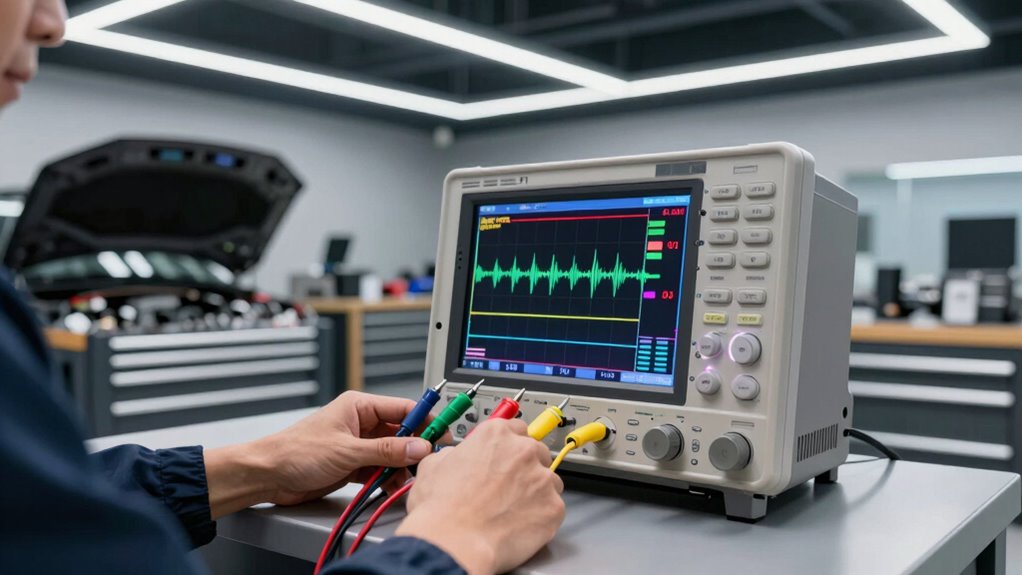

Choosing the right diagnostic tool can make or break your shop’s efficiency. The Autel MaxiScope MP608 stands out as the best overall pick for professional garages due to its seamless integration with existing Autel scan tools and robust 4-channel capability. For those needing higher bandwidth for advanced signal analysis, the UNI-T UPO2072HD offers superior resolution and screen real estate, while the Hantek 1008C provides exceptional value for shops needing 8 channels on a budget. The main tradeoff in this category is between portability and processing power; handheld units offer speed but lack the screen size of PC-based systems. Continue reading to see which model fits your specific diagnostic workflow.

Get business pricing on garage and car supplies
- Business-only prices and quantity discounts
- Tax-exempt purchasing
- Multiple users, one account, clear invoices
Complete the kit


Key Takeaways
- Integrated software ecosystems like Autel‘s provide faster workflow than standalone PC-based scopes for routine diagnostics.
- 8-channel models like the Hantek 1008C are critical for complex engine management systems but require a dedicated PC.
- Bandwidth above 50MHz is rarely necessary for standard automotive sensors but becomes vital for CAN bus and high-speed data analysis.
- Portable handheld scopes sacrifice screen resolution and memory depth for the convenience of moving between vehicles.
- Build quality and probe durability are often the deciding factors for long-term reliability in high-volume shop environments.



| top rated automotive oscilloscopes for professional garage | Channels | Bandwidth |
|---|---|---|
| Autel MaxiScope MP608 4-Channe | 4 | 20MHz |
| Micsig SATO1004 Portable Handh | 4 | 100MHz |
| TOPDON Phoenix Scope | 4 | — |
| Autel MaxiScope MP608 4-Channe | 4 | 20MHz |
| Hantek 1008C PC USB 8-Channel | 8 | — |
| Autel MaxiScope MP608 4-Channe | 4 | 20MHz |
| Hantek 1008C PC USB 8CH Automo | 8 | — |
| Autel MP608 4-Channel Automoti | 4 | 20 MHz |
| UNI-T UPO2072HD Oscilloscope | 2 | 70MHz |
| Hantek 6074BE Digital Oscillos | 4 | 70MHz |
More Details on Our Top Picks
Autel MaxiScope MP608 4-Channel Automotive Oscilloscope
This unit stands out for its seamless integration with the Autel MaxiSys platform, making it a powerful choice for shops already invested in that ecosystem. The 12-bit vertical resolution offers significantly higher precision than the 8-bit standard found on many competitors like the Micsig SATO1004, allowing technicians to spot subtle signal noise in injector drivers or sensor lines. However, this high fidelity comes with a dependency; unlike the standalone TOPDON Phoenix Scope, the MP608 requires a compatible tablet or PC to function, limiting its portability if you don’t already own the host device. It is less flexible for general electronics but superior for guided automotive diagnostics.
Pros:- 12-bit vertical resolution provides superior signal clarity compared to standard 8-bit scopes
- Deep integration with Autel guided tests reduces diagnostic guesswork
- Supports complex bus decoding including CAN FD and FlexRay
- Plug-and-play USB connectivity simplifies setup with compatible hosts
Cons:- 20MHz bandwidth may limit visibility on very high-frequency components compared to 100MHz units
- Heavy reliance on Autel hardware ecosystem for full functionality
- Higher entry cost for shops not already using Autel tools
Best for: Professional garages already using Autel MaxiSys tablets that need high-precision waveform analysis integrated into their existing diagnostic workflow.
Not ideal for: Standalone workshops or hobbyists who do not own an Autel tablet, as the scope cannot operate independently without specific host software.
- Channels:4
- Vertical Resolution:12-bit
- Bandwidth:20MHz
- Max Sampling Rate:80MS/s
- DC Accuracy:±1%
- Protocols:CAN, CAN FD, FlexRay, LIN, UART, I²C
- Weight:2 pounds
- Warranty:1 Year
Our verdict“This is the definitive choice for Autel users who prioritize diagnostic accuracy and workflow integration over standalone flexibility.”
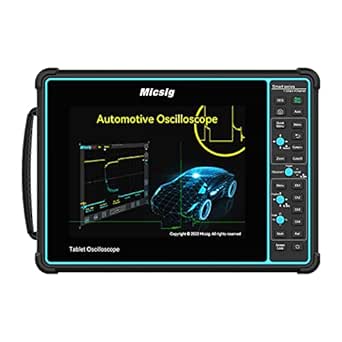
Micsig SATO1004 Portable Handheld Automotive Oscilloscope
Where the Autel MaxiScope MP608 offers precision, the Micsig SATO1004 delivers raw power with its 100MHz bandwidth and 1GSa/s sampling rate. This makes it uniquely capable of capturing fast-transient events, such as ignition coil primary spikes or high-speed communication errors, which might appear aliased or smoothed out on lower-bandwidth scopes like the Autel. The 8-inch touchscreen and battery-powered design offer true standalone utility, eliminating the need to drag a laptop or tablet to the vehicle. The tradeoff lies in complexity; the sheer number of input options and lack of guided automotive tests mean the technician must have a strong foundational understanding of scope operation to utilize its full potential.
Pros:- 100MHz bandwidth captures fast transients and high-frequency noise accurately
- Standalone battery-powered design with 8-inch touchscreen for true mobility
- Smartphone app connectivity allows for remote monitoring and data sharing
- High sampling rate ensures detailed reconstruction of complex waveforms
Cons:- Steep learning curve due to lack of guided automotive test libraries
- Battery life specifications are ambiguous, posing a risk for long shifts
- Complex interface may overwhelm users accustomed to simplified diagnostic tools
Best for: Advanced technicians handling hybrid, electric, or high-performance vehicles requiring high-bandwidth capture of fast-switching electronics.
Not ideal for: Entry-level mechanics or those seeking guided, step-by-step diagnostic workflows, as the interface lacks simplified automotive templates.
- Model:SATO1004
- Bandwidth:100MHz
- Channels:4
- Sampling Rate:1GSa/s
- Display:8-inch Touch Screen
- Power Source:Battery Powered
- Standards:CE, FCC
Our verdict“A high-performance powerhouse for experts who need bandwidth and portability over guided diagnostic assistance.”
TOPDON Phoenix Scope, 4-Channel Automotive Oscilloscope with Accessories
This accessory is designed exclusively for owners of TOPDON Phoenix diagnostic tablets, functioning as a dedicated add-on rather than a general-purpose tool. It competes directly with the Autel MaxiScope MP608 in terms of utility, offering 50M memory depth for capturing long-duration events like slow sensor drifts. While the Autel offers higher vertical resolution, the Phoenix Scope compensates with 23 auto measurements and intuitive cursor operations tailored specifically for automotive troubleshooting. The primary limitation is its lack of independence; it is useless without a compatible Phoenix tablet, and notably, it does not support the Phoenix Nano or XLink Soft Keyboard, restricting its compatibility even within the brand’s own lineup.
Pros:- Deep 50M memory allows for detailed long-duration waveform recording
- Advanced math analysis and FFT support for complex signal processing
- Seamless compatibility with the TOPDON Phoenix diagnostic software suite
- Intuitive trigger and cursor functions streamline manual analysis
Cons:- Incompatible with TOPDON Nano and XLink Soft Keyboard models
- Cannot function as a standalone device without a Phoenix tablet
- Limited to automotive applications, lacking general electronics versatility
Best for: Shops already equipped with TOPDON Phoenix Max, Elite, or Smart tablets looking to add oscilloscope capabilities without switching ecosystems.
Not ideal for: Users with TOPDON Nano devices or those needing a standalone scope, as it requires specific Phoenix tablet hardware to operate.
- Memory Depth:50M
- Channels:4
- Trigger Functions:Edge, pulse width
- Auto Measurements:23 types
- Compatibility:Phoenix Max / Smart / Elite / Lite 3 / Lite 2 / Plus / Plus 2
- Warranty:1 Year
Our verdict“A specialized extension for TOPDON users who want robust automotive analysis capabilities integrated into their existing diagnostic platform.”
Autel MaxiScope MP608 4-Channel Automotive Oscilloscope Waveform Tester
Functionally similar to the standard MP608, this variant emphasizes portability and USB power, making it an ideal companion for technicians who need to move between bays quickly. It shares the 12-bit resolution and guided test library that give it an edge over the Hantek 1008C in terms of precision and ease of use. However, like its sibling, it is tethered to the Autel ecosystem, requiring a MaxiSys tablet or PC. The 20MHz bandwidth is sufficient for 90% of automotive electrical faults but falls short of the Micsig SATO1004 for high-frequency work. Its strength lies in its lightweight design and comprehensive accessory kit, which includes ignition pickups and attenuators, reducing the need for additional purchases.
Pros:- USB-powered design eliminates the need for external power sources
- Includes a comprehensive accessory kit with ignition and multimeter probes
- OEM reference waveforms in the guided library speed up diagnosis
- High accuracy with ±1% DC specification ensures reliable readings
Cons:- 20MHz bandwidth restricts analysis of very fast digital signals
- Dependent on Autel MaxiSys hardware for full diagnostic features
- Shared memory architecture may limit simultaneous channel depth
Best for: Mobile technicians and busy shops needing a lightweight, accurate scope that integrates with Autel tablets for quick electrical checks.
Not ideal for: Engineers or high-end performance shops requiring bandwidth above 20MHz for advanced sensor or injector driver analysis.
- Resolution:12-bit
- Bandwidth:20MHz
- Sample Rate:80MS/s (single channel)
- Memory:32M shared
- Input Range:±50mV to ±200V
- Channels:4
- Connectivity:USB
Our verdict“A highly portable, accurate solution for Autel users who value a complete accessory package and ease of transport.”
Hantek 1008C PC USB 8-Channel Automotive Diagnostic Digital Oscilloscope
The Hantek 1008C offers a unique advantage with its 8 channels, allowing for simultaneous comparison of multiple sensors or ignition events that would require sequential testing on the 4-channel Autel MaxiScope MP608. It is a cost-effective entry point into automotive diagnostics, relying on PC software to provide over 80 preset functions. However, it lacks the standalone hardware and guided automotive intelligence of the TOPDON Phoenix Scope. The resolution is typically lower (often 8-bit in this class), meaning signal details may appear noisier than on the 12-bit Autel units. It is a tool for those who need channel count and budget efficiency rather than precision and guided workflows.
Pros:- 8 channels allow for complex multi-signal comparisons in a single capture
- Includes over 80 preset automotive diagnostic functions
- USB connectivity makes it easy to store and share data via PC
- Low barrier to entry for learning basic oscilloscope principles
Cons:- Lower resolution compared to 12-bit competitors like the Autel MP608
- Requires a PC for operation, reducing mobility in the bay
- Lacks advanced bus decoding and guided test libraries found in premium tools
Best for: Budget-conscious shops or educational facilities needing to monitor multiple signals simultaneously without investing in premium standalone scopes.
Not ideal for: Technicians who require high-resolution precision, guided automotive tests, or the ability to operate without a laptop nearby.
- Channels:8
- Connectivity:USB
- Application:Automotive diagnostics
- Functions:Ignition, Sensor, Bus detection, Starter
- Help Support:Video tutorials included
- Data Saving:Multiple options via PC
Our verdict“A versatile, multi-channel budget option for shops that prioritize channel quantity and PC-based analysis over standalone precision.”
Autel MaxiScope MP608 4-Channel Automotive Oscilloscope, 12-Bit, 20MHz
This model shines when paired with Autel diagnostic tablets, creating a seamless workflow that standalone scopes struggle to match. Its 12-bit vertical resolution captures subtle signal variations that 8-bit competitors might miss, making it ideal for analyzing noisy sensor data. Compared to the Hantek 1008C, the MP608 offers dedicated automotive software and guided test procedures, reducing the learning curve for complex diagnostics. However, it relies heavily on a PC or tablet connection, lacking the true standalone versatility of some handheld units. The 20MHz bandwidth is sufficient for most vehicle networks but may fall short for high-frequency RF applications. If your garage already uses Autel scanners, this scope integrates naturally; if not, the dependency on their ecosystem is a significant constraint.
Pros:- Seamless integration with Autel scanner ecosystems
- High 12-bit resolution for detailed signal analysis
- Includes guided test procedures for common faults
- Supports multi-protocol decoding (CAN, LIN, etc.)
Cons:- Requires connection to PC or Autel tablet to function
- 20MHz bandwidth limits high-frequency signal capture
- Higher cost of entry if not already using Autel tools
Best for: Garages heavily invested in Autel diagnostic tablets and software workflows
Not ideal for: Standalone users who want a self-contained device without PC dependency
- Channels:4
- Resolution:12-bit
- Bandwidth:20MHz
- Sample Rate:80 MS/s
- Power Source:USB-powered
- Compatibility:Autel Scanner, Windows 10/11
Our verdict“This is the logical choice if you want an oscilloscope that talks directly to your Autel diagnostic tools.”
Hantek 1008C PC USB 8CH Automotive Diagnostic Digital Oscilloscope
The Hantek 1008C distinguishes itself with 8 channels, a feature rarely found at this price point in automotive scopes. While the Autel MP608 offers better resolution and bandwidth, the Hantek allows you to view multiple sensor signals simultaneously, which is invaluable for checking injector synchronization or CAN bus interactions. Its 250kHz bandwidth is a significant limitation for high-speed data lines, restricting it to slower analog signals and basic digital triggers. This device is strictly a PC peripheral, requiring a laptop for operation, which adds bulk to your diagnostic cart. It is not a replacement for a high-bandwidth scope but serves as a powerful companion for specific multi-channel tasks where channel count matters more than speed.
Pros:- 8 independent channels for parallel signal monitoring
- Includes a programmable signal generator
- Cost-effective entry into multi-channel diagnostics
- Lightweight and compact form factor
Cons:- Low 250kHz bandwidth limits application scope
- Requires a PC connection for all functionality
- Software interface can feel dated compared to modern scopes
Best for: Technicians needing to view many low-frequency signals simultaneously
Not ideal for: Users requiring high-bandwidth capture for fast digital protocols
- Channels:8
- Resolution:12 bits
- Frequency Range:0-250KHz
- Sampling Rate:2.4MSa/s
- Power Source:Corded Electric (USB)
- Weight:10.88 ounces
- Dimensions:7.48″L x 6.57″W x 1.38″H
Our verdict“Choose this if you need eight channels for slow-speed signal analysis and already have a laptop ready.”
Autel MP608 4-Channel Automotive Oscilloscope, USB Portable Digital Scope
Similar to the MaxiScope MP608, this Autel unit focuses on professional-grade accuracy with its 12-bit resolution and 80 MS/s sampling rate. It stands out for its ability to operate standalone on Windows while still offering deep integration with Autel scanners, providing more flexibility than the strictly tablet-dependent alternatives. Compared to the Hantek 6074BE, the MP608 offers superior software guidance and automotive-specific presets, saving time on complex setups. The 20MHz bandwidth is a compromise, suitable for most engine management systems but not ideal for high-speed communication lines. Its lightweight design is portable but may feel less robust in a rugged shop environment. This is a strong all-rounder for shops that value software support over raw bandwidth.
Pros:- Dual operation modes: standalone PC or Autel scanner
- Preset guided diagnostics simplify complex tests
- High 12-bit vertical resolution for clean waveforms
- Includes comprehensive accessory kit
Cons:- 20MHz bandwidth is low for modern high-speed buses
- Lightweight plastic housing may lack durability
- Advanced features require steep learning curve
Best for: Professional shops needing reliable software guidance and decent resolution
Not ideal for: High-end diagnostics requiring bandwidth above 20MHz
- Channels:4
- Bandwidth:20 MHz
- Sampling Rate:80 MS/s
- Vertical Resolution:12-bit
- Memory Depth:32M
- Weight:1.2 pounds
- Connectivity:USB, Windows 10/11
Our verdict“This scope offers the best balance of software intelligence and hardware capability for general automotive work.”
UNI-T UPO2072HD Oscilloscope – 70MHz, 2 Channel, 12-Bit, 2.5GSa/s, 10.1″ Touchscreen
The UNI-T UPO2072HD delivers raw power with 70MHz bandwidth and a massive 2.5GSa/s sampling rate, far outpacing the Autel MP608 in speed and fidelity. Its 10.1-inch touchscreen provides an intuitive interface that rivals modern tablets, making waveform analysis faster and more visual. However, it only offers 2 channels, which is a critical limitation for automotive diagnostics where you often need to compare multiple sensors or actuators simultaneously. While the Hantek 6074BE offers 4 channels at a similar bandwidth, the UNI-T excels in processing speed and display quality. This unit is heavy and bulky, making it better suited for a static bench than a mobile diagnostic cart. It is a precision instrument for detailed signal analysis rather than a quick troubleshooting tool.
Pros:- High 70MHz bandwidth and 2.5GSa/s sample rate
- Large 10.1-inch touchscreen for easy navigation
- Deep memory (100 Mpts) for long waveform capture
- Multi-function tool with spectrum analyzer features
Cons:- Only 2 channels limit parallel automotive testing
- Heavy and bulky at 12 lbs
- Higher price point than basic automotive scopes
Best for: Engineers or shops needing high-speed capture and large visual displays
Not ideal for: Technicians needing more than two simultaneous channels
- Bandwidth:70MHz
- Channels:2
- Resolution:12-bit
- Sample Rate:2.5GSa/s
- Display:10.1-inch touchscreen
- Memory Depth:100 Mpts
- Weight:12 lbs
Our verdict“This is a powerhouse for detailed signal analysis but lacks the channel count for comprehensive vehicle diagnostics.”
Hantek 6074BE Digital Oscilloscope 70MHz 1GSa/s 4CH USB Virtual Diagnostic Tool
The Hantek 6074BE offers 70MHz bandwidth and 4 channels at a price point that undercuts many competitors, making it a strong value proposition. It matches the bandwidth of the UNI-T UPO2072HD but adds two more channels, providing greater utility for automotive work. Unlike the Autel MP608, it lacks specialized automotive software and guided tests, requiring you to interpret raw waveforms manually. The device is a USB virtual instrument, meaning it has no screen or buttons on the unit itself, relying entirely on your computer’s display. This makes it highly portable but dependent on a PC. It is an excellent choice for tech-savvy users who want high specs without paying for proprietary software ecosystems, but beginners may find the lack of guidance challenging.
Pros:- 70MHz bandwidth and 1GSa/s sampling rate
- 4 channels for simultaneous multi-signal monitoring
- No proprietary software lock-in
- Compact and lightweight USB form factor
Cons:- No standalone display or controls (PC only)
- Lacks automotive-specific guided tests
- Software interface is less polished than premium brands
Best for: Experienced technicians who want high bandwidth and channels without software locks
Not ideal for: Beginners who need guided diagnostics and standalone operation
- Bandwidth:70MHz
- Sampling Rate:1GSa/s
- Channels:4
- Input Sensitivity:2mV-10V/DIV
- Compatibility:Windows 10/8/7
- Power Source:Corded Electric (USB)
Our verdict“This scope delivers high-end specifications in a basic package, ideal for those who prefer manual control over guided workflows.”

How We Picked
I evaluated these oscilloscopes based on their suitability for a professional garage environment, prioritizing workflow efficiency over raw laboratory specifications. The primary criteria included channel count, bandwidth adequacy for automotive signals, software integration, and physical durability. I filtered out hobbyist-grade tools that lack the robustness needed for daily use and excluded units with poor driver support or outdated interfaces.
Ranking logic favored tools that reduce diagnostic time. Models that integrate seamlessly with popular scan tools or offer intuitive touchscreen interfaces ranked higher than those requiring complex PC setups, unless the PC-based model offered a significant advantage in channel count or resolution. I also weighed the accessibility of technical support and the availability of automotive-specific waveform libraries, as these features directly impact a technician’s ability to diagnose intermittent faults quickly.
Factors to Consider When Choosing Top Rated Automotive Oscilloscopes For Professional Garages
Selecting an oscilloscope for a professional shop is not about finding the highest specs on a datasheet. It is about matching the tool’s capabilities to your daily diagnostic tasks and shop infrastructure. Here are the key factors to weigh before purchasing.Bandwidth vs. Application Needs
Many technicians mistakenly believe higher bandwidth is always better. For standard automotive sensors like crankshaft position sensors, oxygen sensors, and fuel injectors, a bandwidth of 20MHz to 50MHz is sufficient. You only need bandwidth exceeding 70MHz if you are analyzing high-speed communication buses like CAN-FD or LIN, or if you are working on hybrid/electric vehicle inverters. Paying extra for 100MHz+ bandwidth when you mostly diagnose internal combustion engines is a waste of budget. Match your bandwidth to your most common complex diagnoses, not your theoretical worst-case scenario.
Channel Count and Simultaneous Testing
The number of channels dictates what you can see simultaneously. A 2-channel scope is limiting for modern engines, as you often need to correlate ignition signals with fuel injection or sensor inputs. 4 channels are the professional standard, allowing you to view complex interactions like misfire patterns across multiple cylinders. 8-channel models are specialized tools, useful for deep dives into engine management strategies or comparing multiple sensors at once, but they often require a dedicated computer and more complex setup time. Do not buy 8 channels unless your shop specifically handles high-performance tuning or complex OEM diagnostic procedures that require it.
Software Integration and Ecosystem
In a busy garage, time is money. Standalone handheld scopes offer speed but may lack deep data logging capabilities. PC-based scopes require a laptop, which adds a step to the process but offers larger screens and more powerful analysis software. The biggest differentiator is ecosystem integration. If your shop already uses Autel, Bosch, or Snap-on scan tools, choosing a scope that talks to your existing tools via one cable can save minutes per diagnosis. Over a year, those minutes add up to significant labor cost savings.
Portability and Physical Form Factor
Handheld units are excellent for quick checks at the vehicle, reducing the need to drag a laptop to the bay. However, they often have smaller screens and less intuitive interfaces for detailed zooming and analysis. PC-based or tablet-based systems offer better visualization but are less mobile. Consider your shop layout. If technicians move between lifts frequently, a handheld or tablet-integrated scope is preferable. If you have a dedicated diagnostic bench, a PC-based system provides a better ergonomic experience for long analysis sessions.
Probe Quality and Accessory Availability
The oscilloscope is only as good as its probes. Standard passive probes are often too bulky for tight engine bays. Look for kits that include back-pin probes, breakout boxes, and flexible leads. Cheap scopes often come with low-quality probes that drift or break easily. Replacing probes costs money and downtime. Verify that the manufacturer sells replacement probes and accessories separately. A scope with excellent specs but poor probe availability will become a liability in a professional setting.
Frequently Asked Questions
Do I need 8 channels for professional automotive diagnostics?
For the vast majority of professional garages, no. Four channels are sufficient for 95% of diagnostic tasks, including ignition analysis, fuel system monitoring, and sensor correlation. Eight channels are only necessary if you are performing advanced engine management calibration, comparing multiple sensors across a large array of cylinders simultaneously, or working in a research and development capacity. Buying an 8-channel scope often introduces unnecessary complexity and cost for routine repair shops.
Is a handheld oscilloscope better than a PC-based one for a shop?
It depends on your workflow. Handheld scopes offer speed and mobility, making them ideal for quick verification tasks at the vehicle. PC-based scopes offer superior screen real estate, better data analysis tools, and easier report generation. Many modern shops prefer tablet-based solutions or scopes that integrate with existing diagnostic tablets to get the best of both worlds. If you rely heavily on visualizing long data logs, a PC-based or tablet-based system is generally more effective.
What is the minimum bandwidth required for CAN bus diagnostics?
Standard CAN bus operates at 500kbps or 1Mbps, which technically requires very little bandwidth. However, to see clean waveforms and detect signal degradation, you need a scope with at least 20MHz to 50MHz bandwidth. This ensures that the rise times of the digital signals are captured accurately without distortion. If you are working on newer vehicles with CAN-FD or Ethernet-based networks, look for scopes with 100MHz or higher bandwidth to capture the faster edge rates of these signals.
Can I use a general-purpose electronics oscilloscope for cars?
You can, but it is not recommended. General-purpose scopes lack automotive-specific presets, such as automatic scaling for ignition coils or fuel injectors. They also typically do not come with automotive-grade probes, which are designed to handle high voltage spikes and fit into tight spaces. Automotive-specific scopes include built-in libraries of known good waveforms, which dramatically speed up the comparison process for technicians who are not expert oscilloscope users.
How important is the sample rate compared to bandwidth?
Sample rate determines how many data points are captured per second, which affects the resolution of the waveform on the screen. A high bandwidth without a sufficient sample rate will result in a jagged, low-resolution image. For automotive diagnostics, a sample rate of at least 1GSa/s is recommended to ensure smooth waveform rendering, especially when zooming in on fast events like injector pulses. However, bandwidth remains the primary constraint for capturing the signal itself without attenuation.
Conclusion
Choosing the right oscilloscope depends on your shop’s specific needs. For most professional garages, the Autel MaxiScope MP608 is the best overall choice due to its balance of portability, 4-channel capability, and integration with popular diagnostic ecosystems. If you are on a tight budget but need multiple channels for complex engine analysis, the Hantek 1008C offers the best value, provided you have a dedicated PC to run it. For high-end shops requiring premium resolution and large-screen analysis for advanced hybrid or electric vehicle work, the UNI-T UPO2072HD is the best premium option. Beginners or shops starting with their first scope should look at the TOPDON Phoenix Scope for its user-friendly interface and included accessories. Match the tool to your workflow, not just the spec sheet, to maximize your diagnostic efficiency.
Fall Picks
fall essentials
As an affiliate, we earn on qualifying purchases.