For long highway trips, I’d start with the Uniden R8W as the best overall pick: its long-range detection, 360-degree awareness, GPS, and camera alerts suit drivers who want a feature-rich setup. The Uniden R7 is a strong alternative for drivers who value dual antennas and directional awareness, while the Cobra RAD 480i offers a simpler connected option. The main tradeoffs are range and filtering versus setup complexity, alert management, and cost of features. A less expensive detector may cover basic needs, but may not offer the GPS or directional tools that make highway alerts easier to interpret. Read on for the full breakdown and advice on choosing the right fit for your driving.

Get business pricing on garage and car supplies
- Business-only prices and quantity discounts
- Tax-exempt purchasing
- Multiple users, one account, clear invoices
Complete the kit


Key Takeaways
- The Uniden R8W leads for feature coverage: it combines long-range detection and 360-degree awareness with GPS, Wi-Fi, Bluetooth, and camera alerts.
- The Uniden R7 and R3 serve different priorities: the R7 adds dual antennas for directional awareness, while the R3 keeps GPS and voice alerts in a simpler single-detector design.
- The Escort Redline 360c is the premium alternative: its plug-and-play positioning and extreme-range focus suit drivers seeking a more advanced setup, though buyers should compare its feature fit with the R8W.
- The Cobra RAD 480i stands apart among familiar brands: Bluetooth and long-range detection make it a connected middle-ground option, rather than a GPS-heavy pick.
- The generic and Speed Sentinel listings offer fewer stated differentiators: their listed modes and alerts may suit basic use, but the limited detail makes direct performance comparisons harder than with the Uniden and Escort models.




| radar detectors for highway driving | Brand | Power | Display | Model |
|---|---|---|---|---|
| Radar Detector for Cars 360° F | XINGZUAN | — | — | — |
| Radar Detector for Cars | — | — | — | — |
| Speed Sentinel 360° Radar Dete | — | Car charger powered | LED screen | — |
| Speed Sentinel Radar Detector | — | 12V power cable | — | — |
| Cobra RAD 480i Laser Radar Det | Cobra | — | — | RAD 480i |
| Uniden R8W | Uniden | 12 V corded electric | OLED | R8W |
| Speed Sentinel 360° Radar Dete | — | Car charger | LED screen | — |
| Uniden R7 Extreme Long-Range L | Uniden | DC | OLED | R7 |
| Uniden R3 Extreme Long Range L | Uniden | DC | Multi-color OLED | R3 |
| Escort Redline 360c Plug and P | Escort | — | — | 0100040-1 |
More Details on Our Top Picks
Radar Detector for Cars 360° Full-Band Detection with X/K/Ka/Ku Signal Support, City & Highway Modes, DSP Noise Reduction, Voice Alerts, Memory Function
For highway drivers who want a simple mix of directional coverage and familiar alerts, this XINGZUAN model brings 360° detection across X, K, Ka, and Ku bands, plus voice alerts and a setting for highway use. Its DSP noise reduction and memory function are intended to make alerts less disruptive and preserve saved settings. Compared with the Speed Sentinel model B0FFK61BL8, it lists Ku-band support and DSP filtering, while that detector provides a stated range of up to 650 feet and a dash mat. The main drawback is that this product gives no useful detection-range figure: the listed “1.5 millimeters” does not clarify highway warning distance. It also lacks stated GPS or app features, so buyers wanting camera alerts or connected updates should look at the Cobra RAD 480i or a GPS-equipped Uniden.
Pros:- Lists 360° coverage across X, K, Ka, and Ku bands
- Highway and city modes let drivers adjust sensitivity for different surroundings
- DSP noise reduction and voice alerts are designed to limit distracting sounds
- Memory function can retain saved settings
Cons:- The listed working distance of 1.5 millimeters does not establish a useful highway detection range
- No GPS, app connectivity, or camera-alert features are specified
- Mounting method and power details are not provided
Best for: Drivers seeking basic 360° band coverage, voice alerts, and separate city and highway settings without needing app or GPS features
Not ideal for: Highway commuters who need a clearly stated detection range, camera alerts, or detailed information about connectivity and installation
- Brand:XINGZUAN
- Frequency bands:X, K, Ka, Ku
- Coverage:360°
- Modes:City and Highway
- Signal processing:DSP noise reduction
- Alert type:Voice alerts
- Memory:Memory function
- Listed working distance:1.5 millimeters (as stated in product data)
Our verdict“Choose it for basic 360° band coverage and voice alerts, but skip it if a verified detection range or connected features are priorities.”
Radar Detector for Cars, Long Range Radar & Laser Detector Up to 1,100 Yards, X/K/Ka/KU/ST/CT Band Detection, DSP False Alert Filtering, Voice Alerts, RDD Stealth, City/Highway Modes
The headline distinction here is a stated detection distance of up to 1,100 yards, paired with X, K, Ka, KU, ST, and CT detection. That range claim gives highway buyers more to compare than the vague distance information supplied for the XINGZUAN model, though the product data warns that terrain and weather can affect performance. DSP false-alert filtering, voice alerts, and city/highway modes address the practical problem of repeated warnings on mixed routes. RDD stealth is another listed feature, but the data does not explain its limits or compatibility. Compared with the Cobra RAD 480i, this detector specifies a longer numerical range, while Cobra adds Bluetooth, app-based alerts, and front-and-rear LaserEye. Buyers should choose this model for its stated range and listed bands, not for phone integration or a proven performance guarantee.
Pros:- Lists detection up to 1,100 yards
- Supports X, K, Ka, KU, ST, and CT bands
- DSP filtering is intended to reduce false alerts
- Includes voice alerts, city/highway modes, and RDD stealth
Cons:- The stated maximum range may vary with terrain and weather
- Windshield mounting is required, limiting placement options
- Product data does not detail app connectivity or the specific laser-detection arrangement
Best for: Highway drivers who prioritize a stated maximum detection distance and want multiple listed bands with voice alerts
Not ideal for: Drivers who want app-connected alerts, a clearly detailed laser setup, or a range figure guaranteed across road and weather conditions
- Maximum stated range:Up to 1,100 yards
- Bands detected:X, K, Ka, KU, ST, CT
- Alert type:Voice alerts
- Modes:City and Highway
- Filtering:DSP false-alert filtering
- Stealth feature:RDD stealth
- Mounting:Windshield-mounted
Our verdict“Pick this for its stated long-range claim and broad band list, but favor the Cobra RAD 480i if connected alerts matter more.”
Speed Sentinel 360° Radar Detector for Cars & Trucks, Voice Alerts – Red
This Speed Sentinel pairs 360° scanning with an LED screen, voice alerts, and a stated warning distance of 200–1000 meters, making it the most display-focused choice in this batch. Its listed 300-meter precise-detection distance adds context to the broader warning-range claim, although actual highway performance is not further documented. The detector supports X, K, Ka, and CT bands and includes auto mute, auto shutdown, and memory storage. Compared with the other Speed Sentinel, B0FFK61BL8, this model provides a display and explicit metric range figures; the other gives a simpler stated maximum of 650 feet and includes an anti-slip dash mat. The tradeoff is limited product detail on mounting, durability, and warranty. It suits drivers who value visible status information, but buyers seeking app alerts or GPS camera warnings should look to Cobra or a GPS-equipped Uniden.
Pros:- LED screen provides a visual alert option alongside voice prompts
- Lists 360° scanning and X, K, Ka, and CT band support
- Provides separate warning-distance and precise-detection figures
- Auto mute, auto shutdown, and memory storage add configurable alert behavior
Cons:- Mounting details, dimensions, durability, and warranty are not specified
- The listed range figures do not include test conditions or performance guarantees
- No GPS or smartphone connectivity is listed
Best for: Drivers of cars or trucks who want an LED readout, voice alerts, and a stated warning range alongside 360° scanning
Not ideal for: Buyers who need documented mounting hardware, durability information, a warranty specification, or GPS-based camera alerts
- Detection bands:X, K, Ka, CT
- Coverage:360° omnidirectional scanning
- Warning distance:200–1000 m
- Precise detection distance:300 m
- Display:LED screen
- Alerts:Voice alerts, auto mute, auto shutdown
- Power:Car charger powered
Our verdict“Choose this Speed Sentinel if a screen and stated range figures matter more than documented mounting details or connected alerts.”
Speed Sentinel Radar Detector 360° Police Radar Detectors for Cars
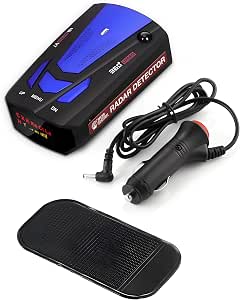
Among these five, this Speed Sentinel has the clearest basic installation description: it is dash-mounted with an anti-slip mat and powered by a 12V cable. Its 360° coverage, X/K/Ka detection, voice alerts, and city/highway modes cover the essentials for drivers who want audible warnings without a screen or app setup. The stated range is up to 650 feet, a more modest figure than the 1,100-yard claim for B0HL7LT7D9 and the 200–1000-meter warning range listed for the other Speed Sentinel. That makes it a less compelling pick for drivers focused on maximum stated warning distance. It also lists no Ku-band support and offers little detail about laser detection. Compared with the XINGZUAN model, its mounting and power are better described, but its listed band range is narrower.
Pros:- Includes an anti-slip mat for dash placement
- Uses a 12V power cable and has a straightforward installation description
- Provides 360° coverage with X, K, and Ka band detection
- Voice alerts and city/highway modes support hands-free warning adjustments
Cons:- Stated detection range is up to 650 feet, shorter than the listed claims for several alternatives
- Laser-detection capabilities are not clearly specified
- Requires a 12V power source and may not suit vehicles without a compatible outlet
Best for: Drivers who want a basic 12V-powered detector with an anti-slip dash mount, voice warnings, and city/highway modes
Not ideal for: Highway commuters prioritizing a longer stated detection range, broad band support, or clearly documented laser detection
- Coverage:360°
- Radar bands:X, K, Ka
- Stated detection range:Up to 650 feet
- Mounting:Dash-mounted with anti-slip mat
- Power:12V power cable
- Alerts:Real-time voice alerts
- Modes:City and Highway
Our verdict“Choose this for a simple dash-mounted setup, but look elsewhere if long-range claims or wider band support lead your decision.”
Cobra RAD 480i Laser Radar Detector, Long Range Detection, Bluetooth, Black
The Cobra RAD 480i is the most connected option in this group, pairing Bluetooth with the Cobra iRadar app and listing Apple CarPlay and Android Auto compatibility. For highway drivers, that connection can add shared, real-time alerts beyond the detector’s own front-and-rear LaserEye detection. Its digital signal processing is intended to filter unwanted alerts, a useful counterpoint to simpler models such as the Speed Sentinel B0FFK61BL8, which provides voice alerts and a dash mat but no listed phone features. Cobra’s tradeoff is that the supplied data gives no numerical detection distance, unlike the 1,100-yard claim on B0HL7LT7D9. Full alert sharing also depends on using a smartphone app. Choose the Cobra for connected awareness and more detailed laser direction coverage; skip it if you want a standalone detector with a clearly stated range.
Pros:- Bluetooth connectivity supports real-time alerts through the Cobra iRadar app
- Lists Apple CarPlay and Android Auto compatibility
- Front-and-rear LaserEye detection adds directional laser coverage
- Digital signal processing is intended to reduce false alarms
Cons:- No numerical detection range is provided in the product data
- Full alert-sharing features require a smartphone app
- The listed detection scope is limited to radar and laser signals
Best for: Highway drivers who use a smartphone, Apple CarPlay, or Android Auto and want app-linked alerts with front-and-rear laser detection
Not ideal for: Drivers who prefer a standalone detector, do not want to rely on a phone app for alert sharing, or require a stated numerical detection range
- Brand:Cobra
- Model:RAD 480i
- Detection technology:LaserEye and digital signal processing
- Laser detection:Front and rear
- Connectivity:Bluetooth
- Platform compatibility:Apple CarPlay and Android Auto
- Detection range:Long range; numerical distance not specified
- Warranty:1-year limited
- Item weight:136.1 g
Our verdict“Choose the RAD 480i for app-linked highway alerts and front-and-rear LaserEye, but pick another model if a stated range is essential.”
Uniden R8W (New Model) Long Range Laser/Radar Detector with 360° Awareness, Wi-Fi, Bluetooth, GPS, Voice Alerts, Red Light & Speed Camera Alerts
The R8W is my strongest all-around pick for drivers who spend long stretches on highways and want alerts from more than one direction. Its dual antennas and 360° awareness pair with GPS auto-mute, which can quiet alerts from familiar locations rather than making every drive a stream of interruptions. Voice alerts and a large OLED display help keep information accessible without relying on a quick glance. Compared with the Uniden R7, the R8W adds Wi-Fi and Bluetooth connectivity, giving it a more connected feature set; the R7 remains a capable alternative for drivers who do not need those additions. The tradeoff is a more complex setup and a corded power connection, so this is less appealing for someone who wants a bare-bones plug-in device. Its premium positioning also makes sense only if you value the extra coverage and connectivity.
Pros:- Dual antennas provide 360° radar and laser threat awareness.
- GPS auto-mute can reduce repeat alerts at familiar locations.
- Voice alerts and a large OLED display make information easier to access while driving.
- Preloaded red-light and speed-camera alerts add location-based warnings.
Cons:- The feature set may take time for new detector owners to configure.
- Requires connection to vehicle power.
- Its premium feature package may be more than occasional highway drivers need.
Best for: Frequent highway drivers who want directional alerts, GPS-based false-alert control, and smartphone connectivity in one windshield-mounted detector.
Not ideal for: First-time buyers seeking a simple, low-cost detector or drivers who do not want a corded unit or time spent configuring settings.
- Brand:Uniden
- Model:R8W
- Detection bands:34.7 GHz, 24.125 GHz
- Display:OLED
- Power:12 V corded electric
- Dimensions:4.9 × 3.5 × 1.5 in
- Connectivity:Wi-Fi, Bluetooth; compatible with smartphones and iPhone
- Warranty:1 year
Our verdict“Choose the R8W if highway coverage and connected features matter more to you than simple setup and a pared-back design.”
Speed Sentinel 360° Radar Detector for Cars & Trucks with Voice Alerts
For drivers who want a straightforward highway companion rather than a feature-heavy setup, Speed Sentinel keeps the basics accessible: plug-and-play installation, voice alerts, and an LED screen. Its listed X, K, and Ka band support and full 360° scanning give it broader stated coverage than a basic forward-only alert approach, while K/Ka filtering and memory settings offer some control over unwanted warnings. Compared with the Uniden R3, it lacks the listed GPS location tools and camera alerts, so it is less suited to building a personalized library of familiar false-alert spots. Its detection range is listed as 200–1000 m, but the product data also gives a separate 300 m detection distance, so buyers should not treat the longer figure as a guaranteed warning distance. This is an accessible, cord-powered option, though false alerts may remain a nuisance in busy areas.
Pros:- Plug-and-play design keeps installation uncomplicated.
- Full 360° scanning covers threats from multiple directions.
- Voice alerts and an LED display make warnings easier to hear and see.
- K/Ka filtering and memory settings provide some customization.
Cons:- False alerts may persist in areas with heavy signal interference.
- Product data lists both a 200–1000 m range and a separate 300 m detection distance.
- Requires a car-charger power connection and is specified for cars and trucks.
Best for: Drivers who want a simple car or truck detector with voice prompts and 360° scanning, without the setup demands of GPS-equipped models.
Not ideal for: Highway commuters who want GPS-based location memory, camera alerts, or stronger control over recurring false alerts.
- Detection range:200–1000 m listed
- Detection distance:300 m listed
- Frequency bands:X, K, Ka
- Scanning:Full 360° omnidirectional
- Display:LED screen
- Alerts:Voice alerts; auto mute
- Filtering:K/Ka band filtering
- Power:Car charger
- Additional functions:Auto shutdown; memory storage for customized settings
Our verdict“Pick Speed Sentinel for simple cord-powered operation, but choose the Uniden R3 if GPS-based filtering and camera alerts matter more.”
Uniden R7 Extreme Long-Range Laser-Radar Detector with GPS, Dual Antennas, and Voice Alerts
The R7 suits highway drivers who want to know not only that a signal is present, but also its direction. Its dual antennas and directional arrows give alerts more context, while built-in GPS can remember false-alert locations and mark points along a route. That combination makes it a more informative choice than the Uniden R3, which offers GPS and voice alerts but does not list dual antennas or directional arrows. The R7 also includes red-light and speed-camera alerts, useful for drivers whose routes mix open highway with towns. The tradeoff is a more involved setup: GPS features and firmware updates take attention, and the controls may feel like extra work for someone seeking a simple detector. It runs on DC power and its listed frequency support is K and Ka, so buyers should check that this matches their needs.
Pros:- Dual antennas and directional arrows help identify where alerts are coming from.
- GPS memory can filter familiar false-alert locations and support user marking.
- Voice alerts reduce the need to watch the display.
- Includes red-light and speed-camera alerts.
Cons:- Setup and firmware updates may be demanding for first-time users.
- The added features can be unnecessary for drivers who only want basic alerts.
- Listed supported bands are K and Ka.
Best for: Highway drivers who value directional information and GPS memory for recurring false alerts, and are comfortable configuring a more capable detector.
Not ideal for: Drivers who want a very simple plug-in unit or who prefer a smaller feature set with less setup and maintenance.
- Brand:Uniden
- Model:R7
- Supported bands:K, Ka
- Antennas:Dual
- Display:OLED
- Power:DC
- Weight:6.72 oz
- GPS features:False-alert memory and location marking
- Additional alerts:Voice, red-light camera, and speed-camera alerts
Our verdict“Choose the R7 over the R3 if directional arrows are a priority and you are willing to spend time setting up GPS features.”
Uniden R3 Extreme Long Range Laser and Radar Detector with GPS, Voice Alerts, and Multi-Color OLED Display
The R3 is the more focused Uniden choice for highway drivers who want long-range detection and GPS-based alert management without stepping up to the R7’s dual antennas and directional arrows. Its GPS can filter repeat false alerts and let drivers mark locations, while voice notifications and a multicolor OLED make warnings easier to follow without constant screen checks. Preloaded red-light and speed-camera alerts also suit routes that alternate between open roads and towns. Compared with the Uniden R8W, the R3 does not list Wi-Fi or Bluetooth, so it offers a less connected experience; its appeal is a simpler feature mix centered on detection and GPS. The listed weight and dimensions suggest a unit that may occupy noticeable windshield space. Buyers should also plan for setup, since its filtering and alert options benefit from configuration.
Pros:- GPS supports false-alert filtering and user-marked locations.
- Voice alerts and a multicolor OLED help communicate warnings clearly.
- Preloaded red-light and speed-camera alerts add useful route information.
- Supports the listed 34.7 GHz, 24.125 GHz, and 10.525 GHz frequencies.
Cons:- The listed 1.7 lb weight may feel bulky for a windshield-mounted unit.
- Setup is needed to get the most from GPS and filtering features.
- Does not list the R8W’s Wi-Fi or Bluetooth connectivity.
Best for: Highway commuters who want GPS false-alert filtering, voice alerts, and camera warnings but do not need the R7’s directional arrows or the R8W’s listed connectivity.
Not ideal for: Drivers who need a compact, low-profile detector or want a quick setup with minimal configuration.
- Brand:Uniden
- Model:R3
- Supported frequencies:34.7 GHz, 24.125 GHz, 10.525 GHz
- Display:Multi-color OLED
- Power:DC
- Dimensions:4.5 × 2.81 × 1.25 in
- Weight:1.7 lb listed
- Warranty:1 year
- Features:GPS, voice alerts, false-alert filtering, and preloaded red-light and speed-camera alerts
Our verdict“The R3 is a practical choice for GPS-guided highway alerts if you can do without the R7’s directional tracking and the R8W’s connectivity.”
Escort Redline 360c Plug and Play Radar Detector, Extreme Range
The Redline 360c is aimed at highway drivers who want broad coverage paired with in-car connectivity. Its 360-degree awareness and advanced filtering are intended to provide alerts from multiple directions while limiting nuisance signals; GPS AutoLearn adds location-based alert management. Built-in Wi-Fi and compatibility with Apple CarPlay and Android Auto distinguish it from the Uniden R7, whose listed strengths center on dual antennas, directional arrows, and GPS rather than those connected features. That extra integration can appeal to drivers who already use a connected dashboard, but it also means more setup than a basic plug-and-play label might suggest. The product data does not specify frequency bands or physical dimensions, making direct technical comparison harder. Its premium feature set and installation considerations are a poor match for buyers who want a simple, inexpensive windshield detector.
Pros:- 360-degree awareness covers alerts from multiple directions.
- GPS AutoLearn and advanced filtering are designed to reduce repeat nuisance alerts.
- Built-in Wi-Fi adds connectivity.
- Compatible with Apple CarPlay and Android Auto.
Cons:- Setup may be difficult for drivers who are not comfortable with connected devices.
- The premium feature set may be unnecessary for occasional highway trips.
- Product data does not specify supported frequency bands or dimensions.
Best for: Tech-oriented highway drivers who want 360° awareness, GPS-based filtering, Wi-Fi, and CarPlay or Android Auto compatibility.
Not ideal for: Buyers seeking a simple low-complexity detector, or those who need clearly listed band support and dimensions before choosing.
- Brand:Escort
- Model:0100040-1
- Item type:Radar detector
- Weight:14.24 oz
- Coverage:360-degree awareness
- Connectivity:Built-in Wi-Fi
- Smartphone integration:Apple CarPlay and Android Auto compatibility
- Filtering:Advanced filtering and GPS AutoLearn
- Warranty:1-year limited
Our verdict“Choose the Redline 360c if dashboard connectivity and 360° coverage are priorities, but compare its setup demands with the more directional Uniden R7.”

How We Picked
I ranked these detectors around the demands of highway driving: useful detection range, alert clarity, resistance to distracting false alerts, and features that help a driver understand where a signal may be coming from. I also weighed practical usability, including voice alerts, GPS functions, camera alerts, and whether a model’s listed capabilities give a buyer enough information to judge its fit. A long feature list alone did not guarantee a higher place; the value of each feature depends on whether it reduces uncertainty or makes alerts easier to manage at speed.
The Uniden R8W ranks first for its combination of long-range detection, 360-degree awareness, and location-based features. The R7 follows for directional awareness, while the R3 and Cobra RAD 480i make more focused cases around GPS simplicity and connected functionality. The Escort Redline 360c is positioned as a premium alternative, and the remaining models rank lower because their supplied descriptions provide fewer distinct details for comparing highway performance, filtering, and usability. I treated stated specifications as product claims, not as independent test results.
| radar detectors for highway driving | Brand | Display |
|---|---|---|
| Radar Detector for Cars 360° F | XINGZUAN | — |
| Radar Detector for Cars | — | — |
| Speed Sentinel 360° Radar Dete | — | LED screen |
| Speed Sentinel Radar Detector | — | — |
| Cobra RAD 480i Laser Radar Det | Cobra | — |
| Uniden R8W | Uniden | OLED |
| Speed Sentinel 360° Radar Dete | — | LED screen |
| Uniden R7 Extreme Long-Range L | Uniden | OLED |
| Uniden R3 Extreme Long Range L | Uniden | Multi-color OLED |
| Escort Redline 360c Plug and P | Escort | — |
Factors to Consider When Choosing Radar Detectors For Highway Driving
Choosing a highway detector is less about collecting the longest feature list and more about deciding which alerts you can use comfortably while driving. I’d match the detector to your routes, tolerance for extra setup, and need for location-based alerts before comparing individual models.
Prioritize Useful Range, Not a Single Distance Claim
Long detection range can give a driver more time to respond, but a stated maximum distance is not a guarantee of what you will receive on every road. Terrain, bends, traffic, and the source of the signal can affect warning time. A common mistake is choosing solely by a yardage figure while ignoring how the device filters and presents alerts. For highway use, look for a combination of range claims and features that help distinguish persistent signals from nuisance alerts. If a listing does not explain how alerts are prioritized or filtered, treat that as an information gap rather than proof of poor performance. Match the detector to your usual routes, since open highways and busy urban interchanges create different alert conditions.
Decide Whether GPS Is Worth the Added Setup
GPS features can support location-based camera alerts and help a detector remember recurring alert points, depending on the model’s functions. That can be useful on commutes or familiar highway corridors where the same fixed sources appear repeatedly. It also means more settings, updates, and decisions about what locations or alerts to store. Buyers sometimes pay for GPS without checking which location-based functions the specific detector actually lists. If you want a straightforward device and rarely drive repeat routes, a simpler model may be easier to live with. If you travel across many familiar routes, location tools may help reduce repeated distractions.
Choose Directional Awareness for Easier Signal Interpretation
Some detectors provide 360-degree coverage, and models with multiple antennas may also offer more information about signal direction. Directional cues can help a driver make sense of whether a source is ahead, beside, or behind the vehicle, but they do not replace careful driving or guarantee a precise source location. A frequent buying error is treating “360-degree” as a promise of equal performance or identical directional detail across all models. Check whether the product description names dual antennas or a specific directional display if that distinction matters to you. Drivers who mainly want a warning may not need the added complexity; frequent highway travelers may value the extra context.
Balance False-Alert Filtering Against Missed Warnings
City and highway modes, DSP filtering, and GPS-based controls are intended to make alerts more manageable, but filtering can involve tradeoffs. A setting that suppresses frequent nuisance signals may also change what you hear, so it is worth learning how the detector handles alerts before relying on it. Avoid assuming that the quietest device is automatically the most useful one. Start with the manufacturer’s recommended settings, then adjust only after you understand what each control does. Voice alerts can help keep attention on the road, while frequent beeps or unclear messages may become distracting. The right balance depends on your routes and how much alert information you want while driving.
Check the Installation and Update Routine Before Buying
A detector’s usefulness depends partly on where and how it is mounted, whether its display is easy to see, and whether its alerts can be heard over road noise. Check the included mounting approach and the space available around your windshield before selecting a larger or feature-heavy model. GPS and connected functions may call for updates or phone pairing, so buyers who prefer a simple plug-in device should account for that upkeep. Wireless features can add convenience, but only if you are willing to manage the connection and settings. Also confirm current local laws and vehicle rules before installing or using a detector, since requirements vary by location and vehicle type.
Pay for Features You Will Actually Use
Premium models make the most sense when their extra range claims, directional information, connectivity, or location features match a real driving need. A long list of bands or alerts can look impressive without improving the experience for a driver who wants basic warnings on occasional trips. On the other hand, frequent travelers may benefit from spending more for tools that help manage alerts over varied routes. Compare the functions named in each listing rather than assuming similarly worded models perform alike. When a product description gives few specifics, consider whether you are comfortable buying with less clarity about its differences. A modest, understandable setup can be a better fit than a feature-rich detector whose settings you will not use.
Frequently Asked Questions
Is the Uniden R8W a better highway choice than the Uniden R7?
I’d choose the R8W if you want a broader feature set, including Wi-Fi, Bluetooth, GPS, and red-light and speed-camera alerts alongside 360-degree awareness. The R7 is a compelling alternative if dual antennas and directional information are your main priorities. The product descriptions do not provide like-for-like independent performance data, so I would not assume one has a guaranteed range advantage based only on the listings. Compare the features you will use, the setup you are comfortable managing, and the alerts you want on your routes. For a simpler decision, pick the R7 for its stated dual-antenna design or the R8W for its extra connected and location-based features.
Do I need GPS in a detector if I already use navigation on my phone?
Not necessarily: phone navigation and detector GPS can serve different purposes, and the detector’s listed functions may include camera alerts or location-based alert management. If your navigation app already covers the alerts you want and you prefer fewer devices to configure, GPS on the detector may add little value. Check the exact functions supported by the detector rather than assuming every GPS model behaves the same way. GPS can be more appealing if you want those features integrated into the detector itself. Consider update requirements and phone compatibility before making connectivity a deciding factor.
Should I choose a 360-degree detector or one with dual antennas?
These descriptions do not mean the same thing in every product listing. “360-degree” generally signals coverage around the vehicle, while a dual-antenna design, such as the Uniden R7’s, is a distinct hardware detail that may support directional awareness. Check the product’s stated display and alert behavior to learn whether it tells you more than the presence of a signal. If you mainly want a warning, broad coverage may be enough. If knowing the signal’s direction would help you interpret alerts, give more weight to models that explicitly list directional features.
Are the less-detailed generic or Speed Sentinel detectors suitable for long highway trips?
They may suit drivers who want basic listed functions such as voice alerts, city and highway modes, or 360-degree detection, but the supplied descriptions give less detail than the Uniden, Escort, and Cobra listings. That makes it harder to compare filtering behavior, GPS support, and other highway-focused tools before buying. I would check the full product documentation for supported bands, update options, alert controls, and mounting details. If you want more confidence in how a detector handles repeat alerts or location features, a listing with clearer specifications is easier to evaluate. Choose a simpler model only if its verified functions match your needs.
Can I use a radar detector in every state or vehicle?
No; rules can vary by location and by vehicle type, and some jurisdictions restrict detector use or mounting. Before buying, check the current laws for every place where you drive, including any rules that apply to commercial vehicles. A detector’s RDD-stealth claim does not make its use lawful where detectors are prohibited. Mounting rules can also matter, so review local windshield and equipment regulations. If your routes cross state or national borders, confirm the rules for each area rather than relying on a general claim from a product listing.
Conclusion
For most highway drivers who want a broad mix of detection, direction, and location features, I’d make the Uniden R8W my best overall pick. Choose the Uniden R7 as the best fit for directional awareness, and the Uniden R3 as a more focused GPS-and-voice-alert option. The Cobra RAD 480i is my connected alternative for buyers drawn to Bluetooth without the R8W’s wider listed feature set, while the Escort Redline 360c is the premium choice for shoppers seeking its extreme-range positioning and plug-and-play design. For beginners, I’d favor a model whose controls and alert features are easy to understand before paying for advanced functions. If you want a basic detector, compare the Speed Sentinel and generic options carefully against their full specifications; the listings supplied here leave more unanswered questions than the established-feature-rich picks.