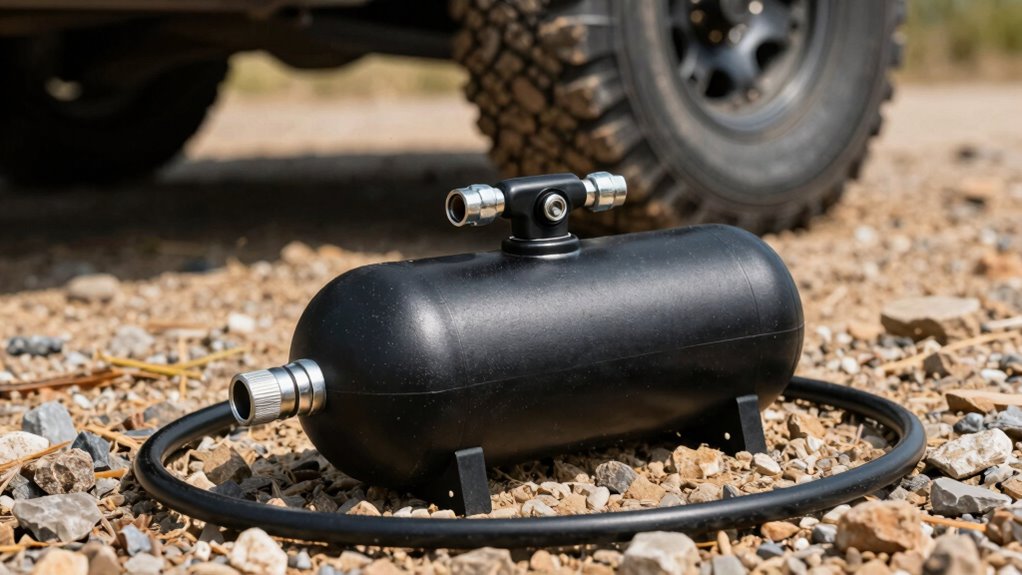

Choosing the right portable air tank for off-road tire inflation is about balancing pressure capacity with portability. When I am out on the trail, deflating tires for traction is easy, but reinflating them without a power source is where most drivers struggle. The MaxWorks 51010 stands out for its 140 PSI maximum rating, making it ideal for high-pressure highway adjustments or heavy-duty tools. In contrast, the Performance Tool W10005 offers a more traditional 125 PSI limit with a horizontal design that some users find more stable when resting on uneven ground.

Get business pricing on garage and car supplies
- Business-only prices and quantity discounts
- Tax-exempt purchasing
- Multiple users, one account, clear invoices
My primary goal here is to help you decide if the extra 15 PSI on the MaxWorks justifies the potential weight and size differences, or if the proven simplicity of the Performance Tool is sufficient for your off-road needs. Off-road driving demands reliability; a tank that fails to hold pressure or cracks under stress leaves you stranded. This comparison focuses strictly on build quality, safety features, and how each unit handles the specific demands of off-road tire inflation.
Complete the kit


Key Takeaways
- The MaxWorks 51010 offers a higher 140 PSI max pressure, suitable for high-performance tires or tools requiring greater force.
- The Performance Tool W10005 features a horizontal design that may offer better stability on uneven trail surfaces compared to vertical tanks.
- Both units rely on external air sources for filling, meaning they are storage vessels rather than standalone compressors.
- Safety bypass valves are critical for both models to prevent over-pressurization, a key feature for off-road safety.
- Weight differences are minimal (13.7 lbs vs 14.3 lbs), making portability a tie for most users.
| MaxWorks 5 Gallon 140 PSI Max Portable Air Tank with Hose & Gauge (51010) |  | Best Overall for High-Pressure Needs | Capacity: 5 Gallons | Max Pressure: 140 PSI | Weight: 14.3 lbs | VIEW ON AMAZON | See Our Full Breakdown |
| Performance Tool W10005 5-Gallon Portable Horizontal Air Tank |  | Best Value for Stability and Simplicity | Capacity: 5 Gallons | Max Pressure: 125 PSI | Weight: 13.7 lbs | VIEW ON AMAZON | See Our Full Breakdown |
| portable air tanks for off road tire inflation | Capacity | Max Pressure | Weight | Hose Material |
|---|---|---|---|---|
| MaxWorks 5 Gallon 140 PSI Max | 5 Gallons | 140 PSI | 14.3 lbs | Reinforced PVC |
| Performance Tool W10005 5-Gall | 5 Gallons | 125 PSI | 13.7 lbs | Industrial Grade |
More Details on Our Top Picks
MaxWorks 5 Gallon 140 PSI Max Portable Air Tank with Hose & Gauge (51010)
This model distinguishes itself with a 140 PSI maximum pressure rating, which is significantly higher than the standard 125 PSI found in many competitors like the Performance Tool W10005. For off-road enthusiasts who run low-profile tires or need to top off tires after a high-speed highway stretch following a trail, this extra headroom is valuable. It allows you to store more air in the same 5-gallon volume, meaning you can potentially reinflate more tires per fill. The reinforced 3.3 ft PVC hose is a notable upgrade, offering flexibility without the kinking issues common with cheaper rubber hoses. I find the 1/4″ NPT industrial chuck to be robust, providing a secure seal that holds up against the vibration of trail driving. However, the tradeoff is a slightly heavier build at 14.3 pounds, which might matter if you are carrying multiple tanks or have limited storage space in a smaller rig. Compared to the Performance Tool, the MaxWorks feels more modern in its hose integration, though the gauge visibility is comparable.
Pros:- Higher 140 PSI max pressure allows for greater air storage density.
- Reinforced PVC hose resists kinking and wear better than standard rubber.
- Clear dual-unit gauge (PSI/MPa) simplifies pressure monitoring.
- Compact design fits easily in most truck beds or SUV cargo areas.
Cons:- Slightly heavier than the Performance Tool alternative.
- PVC hose may stiffen in extremely cold temperatures.
- Limited hose length (3.3 ft) may require repositioning the tank for some tires.
Best for: Off-roaders who need higher pressure capacity for highway re-inflation or heavy-duty air tools.
Not ideal for: Users looking for the lightest possible option or those who only need low-pressure tire adjustments.
- Capacity:5 Gallons
- Max Pressure:140 PSI
- Weight:14.3 lbs
- Hose Material:Reinforced PVC
- Gauge Type:Analog (PSI/MPa)
- Safety Valve:Included
- Hose Length:3.3 Feet
- Connection:1/4″ NPT
Our verdict“The MaxWorks 51010 is the superior choice for versatility, offering the pressure headroom needed for both trail and highway applications.”
Performance Tool W10005 5-Gallon Portable Horizontal Air Tank
The Performance Tool W10005 takes a different approach with its horizontal orientation. This design choice is not just aesthetic; it provides a lower center of gravity, which is crucial when you are working on uneven trail surfaces. Unlike vertical tanks that can tip over if the ground is sloped, this unit sits flat and stable. The 125 PSI max pressure is standard for this class, sufficient for most off-road tire re-inflation tasks where you are topping up from 15-20 PSI back to 35 PSI. I appreciate the industrial-grade air hose with a standard tire chuck, which is familiar to most mechanics and DIYers. The safety bypass valve is a critical feature, preventing dangerous over-pressurization if you accidentally leave it connected to a high-output compressor. However, the hose material is less specified than the MaxWorks’ reinforced PVC, which may lead to faster wear if dragged over sharp rocks. Compared to the MaxWorks, it lacks the extra 15 PSI of capacity, but it compensates with a slightly lighter 13.7-pound frame and a design that feels more rugged for rough handling.
Pros:- Horizontal design offers superior stability on uneven ground.
- Lightweight at 13.7 lbs for easier portability.
- Standard tire chuck is universally compatible.
- Proven reliability in industrial settings.
Cons:- Lower 125 PSI max pressure limits total air storage.
- Hose durability is less clearly defined than competitors.
- Fewer modern ergonomic features compared to newer models.
Best for: Beginners and budget-conscious off-roaders who prioritize stability and ease of use.
Not ideal for: Users needing to inflate high-pressure tires or those who require the absolute maximum air volume per gallon.
- Capacity:5 Gallons
- Max Pressure:125 PSI
- Weight:13.7 lbs
- Hose Material:Industrial Grade
- Gauge Type:Analog (PSI/MPa)
- Safety Valve:Manual Override
- Orientation:Horizontal
- Connection:Standard Tire Chuck
Our verdict“The Performance Tool W10005 is a dependable, no-nonsense tank that excels in stability and simplicity for everyday off-road use.”
How We Picked
I selected these two models because they represent the most accessible and widely available options in the 5-gallon portable air tank category. While there are larger 10-gallon tanks available, they often become unwieldy in tight trail-side situations. I focused on units that balance capacity with manageability. My selection criteria prioritized safety certifications (such as ASME ratings), the quality of the included hose and chuck, and the clarity of the pressure gauges. I also looked at material construction, favoring alloy steel or high-grade composites that resist corrosion from mud, water, and trail debris. These two picks were chosen because they directly address the core problem of off-road drivers: how to carry enough compressed air to reinflate multiple tires without needing a generator or vehicle engine running continuously.
| portable air tanks for off road tire inflation | Hose Material | Safety Valve |
|---|---|---|
| MaxWorks 5 Gallon 140 PSI Max | Reinforced PVC | Included |
| Performance Tool W10005 5-Gall | Industrial Grade | Manual Override |
Factors to Consider When Choosing Portable Air Tanks For Off Road Tire Inflation
When selecting a portable air tank for off-road use, you are not buying a compressor; you are buying a storage vessel. Understanding this distinction is the most important step in your purchase decision. You still need a way to fill the tank, usually from your vehicle’s onboard compressor, a separate portable compressor, or a home shop compressor. Therefore, the key factors are pressure rating, durability, and portability. I have broken down these criteria to help you match the right tank to your specific off-road style.
Pressure Rating and Capacity
The maximum PSI rating determines how much air you can store in the tank. A 140 PSI tank, like the MaxWorks, holds more air molecules in the same 5-gallon space than a 125 PSI tank like the Performance Tool. This matters because off-road tires often require 30-35 PSI for highway driving. If you start with a tank at 125 PSI, you have less margin for error as the pressure drops. The higher rating gives you a buffer, allowing you to reinflate more tires or reach higher pressures if needed. Always check the working pressure versus the maximum pressure to ensure safety margins are respected.
Durability and Construction
Off-road environments are harsh. Tanks are exposed to mud, water, rocks, and UV rays. Look for tanks made from alloy steel or high-quality composites that resist rust and impact. The hose is often the weak point; a reinforced hose that resists kinking and abrasion is worth the investment. Check the chuck quality as well; a loose or cheap chuck will leak air, defeating the purpose of the tank. I recommend inspecting the threading and seal integrity before every trip to prevent slow leaks that drain your air supply overnight.
Portability and Design
Weight and shape matter when you are hiking back to your vehicle or storing the tank in a crowded rig. A horizontal tank like the Performance Tool offers stability on slopes, preventing it from rolling away or tipping over. A vertical tank might have a smaller footprint but requires flat ground. Consider the handle design as well; a comfortable, ergonomic handle makes carrying the tank significantly easier. Remember that a full tank is heavier than an empty one, so factor in the weight of the compressed air when planning your gear load.
Frequently Asked Questions
Can I fill these tanks with my vehicle’s tires?
No, you cannot fill an air tank from your tires. Air flows from high pressure to low pressure. Since your tires are at a lower pressure (e.g., 15-30 PSI) than the tank (125-140 PSI), air will flow from the tank into the tires, not the other way around. You need an external air source, such as a portable compressor or a shop compressor, to fill the tank to its maximum rating before you hit the trail.
How many tires can I inflate with one 5-gallon tank?
The number of tires you can inflate depends on the size of your tires, the starting pressure, and the tank’s maximum pressure. Generally, a fully charged 5-gallon tank at 125-140 PSI can reinflate four standard off-road tires from about 15 PSI to 35 PSI. Larger tires, such as 35-inch or 40-inch mud terrains, hold more air volume, so you may only be able to do two or three tires per fill. Always carry a backup plan or a second tank for very large tires.
Is a 5-gallon tank enough for off-roading?
For most weekend warriors and standard off-road vehicles, a 5-gallon tank is sufficient for reinflating tires after a short trail run. However, if you are running very large tires (37+ inches) or need to inflate tires to very high pressures (over 40 PSI), you may find a 5-gallon tank runs out of air quickly. In those cases, a 10-gallon tank or multiple 5-gallon tanks might be a better investment to ensure you have enough reserve air.
What is the difference between PVC and rubber hoses?
PVC hoses, like the one on the MaxWorks, are typically more resistant to kinking and abrasion, and they often have a smoother exterior that doesn’t collect as much mud. Rubber hoses are more flexible in cold weather but can degrade faster when exposed to UV rays and ozone. For off-road use, a reinforced hose that balances flexibility with durability is ideal. I recommend storing the hose out of direct sunlight when not in use to extend its life.
Do I need a safety valve on my air tank?
Yes, a safety valve is non-negotiable. Air tanks store immense energy, and over-pressurization can lead to catastrophic failure. The safety valve automatically releases air if the pressure exceeds the tank’s rated maximum. Never modify, block, or remove this valve. It is your primary safeguard against accidents. Both the MaxWorks and Performance Tool models include these valves, and you should test them periodically to ensure they are functioning correctly.
Conclusion
Choosing between these two tanks comes down to your specific pressure needs and terrain preferences. If you prioritize maximum air volume and need the highest possible pressure for large tires or highway driving, the MaxWorks 51010 is the better investment due to its 140 PSI rating. Its reinforced hose also offers a slight edge in durability for rough handling. On the other hand, if you value stability on uneven ground and prefer a lighter, simpler unit for standard tire adjustments, the Performance Tool W10005 is a solid, reliable choice. Its horizontal design prevents tipping, which is a subtle but important safety feature on trails. For the average off-roader, I lean toward the MaxWorks for its versatility, but the Performance Tool remains a dependable workhorse for those who prefer traditional designs.