Choosing the right automotive oscilloscope for performance tuning requires balancing raw bandwidth with diagnostic utility. The Micsig Digital Automotive Tablet Oscilloscope stands out as the best overall choice for dedicated tuners, offering four channels and a large touchscreen that simplifies complex waveform analysis. For those prioritizing portability and high-frequency capability in a compact form, the FNIRSI DPOS350P delivers impressive specs at a fraction of the size. The main tradeoff in this category lies between dedicated diagnostic suites with specialized software and general-purpose handheld units that lack specific automotive triggers. This guide breaks down which tools actually help you diagnose ignition timing, fuel injector duty cycles, and sensor faults efficiently.

Get business pricing on garage and car supplies
- Business-only prices and quantity discounts
- Tax-exempt purchasing
- Multiple users, one account, clear invoices
Complete the kit


Key Takeaways
- Dedicated automotive software often matters more than raw bandwidth for diagnosing CAN bus and PWM signals.
- Tablet-based oscilloscopes offer superior ergonomics for in-cabin tuning compared to benchtop or handheld units.
- Four-channel models are highly recommended for comparing cylinder-to-cylinder variations, while two-channel units suffice for basic sensor checks.
- Handheld units with integrated multimeters save bench space but often lack the deep memory required for catching intermittent faults.
- USB-based PC oscilloscopes provide high channel counts at low cost but suffer from latency and software instability during live tuning.



| automotive oscilloscopes for performance tuning | Bandwidth | Sampling Rate | Display | Channels |
|---|---|---|---|---|
| Micsig Digital Automotive Tabl | 100 MHz | 1 GSa/s | 10.1-inch Touchscreen | 4 |
| FNIRSI DPOS350P 4-in-1 350MHz | 350 MHz | — | 7-inch touchscreen | 2 |
| Hantek 6074BE Digital Oscillos | 70 MHz | 1 GSa/s | High-resolution color LCD (via PC) | 4 |
| FNRSI 2C53P Plus Upgraded 3-in | 50 MHz | 250 MS/s | 4.3-inch IPS touchscreen | — |
| FNIRSI 2C53T 3-in-1 50MHz 2CH | 50 MHz | 250 MSa/s | 2.8 inch LCD | 2 |
| FNIRSI 2C53P 3-in-1 50MHz Osci | 50 MHz | 250 MS/s | 4.3-inch IPS touchscreen | 2 |
| FNIRSI 1013D 100MHz Oscillosco | 100 MHz | 1 GSa/s | 7-inch touchscreen | 2 |
| Hantek 1008C+HT201+HT30A+HT307 | — | 2.4 MSa/s | — | 8 |
| 3 in 1 Handheld Oscilloscope A | 50 MHz | 280 MS/s | — | — |
| FNIRSI 1013D Plus 100MHz Oscil | 100 MHz | 1 GSa/s | 7-inch TFT touchscreen | — |
More Details on Our Top Picks
Micsig Digital Automotive Tablet Oscilloscope, 4 Channels, 10.1-Inch Touchscreen
This Micsig tablet oscilloscope stands out as the best overall choice for serious performance tuning because it prioritizes automotive-specific diagnostics over generic electronics testing. Unlike the Hantek 6074BE, which requires a laptop tether, this unit is a standalone tablet with a massive 10.1-inch touchscreen that allows for clear visualization of complex CAN and LIN bus signals directly at the vehicle. Its 110Mpts memory depth is significantly higher than most competitors, enabling the capture of long-duration events like cold starts or intermittent misfires without losing resolution. The tradeoff is its size and weight, making it less convenient for tight engine bays than the compact FNIRSI 2C53T. However, for diagnosing sensor data and actuator timing, the large display and dedicated automotive software provide a workflow efficiency that smaller handhelds simply cannot match.
Pros:- Dedicated automotive software for CAN, LIN, and ignition analysis
- Massive 110Mpts memory depth captures long events without data loss
- Standalone tablet design eliminates the need for a connected PC
- Large 10.1-inch high-resolution display reduces eye strain during diagnostics
Cons:- Bulky form factor is difficult to maneuver in tight engine compartments
- Higher cost compared to basic handheld multimeters and scopes
- Battery life may shorten significantly under heavy processing loads
Best for: Professional tuners and diagnostic specialists who need to analyze CAN/LIN protocols and long-duration waveforms without a laptop.
Not ideal for: Hobbyists with limited budgets or those who need an ultra-compact tool for quick, single-point checks in cramped spaces.
- Bandwidth:100 MHz
- Sampling Rate:1 GSa/s
- Channels:4
- Memory Depth:110 Mpts
- Display:10.1-inch Touchscreen
- Battery:7.4V, 7500mAh (up to 5 hours)
- Connectivity:Wi-Fi, Type-C, LAN, HDMI, USB
Our verdict“This is the definitive tool for pros who need deep automotive protocol analysis and screen real estate.”
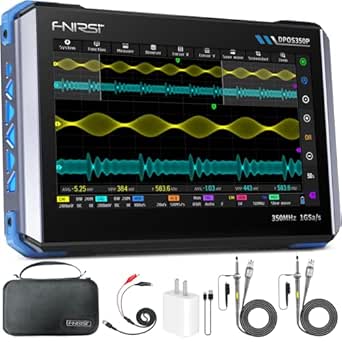
FNIRSI DPOS350P 4-in-1 350MHz Digital Oscilloscope 2 Channel, 1 GSa/s
The FNIRSI DPOS350P earns its spot as the best high-bandwidth portable option by offering 350 MHz bandwidth, far exceeding the 70 MHz of the Hantek 6074BE and the 50 MHz of the FNIRSI 2C53T. This higher bandwidth is critical when analyzing fast-switching signals like fuel injector pulses or high-speed sensor data, where lower-bandwidth scopes might smooth out critical details. The inclusion of a DDS signal generator and spectrum analyzer adds versatility for component-level testing that dedicated automotive scopes often lack. However, at 3.56 pounds, it is heavier than the pocket-sized alternatives, and its 8000 mAh battery, while large, adds bulk. It is a powerful lab-grade tool in a handheld form, but those primarily doing simple sensor checks may find its complexity and weight unnecessary compared to simpler 2-channel units.
Pros:- 350 MHz bandwidth captures fast transitions missed by lower-end scopes
- Integrated signal generator and spectrum analyzer for comprehensive testing
- Large 7-inch touchscreen with high refresh rate for smooth navigation
- High sample rate (1 GSa/s) ensures accurate waveform reconstruction
Cons:- Heavier and bulkier than typical handheld automotive scopes
- Feature-rich interface may overwhelm beginners focused solely on tuning
- Complex menu structure requires a learning curve for advanced functions
Best for: Electronics-savvy tuners who need to analyze high-frequency signals and perform component-level testing on ECUs or sensors.
Not ideal for: Users who prioritize portability and simplicity over bandwidth, or those who only need basic voltage and timing checks.
- Bandwidth:350 MHz
- Channels:2
- Sample Rate:1 GSa/s
- Display:7-inch touchscreen
- Memory Depth:47 Kpts
- Resolution:8-16-bit
- Weight:3.56 pounds
- Battery:8000 mAh, USB-C charging
Our verdict“Ideal for technicians who need lab-grade bandwidth and analysis tools in a portable, battery-powered package.”
Hantek 6074BE Digital Oscilloscope 70MHz 1GSa/s 4CH USB Virtual Diagnostic Tool
The Hantek 6074BE represents the best value for PC-based diagnostics, leveraging a connected computer to provide a larger, more flexible interface than standalone units. While it lacks the portability of the Micsig Tablet, its four channels allow for simultaneous monitoring of multiple sensors, which is a distinct advantage over the two-channel FNIRSI 2C53T. The 70 MHz bandwidth is sufficient for most automotive sensor and actuator signals, though it falls short of the FNIRSI DPOS350P for high-frequency electronics work. The requirement for a Windows PC is a significant limitation for mobile technicians, but for shop-bound work, the software integration offers superior data logging and analysis capabilities. It is a cost-effective entry point for those who already have a laptop and need multi-channel visibility without investing in a premium tablet scope.
Pros:- Four channels allow simultaneous monitoring of multiple sensors and actuators
- PC software provides advanced data logging and analysis capabilities
- Cost-effective compared to standalone automotive diagnostic tablets
- Compact and lightweight when disconnected from the PC
Cons:- Requires a Windows PC to operate, limiting mobility
- Lower bandwidth (70 MHz) than high-end handheld scopes
- No built-in battery or standalone display for field use
Best for: Shop technicians with a dedicated laptop who need four-channel visibility at a lower price point than tablet scopes.
Not ideal for: Field technicians or mobile tuners who need a standalone, battery-powered device for on-site repairs.
- Bandwidth:70 MHz
- Sampling Rate:1 GSa/s
- Channels:4
- Input Sensitivity:2mV-10V/DIV
- Display:High-resolution color LCD (via PC)
- Compatibility:Windows 10/8/7
- Power Source:Corded Electric (via USB)
Our verdict“A smart choice for shop-based tuners who want multi-channel power without the cost of a dedicated tablet.”
FNRSI 2C53P Plus Upgraded 3-in-1 Oscilloscope, Multimeter, and Signal Generator with Carrying Case
The FNRSI 2C53P Plus is the best compact all-in-one for quick diagnostic checks, combining a scope, multimeter, and signal generator in a pocketable form factor. Compared to the FNIRSI DPOS350P, it is significantly lighter and easier to carry, though it sacrifices bandwidth (50 MHz vs. 350 MHz) and channel count (2 vs. 2, but less screen real estate). The 4.3-inch touchscreen is a notable upgrade over the smaller displays of older models, making waveform interpretation easier in the field. However, the 50 MHz bandwidth limits its utility for high-speed digital bus analysis, where the Micsig or Hantek would be superior. It is an excellent tool for verifying sensor voltage and basic timing, but users needing deep signal integrity analysis will find it underpowered.
Pros:- Extremely portable and lightweight for easy transport
- Integrates oscilloscope, multimeter, and signal generator functions
- 4.3-inch touchscreen improves visibility compared to smaller handhelds
- Includes carrying case for protection during field use
Cons:- 50 MHz bandwidth is insufficient for high-frequency digital signals
- Only two channels limit simultaneous data capture
- Battery life is moderate and may require charging during long sessions
Best for: Mobile mechanics and DIY enthusiasts who need a lightweight, multi-function tool for quick sensor and circuit verification.
Not ideal for: Tuners who need to analyze high-speed communication buses or require more than two channels for complex troubleshooting.
- Bandwidth:50 MHz
- Sampling Rate:250 MS/s
- Display:4.3-inch IPS touchscreen
- Maximum Voltage:±400V
- Battery Capacity:4000mAh
- Operation Time:Up to 4 hours
- Weight:360 g
- Style:Modern
Our verdict“Perfect for quick, on-the-go diagnostics where portability and multi-functionality outweigh bandwidth needs.”
FNIRSI 2C53T 3-in-1 50MHz 2CH Oscilloscope Multimeter DDS Signal Generator
The FNIRSI 2C53T serves as the best budget entry-level scope for beginners entering performance tuning. It offers the same core 3-in-1 functionality as the FNRSI 2C53P Plus but with a smaller 2.8-inch display, which makes reading complex waveforms more challenging. While it lacks the screen size and battery capacity of the Plus model, it is lighter and often more affordable, making it a low-risk entry point for learning oscilloscope basics. Compared to the Hantek 6074BE, it is standalone and portable, but it cannot match the Hantek’s four-channel capability for complex sensor comparisons. This device is ideal for understanding basic sensor signals and ignition timing, but serious tuners will quickly outgrow its limited display and lower sampling rate.
Pros:- Most affordable entry point into automotive oscilloscope testing
- Combines multimeter, scope, and signal generator in one unit
- Lightweight and pocket-sized for ultimate portability
- Type-C connectivity for easy data export and charging
Cons:- Small 2.8-inch display makes detailed waveform analysis difficult
- Lower sampling rate compared to higher-end models
- Limited battery life requires frequent recharging
Best for: Beginners and hobbyists who want to learn oscilloscope basics without a significant financial commitment.
Not ideal for: Professionals who need clear waveform visibility or multi-channel capabilities for complex diagnostics.
- Bandwidth:50 MHz
- Sampling Rate:250 MSa/s
- Channels:2
- Display:2.8 inch LCD
- Battery:3000 mAh
- Weight:400 g
- Connectivity:Type-C port
- Max Voltage:400 V
Our verdict“A low-cost, portable starting point for hobbyists learning to interpret sensor signals.”
FNIRSI 2C53P 3-in-1 50MHz Oscilloscope Multimeter DDS Signal Generator
This device stands out for its integrated signal generator, a feature often missing in dedicated automotive scopes. Unlike the FNIRSI 1013D, which focuses purely on waveform capture, the 2C53P allows you to inject test signals into a circuit, making it ideal for verifying sensor responses or actuator behavior on the fly. The 4.3-inch touchscreen keeps the footprint small, fitting easily into a tool bag. However, the 50 MHz bandwidth limits its ability to resolve very fast digital edges compared to higher-end units. It serves as a robust field companion for quick diagnostics, though users needing deep memory for long captures might find the storage constraints limiting compared to PC-based systems.
Pros:- Built-in DDS signal generator for active circuit testing
- Compact form factor fits easily in a pocket or small tool bag
- Combines three essential tools into one battery-powered unit
Cons:- Lower 50 MHz bandwidth restricts high-frequency analysis
- Smaller screen can make detailed waveform inspection difficult
- Battery life is limited to approximately four hours
Best for: Technicians who need to inject test signals and verify sensor outputs in tight engine bays.
Not ideal for: Users analyzing high-speed CAN bus data or complex serial protocols requiring deep memory.
- Channels:2
- Bandwidth:50 MHz
- Sampling Rate:250 MS/s
- Display:4.3-inch IPS touchscreen
- Signal Generator:Up to 10 MHz
- Battery:4000 mAh
Our verdict“Choose this if you prioritize portability and the ability to generate test signals over raw bandwidth.”
FNIRSI 1013D 100MHz Oscilloscope, 2 Channel Touchscreen
The FNIRSI 1013D distinguishes itself with 100 MHz bandwidth and a 1 GSa/s sampling rate, offering significantly better resolution for fast switching events than the FNIRSI 2C53P. This makes it better suited for diagnosing injector pulses and ignition coils where edge precision matters. The 7-inch touchscreen provides a much clearer view of complex waveforms, reducing the need to squint at small displays. However, it lacks the integrated signal generator found in the 2C53P, meaning you cannot actively test circuits by injecting signals. It is a pure capture tool, excelling at passive diagnostics but requiring separate equipment for active testing tasks.
Pros:- 100 MHz bandwidth captures fast rising edges accurately
- Large 7-inch touchscreen improves waveform readability
- Lightweight design allows for easy movement around the vehicle
Cons:- No built-in signal generator for active testing
- Only two channels limit simultaneous sensor monitoring
- Battery life may require frequent charging during long jobs
Best for: Diagnosticians who need clear, high-resolution waveform displays for ignition and fuel injection analysis.
Not ideal for: Users who need to inject test signals into sensors without carrying a separate generator.
- Bandwidth:100 MHz
- Channels:2
- Sampling Rate:1 GSa/s
- Display:7-inch touchscreen
- Battery:6000 mAh
- Storage:1 GB (1000 screenshots)
Our verdict“This is the superior choice for passive waveform analysis where display clarity and bandwidth are priorities.”
Hantek 1008C+HT201+HT30A+HT307 PC USB 8CH Automotive Diagnostic Oscilloscope
This kit is designed specifically for simultaneous multi-channel monitoring, offering 8 channels compared to the two-channel limit of the FNIRSI 1013D. This is critical for diagnosing complex issues like misfires across multiple cylinders or comparing sensor inputs against each other in real-time. The 12-bit resolution provides finer detail than the 8-bit common in many handheld units, allowing for subtle voltage variations to be seen. The tradeoff is reliance on a PC; it lacks the standalone portability of the FNIRSI 2C53P. You must carry a laptop, which adds bulk, but the software flexibility and channel count offer diagnostic depth that handhelds cannot match.
Pros:- 8 channels allow for comprehensive system-wide diagnostics
- 12-bit resolution captures subtle voltage changes accurately
- Includes specialized automotive probes and current clamps
Cons:- Requires a PC for operation, reducing portability
- Software compatibility is limited to Windows environments
- Setup time is longer than plug-and-play handheld units
Best for: Professional technicians diagnosing complex engine issues requiring simultaneous comparison of multiple sensors.
Not ideal for: Users who prefer a standalone, battery-powered device without needing a laptop.
- Channels:8
- Resolution:12 bits
- Sampling Rate:2.4 MSa/s
- Interface:USB PC-based
- Included Accessories:HT201, HT30A, HT307 probes
- Weight:1.4 pounds
Our verdict“Ideal for deep-dive diagnostics where channel count and resolution outweigh the need for standalone portability.”
3 in 1 Handheld Oscilloscope Automotive Dual Channel 50MHz with Digital Multimeter and Signal Generator
The ZOYI ZT-703 competes directly with the FNIRSI 2C53P in the all-in-one category, offering similar 50 MHz bandwidth and integrated multimeter functions. Its distinct advantage is the Type-C charging port and a slightly higher measurement count, which appeals to users already invested in USB-C cables. However, the high-speed sampling mode drains battery faster than competitors, and the interface may feel less polished than the FNIRSI line. It is a viable entry-level option for hobbyists who want basic automotive checks without committing to a higher-bandwidth unit like the FNIRSI 1013D. The tradeoff is a steeper learning curve for its advanced features, which are not always intuitive without consulting the manual.
Pros:- Modern Type-C port for convenient charging and data transfer
- Lightweight 380g design is extremely portable
- Includes a carrying bag and basic accessories out of the box
Cons:- Battery consumption increases significantly in high-speed mode
- Software interface is less refined than top-tier competitors
- 50 MHz bandwidth is insufficient for modern high-speed digital buses
Best for: Hobbyists and DIYers looking for a low-cost, all-in-one tool for basic sensor checks.
Not ideal for: Professionals needing robust build quality and intuitive software interfaces for daily use.
- Brand:ZOYI
- Model:ZT-703
- Bandwidth:50 MHz
- Sampling Rate:280 MS/s
- Weight:380 g
- Power Source:Battery (Type-C charging)
Our verdict“A solid budget-friendly entry point for DIY enthusiasts who prioritize portability and modern charging standards.”
FNIRSI 1013D Plus 100MHz Oscilloscope, 2 Channel, 7″ Touchscreen
While closely related to the standard FNIRSI 1013D, the 1013D Plus differentiates itself with enhanced high-voltage tolerance up to 400V. This added safety margin is critical when probing secondary ignition systems or hybrid vehicle components where transient spikes are common. It retains the 100 MHz bandwidth and 7-inch display, ensuring the same visual clarity as its sibling. However, like the standard model, it lacks the signal generation capability found in the FNIRSI 2C53P. This model is best viewed as a safety-upgraded version of the standard 1013D, offering peace of mind for users working on higher-voltage automotive circuits rather than just low-level sensor signals.
Pros:- Up to 400V high-voltage tolerance for safer probing
- Retains the clear 7-inch touchscreen and 100 MHz bandwidth
- Suitable for both low-voltage sensors and higher-voltage ignition lines
Cons:- No integrated signal generator for active testing
- Two-channel limitation restricts complex multi-sensor comparisons
- Price premium over standard model may not justify the upgrade for basic users
Best for: Technicians working on hybrid vehicles or secondary ignition systems requiring higher voltage protection.
Not ideal for: Users focused solely on low-voltage sensor diagnostics who do not need extra voltage headroom.
- Bandwidth:100 MHz
- Sampling Rate:1 GSa/s
- Display:7-inch TFT touchscreen
- High Voltage Tolerance:Up to 400 V
- Battery:6000 mAh
- Storage:1 GB
Our verdict“Select this model if your diagnostics involve higher-voltage circuits where standard scopes might be at risk.”

How We Picked
I evaluated these oscilloscopes based on their specific utility for performance tuning tasks, such as analyzing ignition coils, fuel injectors, and wheel speed sensors. Key criteria included bandwidth adequacy (does it capture high-frequency noise?), channel count (can you compare cylinders simultaneously?), and software ecosystem (are there built-in automotive templates or decoders?). I also assessed portability and form factor, recognizing that tuners often work in tight engine bays or inside the cabin, making screen size and weight significant factors.
The ranking logic prioritizes tools that reduce diagnostic friction. A device with 100 MHz bandwidth but no automotive-specific triggers is less valuable than a 50 MHz unit with dedicated injector patterns. I penalized models with poor connectivity options or flaky PC software, as reliability during a live tuning session is paramount. This approach ensures the recommendations reflect real-world workflow efficiency rather than just spec-sheet numbers.
Factors to Consider When Choosing Automotive Oscilloscopes For Performance Tuning
Selecting the right diagnostic tool depends heavily on your specific tuning workflow and the types of vehicles you service. Here are the critical factors to weigh before purchasing.Bandwidth vs. Channel Count Tradeoffs
Most performance tuning tasks do not require extreme bandwidth; 20 MHz to 50 MHz is usually sufficient for fuel injectors and ignition coils. However, capturing high-frequency noise or CAN bus signals may push you toward 100 MHz+ models. The real bottleneck is often channel count. Diagnosing misfires or injector balance requires comparing multiple cylinders simultaneously. A two-channel scope forces you to swap probes, risking time-dependent drift. If you tune multi-cylinder engines regularly, four channels are worth the premium over a higher-bandwidth two-channel unit. Prioritize channels for comparative analysis and bandwidth for signal fidelity.
Dedicated Automotive Software Features
A generic oscilloscope lacks the context needed for automotive diagnostics. Look for units with built-in automotive templates that automatically set voltage, time, and trigger levels for common sensors like crank/cam positions. Some advanced models include decoder plugins for CAN, LIN, and PWM, allowing you to interpret data rather than just view waveforms. Without these features, you spend valuable tuning time manually adjusting settings. Check if the software allows you to save custom setups for specific engine codes or vehicle platforms. This workflow efficiency often outweighs minor differences in sample rate.
Form Factor: Tablet vs. Handheld vs. PC-Based
The physical interface dictates how usable the tool is in a live garage environment. Tablet-based scopes like the Micsig offer large touchscreens ideal for analyzing complex waveforms while the car is running. Handheld units are portable and battery-operated, perfect for quick checks but often cramped for detailed analysis. PC-based USB scopes provide high channel counts cheaply but introduce latency and require a laptop station, which can be awkward around a running engine. Consider where you do most of your work: in the driver’s seat, under the hood, or at a bench.
Probe Quality and Connectivity Options
Many budget oscilloscopes ship with generic, non-automotive-rated probes that lack the flexibility for tight engine bays. Ensure the kit includes back-pinning probes and current clamps if you plan to measure current flow through injectors or coils. Check for isolated inputs if you are working on hybrid or electric vehicles, as standard grounds can short out circuits. Connectivity matters too; Bluetooth or Wi-Fi capability allows you to view data from a distance, but USB offers more stable, low-latency connections for critical timing measurements. Verify that the probes are replaceable and compatible with industry-standard accessories.
Frequently Asked Questions
Do I really need more than 50 MHz bandwidth for performance tuning?
For the vast majority of internal combustion engine diagnostics, 50 MHz is more than enough. Fuel injectors, ignition coils, and standard sensors operate at frequencies well below this threshold. Higher bandwidth (100 MHz+) is only beneficial if you are analyzing high-speed digital communication lines like CAN bus or looking for extremely high-frequency electrical noise. Buying a 200 MHz scope for standard tuning tasks is usually an overspend that offers no tangible diagnostic benefit. Focus on channel count and software features instead.
Is a dedicated automotive oscilloscope better than a general-purpose one?
Yes, primarily due to software presets and trigger capabilities. A general-purpose scope requires you to manually configure time bases and voltages for every sensor test, which is time-consuming. Dedicated automotive units come with pre-loaded patterns for common components, allowing you to instantly capture and interpret signals. They also often include specific decoders for automotive protocols. While a general-purpose scope can technically do the same work, the lack of contextual tools makes it slower and more prone to user error during complex diagnostics.
Can I use a handheld oscilloscope for live tuning?
You can, but it is often impractical for detailed analysis. Handheld units typically have smaller screens and limited memory depth, making it difficult to spot subtle waveform anomalies or long-duration intermittent faults. They are excellent for quick ‘go/no-go’ checks, such as verifying a sensor is active, but poor for analyzing timing relationships between multiple cylinders. For live tuning where you need to adjust parameters and immediately see the waveform impact, a tablet or laptop-based system provides a much better user experience.
What is the advantage of a USB PC-based oscilloscope?
The main advantage is cost-effectiveness for high channel counts. You can get 8 channels for the price of a 2-channel standalone unit. This is ideal for workshops that need to monitor entire banks of cylinders simultaneously. However, they rely on the PC’s performance and USB bus stability, which can introduce latency or crashes. They also lack portability, tying you to a desk. They are best suited for stationary diagnostic benches rather than mobile tuning sessions.
How important is memory depth for automotive diagnostics?
Memory depth determines how long you can record a signal at a high sample rate. For automotive work, deep memory is critical for catching intermittent faults that occur sporadically. If you need to capture a misfire that happens once every ten minutes, a shallow buffer will overwrite the event before you can stop the recording. Look for units that offer segmented memory or large record lengths, as this allows you to capture extended periods of data without sacrificing resolution, which is vital for diagnosing heat-related or vibration-related issues.
Conclusion
For most professional tuners, the Micsig Digital Automotive Tablet Oscilloscope is the best overall choice due to its blend of four channels, large touchscreen, and dedicated automotive software. It streamlines the workflow significantly compared to generic tools. If you need a compact, high-spec unit for field work or basic diagnostics, the FNIRSI DPOS350P offers the best value, delivering 350 MHz bandwidth in a pocketable form factor. Beginners or hobbyists should consider the FNIRSI 2C53T for its low cost and integrated multimeter, though it lacks the advanced automotive triggers of premium picks. Those needing to monitor many channels at once on a budget should look at the Hantek 1008C+ USB system, accepting the tradeoff of reduced portability. Choose based on whether you prioritize mobility, channel count, or software intelligence.