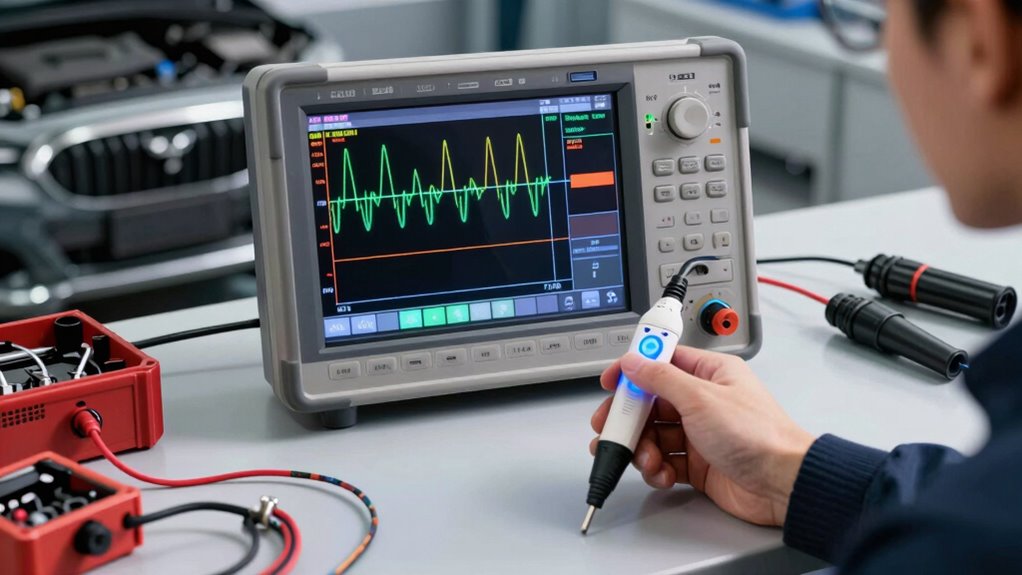
The best overall automotive oscilloscope diagnostic kit in this roundup is the OWON VDS3104, which pairs four scope channels plus an auxiliary channel with 100 MHz bandwidth and a long record length. The Hantek 1008C+ kit stands out for capturing multiple vehicle signals at once, while the Hantek 2D82 Auto Kit suits technicians who want a portable scope and multimeter in one unit. The main tradeoff is between PC-based kits, which can offer more channels and detailed analysis, and handheld models, which are easier to carry and use at the vehicle. Bandwidth, included accessories, and compatibility with your computer and diagnostic workflow also separate these options. Read on for the full comparison and guidance on choosing the right kit for your work.

Get business pricing on garage and car supplies
- Business-only prices and quantity discounts
- Tax-exempt purchasing
- Multiple users, one account, clear invoices
Complete the kit



Key Takeaways
- The OWON VDS3104 leads for broad diagnostic capability: its four scope channels, auxiliary channel, 100 MHz bandwidth, and 5 M record length suit more demanding multi-signal work than basic kits.
- The Hantek 1008C+ kit is the standout for channel count: eight channels can help correlate several inputs, but its PC-based setup is less convenient than a handheld instrument.
- The Hantek 2D82 Auto Kit trades bench-style capacity for mobility: its integrated multimeter and signal source make it a practical choice when a technician wants multiple tools in one portable unit.
- Several listings overlap by model: the DSO3064 appears in multiple entries, as do the Hantek 6074BE and 1008C family, so buyers should compare the exact included probes, leads, and accessories rather than relying on the title alone.
- More bandwidth or channels do not automatically make a better automotive kit: match those specifications to the signals you plan to capture, and weigh them against software setup, computer needs, and portability.




| automotive oscilloscope diagnostic kit | Channels | Bandwidth | Sampling rate | Weight |
|---|---|---|---|---|
| Autel MP608 4-Channel Automoti | 4 | 20 MHz | 80 MS/s | 1.2 lb |
| Hantek 6074BE Digital Oscillos | 4 | 70 MHz | 1 GSa/s | — |
| Hantek 4 in 1 Automotive Diagn | 2 | — | — | — |
| Hantek 4CH Automotive USB Osci | 4 | 60 MHz | 200 MS/s | 0.5 kg |
| Hantek 1008C+ HT201+ HT30A+ HT | 8 | — | 2.4 MSa/s | 1.4 lb |
| Hantek 6074BE 4-Channel 70MHz | 4 | 70MHz | 1GSa/s | — |
| Hantek 4CH Automotive USB Osci | 4 | 60MHz | 200MS/s | 0.5kg |
| Hantek 2D82 Auto Kit I/II/III | — | 80MHz | — | — |
| 4CH Automotive Oscilloscope Ki | 4 | 60MHz | 200MS/s | 8.82 pounds |
| OWON VDS3104 PC Oscilloscope w | 4+1 multifunction channels | 100MHz | — | — |
| Hantek 1008C PC USB 8CH Automo | 8 | — | — | 0.5 kg |
More Details on Our Top Picks
Autel MP608 4-Channel Automotive Oscilloscope, USB Portable Digital Scope
The MP608 is the strongest fit here for technicians who want automotive-focused guidance alongside four-channel waveform capture. Its 12-bit vertical resolution can help distinguish small signal changes, while the built-in preset diagnostics and waveform library offer a starting point for troubleshooting rather than requiring every test to begin from scratch. Compared with the Hantek 6074BE, it emphasizes vehicle protocols and Autel scanner compatibility over higher bandwidth and sampling speed. That makes it a more tailored choice for vehicle work, but not the fastest option in this group: its 20 MHz bandwidth and 80 MS/s rate may limit headroom for faster signals. It can run on Windows as a standalone scope, though getting the most from it still calls for familiarity with scope setup and waveform interpretation.
Pros:- Four channels support comparing multiple vehicle signals at once.
- 12-bit vertical resolution helps show finer signal variations.
- Preset diagnostics and a waveform library can speed up common troubleshooting.
- Windows standalone operation and Autel scanner compatibility suit an automotive workflow.
Cons:- 20 MHz bandwidth and 80 MS/s sampling rate trail the Hantek 6074BE and DSO3064.
- Getting reliable results still requires knowledge of probing and waveform interpretation.
- The listed 12-month warranty is limited to one year.
Best for: Automotive technicians who want four-channel testing, guided waveform references, and compatibility with Autel scanners.
Not ideal for: Buyers diagnosing higher-frequency electronics or prioritizing maximum bandwidth and sampling speed; the Hantek 6074BE offers more headroom.
- Channels:4
- Bandwidth:20 MHz
- Sampling rate:80 MS/s
- Vertical resolution:12-bit
- Voltage range:±50 mV to ±200 V
- Memory depth:32M
- Compatibility:Windows 10/11; Autel scanners
- Weight:1.2 lb
- Warranty:12 months
Our verdict“Choose the MP608 if guided, vehicle-oriented diagnostics matter more to you than the higher bandwidth offered by the Hantek 6074BE.”
Hantek 6074BE Digital Oscilloscope 70MHz 1GSa/s 4CH USB Virtual Diagnostic Tool
The Hantek 6074BE stands out for buyers who want four channels with 70 MHz bandwidth and 1 GSa/s sampling in a PC-based setup. That combination gives it more capture headroom than the Autel MP608 and the Hantek DSO3064, which can help when examining quicker-changing signals or comparing several traces. Automatic measurements and waveform recording add useful analysis tools, while its multimeter and waveform-generator functions broaden its role beyond basic scope capture. The tradeoff is a Windows-dependent USB workflow: unlike the handheld Hantek 2D82 III, it is not a self-contained instrument for moving around a vehicle. Its listed resolution and screen-size details are unusual for a PC scope, so buyers should confirm the intended display arrangement and software requirements before choosing it.
Pros:- 70 MHz bandwidth and 1 GSa/s sampling exceed the MP608 and DSO3064 figures.
- Four channels allow simultaneous comparison of several signals.
- Automatic measurements and waveform recording support analysis and documentation.
- Multiple instrument functions add flexibility for electronics testing.
Cons:- Requires a Windows PC and USB connection to operate.
- Bulkier PC-based setup is less convenient for portable vehicle-side work than the Hantek 2D82 III.
- The listed 70 MHz bandwidth still sets a ceiling for higher-frequency testing.
Best for: Automotive and electronics technicians who already use a Windows laptop and want four-channel capture with higher bandwidth and sampling speed.
Not ideal for: Mobile technicians who need a standalone handheld display, or buyers who want a scope that works without a Windows PC.
- Channels:4
- Bandwidth:70 MHz
- Sampling rate:1 GSa/s
- Input sensitivity:2 mV–10 V/div
- Compatibility:Windows 7/8/10
- Power source:Corded electric
- Display resolution:1600 × 1200
Our verdict“Pick the 6074BE if your priority is fast, four-channel capture at a Windows workstation rather than standalone portability.”
Hantek 4 in 1 Automotive Diagnostic USB Oscilloscope 2 Channel 80MHz Signal Generator Handheld Digital Multimeter Kit
The Hantek 2D82 III is the most portable choice in this group, combining a handheld oscilloscope, signal source, and multimeter in a battery-powered body with a color LCD. That makes it better suited to quick checks at the vehicle than the USB-dependent Hantek 6074BE or DSO3064, which need a Windows computer. Its compact form also means fewer separate instruments to carry for basic electrical troubleshooting. The compromise is two channels, so it cannot match the four-channel options when a diagnosis depends on comparing several signals at once. The supplied data identifies an 80 MHz signal source but does not specify the scope’s sampling rate, so buyers focused on capture performance should compare the published scope details carefully before choosing it over the MP608 or DSO3064.
Pros:- Handheld, battery-powered design is easier to bring to the vehicle than PC-based scopes.
- Combines oscilloscope, signal generator, and multimeter functions.
- Color LCD and adjustable viewing stand support on-device operation.
- Compact dimensions make it convenient for tool-bag storage.
Cons:- Two channels provide less simultaneous signal comparison than the four-channel MP608 or DSO3064.
- The provided product data does not specify a sampling rate.
- Scope operation still requires measurement skills; a compact format does not replace test knowledge.
Best for: Mobile mechanics and automotive hobbyists who want a battery-powered handheld tool for basic waveform checks, signal generation, and multimeter work.
Not ideal for: Technicians who need to compare three or more signals simultaneously or require clearly specified sampling performance for detailed scope work.
- Model:Hantek 2D82 III
- Channels:2
- Signal source:80 MHz
- Power source:Battery powered
- Minimum operating voltage:10 mV
- Functions:Oscilloscope, signal generator, multimeter, automotive diagnostics
- Dimensions:7.83 × 3.86 × 1.57 in
- Display:High-definition color LCD
Our verdict“Choose the 2D82 III for portable, multi-function checks, but opt for a four-channel kit if your diagnostics depend on comparing several traces.”
Hantek 4CH Automotive USB Oscilloscope DSO3064 Kit for Car Diagnostics
The DSO3064 occupies a useful middle ground for automotive diagnostics: its four channels, 60 MHz bandwidth, and 200 MS/s sampling offer more capture capacity than the Autel MP608, without the 6074BE’s stated 1 GSa/s rate. The built-in FFT spectrum analysis and frequency counter give technicians ways to inspect signals beyond their basic time-domain shape, making it a better fit for methodical bench or workshop analysis than quick handheld checks. Compared with the battery-powered Hantek 2D82 III, it trades portability for extra channels and analysis tools. The cost of that capability is a Windows-dependent USB setup and a learning curve for users new to waveform work. Its 10k–16M per-channel memory range also means capture depth varies by configuration.
Pros:- Four channels support concurrent comparison of multiple vehicle circuits.
- 60 MHz bandwidth and 200 MS/s sampling provide more headroom than the MP608.
- FFT spectrum analysis and a frequency counter add diagnostic tools beyond waveform viewing.
- USB 2.0 connection and listed LAN option support computer-based workflows.
Cons:- Requires a Windows computer, unlike the handheld Hantek 2D82 III.
- Advanced analysis functions may take time to learn and apply correctly.
- Per-channel memory depth varies from 10k to 16M.
Best for: Workshop technicians who need four-channel automotive signal capture plus FFT and frequency-counter analysis in a Windows-based setup.
Not ideal for: Mobile users who need a standalone screen, or beginners seeking a handheld, all-in-one instrument with simpler on-vehicle operation.
- Channels:4
- Bandwidth:60 MHz
- Sampling rate:200 MS/s
- Memory depth:10k–16M per channel
- Interface:USB 2.0
- Analysis functions:FFT spectrum analysis; frequency counter
- Weight:0.5 kg
- Warranty:1 year
Our verdict“Choose the DSO3064 if you want four-channel vehicle analysis with FFT tools and can work from a Windows-connected setup.”
Hantek 1008C+ HT201+ HT30A+ HT307 PC USB 8-Channel Automotive Diagnostic Oscilloscope
The main reason to choose this Hantek bundle is its eight-channel layout: it can monitor more circuits at once than the four-channel MP608, 6074BE, or DSO3064, which may help when tracing related signals across a complex vehicle system. The kit also supports automotive diagnostics, general-purpose scope work, and programmable signal generation, so it can serve more than one testing task at a Windows workstation. But channel count is not the same as capture speed. Its 2.4 MSa/s sampling rate and 0–250 kHz frequency range are modest beside the DSO3064 and 6074BE, so this is a specialized pick for broader, slower signal monitoring rather than the fastest waveform analysis. It also depends on a PC, unlike the handheld Hantek 2D82 III.
Pros:- Eight channels allow more simultaneous signal monitoring than the four-channel kits.
- Supports automotive diagnostics, general-purpose scope functions, and signal simulation.
- USB data transfer supports a PC-based testing workflow.
- 12-bit resolution is specified for the unit.
Cons:- 2.4 MSa/s sampling rate is substantially lower than the DSO3064 and 6074BE figures.
- Requires a Windows PC and cannot operate as a standalone instrument.
- The stated frequency range ends at 250 kHz, limiting suitability for higher-frequency work.
Best for: Technicians and electronics hobbyists who need to monitor many vehicle circuits at once and can work with Windows software.
Not ideal for: Buyers diagnosing faster signals or seeking a standalone scope; the sampling rate is lower than the Hantek DSO3064 and 6074BE, and this kit needs a PC.
- Channels:8
- Resolution:12-bit
- Memory depth:4K
- Sampling rate:2.4 MSa/s
- Frequency range:0–250 kHz
- Connection:USB
- Weight:1.4 lb
- Dimensions:7.48 × 6.57 × 1.38 in
Our verdict“Choose this kit when eight simultaneous channels matter more than high-speed capture or standalone portability.”
Hantek 6074BE 4-Channel 70MHz Automotive Oscilloscope Diagnostic Tool
The Hantek 6074BE is a strong fit for technicians who want four channels and a 1GSa/s sampling rate for capturing changing ignition, sensor, and bus signals. Its higher sampling rate gives it an advantage over the Hantek DSO3064, which is specified at 200MS/s, while the DSO3064 adds FFT analysis and optional LAN connectivity. Automatic measurements and waveform recording can reduce repetitive setup during diagnosis, though this remains a Windows-based PC tool rather than a self-contained handheld scope. Its 70MHz bandwidth is useful for broad automotive work, but the product data does not specify included probes or a battery option. I’d choose it over the OWON VDS3104 when the listed Windows compatibility and straightforward four-channel capture matter more than a larger record length or a bundled diagnostic accessory set.
Pros:- Four channels allow comparison of multiple vehicle signals at once.
- 1GSa/s sampling rate supports detailed capture of fast-changing waveforms.
- Automatic measurements and waveform recording can speed repeat diagnostic checks.
- Portable PC-based format works with Windows 7, 8, and 10.
Cons:- Requires Windows and a connected computer rather than operating as a standalone scope.
- Corded-electric power means it is not specified for battery-powered field use.
- The product data does not detail included probes or a complete automotive accessory kit.
Best for: Automotive technicians using a Windows laptop who need four-channel capture and fast sampling for ignition, sensor, and bus diagnostics.
Not ideal for: Beginners seeking a standalone, battery-powered scope or buyers who need clearly specified included automotive probes and accessories.
- Channels:4
- Bandwidth:70MHz
- Sampling rate:1GSa/s
- Input sensitivity:2mV–10V/DIV
- Compatibility:Windows 10/8/7
- Power source:Corded electric
Our verdict“Choose the 6074BE if fast four-channel capture on a Windows computer is your priority, and skip it if you need a standalone scope with a clearly documented accessory kit.”
Hantek 4CH Automotive USB Oscilloscope DSO3064 Kit for Car Diagnostics
The DSO3064 earns its place for buyers who want FFT spectrum analysis alongside conventional automotive waveform checks. Its four channels and 60MHz bandwidth suit multi-signal troubleshooting, while USB 2.0 provides the main computer connection and optional LAN can help fit a workshop setup. Compared with the Hantek 6074BE, this model has a lower listed sampling rate—200MS/s versus 1GSa/s—but its FFT feature and connectivity options give it a different diagnostic emphasis. The 10k–16M memory depth per channel offers flexibility for recording, although the data does not clarify which configurations or accessories are included. At 0.5kg it is lighter than the other DSO3064 listing, but it still depends on Windows software and is not a standalone handheld instrument.
Pros:- FFT spectrum analysis adds a way to examine signal frequency content.
- Four channels support simultaneous comparison of vehicle circuits.
- USB 2.0 is included, with LAN available as an option.
- Memory depth is specified as 10k–16M per channel.
Cons:- Its 200MS/s sampling rate is lower than the Hantek 6074BE and OWON VDS3104.
- Windows dependence limits use without a compatible computer.
- LAN is optional, and the included automotive accessories are not detailed.
Best for: Workshop technicians who use FFT to inspect signal content and want USB connectivity with the option of LAN integration.
Not ideal for: Buyers prioritizing the highest listed sample rate, a self-contained battery-powered scope, or a fully specified probe kit.
- Channels:4
- Bandwidth:60MHz
- Sampling rate:200MS/s
- Memory depth:10k–16M per channel
- Interface:USB 2.0; LAN optional
- Weight:0.5kg
- Warranty:1 year
Our verdict“Pick this DSO3064 when FFT and workshop connectivity matter more than maximum sample rate or standalone portability.”
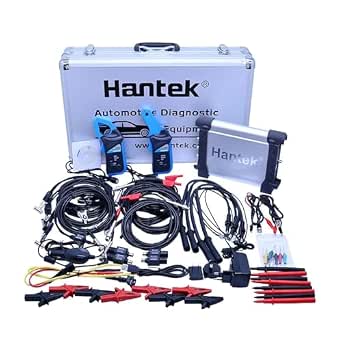
Hantek 2D82 Auto Kit I/II/III Digital Car Handheld Oscilloscope 4-in-1 + Multimeter, 80MHz Signal Source, Automotive Diagnostic, Portable
The 2D82 Auto Kit is the most self-contained choice here for buyers who want more than a PC oscilloscope: it combines an oscilloscope, multimeter, and waveform generator, with battery power and over 80 vehicle test functions listed. Video guides may help users follow diagnostic procedures without building every test from scratch. Compared with the Hantek 6074BE, it trades the 6074BE’s specified 1GSa/s sampling rate and four-channel design for an integrated handheld workflow and broader tool mix. Its 80MHz bandwidth is listed, but detailed sampling and channel specifications are absent, so I would not select it based on performance figures alone. The product data also describes a bulky form factor, which tempers its portability advantage over a laptop-connected scope.
Pros:- Combines oscilloscope, multimeter, and waveform generator functions in one device.
- Battery-powered operation supports use away from a fixed computer setup.
- Lists over 80 vehicle testing functions and includes video guides.
- 80MHz bandwidth is specified for automotive signal work.
Cons:- Sampling rate and channel count are not specified in the supplied product data.
- The stated dimensions suggest a bulkier form than a compact handheld tool.
- The range of functions may make setup less straightforward for first-time users.
Best for: Mobile technicians and vehicle owners who want a battery-powered device combining waveform checks, multimeter tasks, and guided automotive tests.
Not ideal for: Signal-analysis specialists who need clearly stated sampling rate, channel count, or multi-channel capture specifications.
- Bandwidth:80MHz
- Functions:Oscilloscope, multimeter, waveform generator
- Vehicle test functions:Over 80
- Power source:Battery powered
- Measurement type:Multimeter
- Dimensions:7.87 × 15.16 × 9.65 inches
- Warranty:2 years
- Included component:2D82 Auto Kit I
Our verdict“Choose the 2D82 when an integrated, battery-powered diagnostic tool matters more than fully documented oscilloscope performance specifications.”
4CH Automotive Oscilloscope Kit DSO3064 for Car Diagnostics, USB 2.0, 200MS/s, 60MHz Bandwidth
This DSO3064 listing is aimed squarely at vehicle troubleshooting, with stated support for CAN bus data viewing, startup diagnostics, FFT, and pass/fail checks. Four channels and 200MS/s sampling give it a useful base for comparing signals, though its speed is well below the Hantek 6074BE at 1GSa/s and the OWON VDS3104 at 1GS/s. Its stated 8–36V input range and Windows software support make the automotive focus more explicit than the general PC-scope details supplied for the other DSO3064 listing. The tradeoff is substantial: at 8.82 pounds, it is a less appealing option for frequent mobile work, and it requires a Windows computer. I’d favor this version when the listed vehicle-specific checks matter more than a lighter setup.
Pros:- Automotive-oriented functions include CAN bus viewing and startup diagnostics.
- FFT and pass/fail checks extend analysis beyond basic waveform viewing.
- Four channels support simultaneous circuit comparison.
- Input voltage range is specified as 8–36V.
Cons:- At 8.82 pounds, it is cumbersome for frequent mobile diagnostics.
- Windows software is required for operation.
- The 200MS/s sampling rate is lower than the 1GS/s models in this roundup.
Best for: Automotive repair shops that need Windows-based CAN viewing, startup checks, and pass/fail measurements in a fixed or semi-fixed workspace.
Not ideal for: Mobile technicians who carry equipment between vehicles, or users seeking a lightweight standalone scope or broader non-automotive use.
- Channels:4
- Bandwidth:60MHz
- Sampling rate:200MS/s
- Memory depth:10k–16M per channel
- Input voltage range:8–36V
- Interface:USB 2.0; LAN optional
- Weight:8.82 pounds
Our verdict“Choose this DSO3064 for its stated vehicle-specific checks in a workshop setting, but avoid it if weight or high sampling speed is a priority.”
OWON VDS3104 PC Oscilloscope with 100 MHz Bandwidth, 4+1 Channels, 1 GS/s Sample Rate, 5 M Record Length and Automotive Diagnostics Kit
The OWON VDS3104 has the strongest stated specification set in this group for a PC-based automotive kit: 100MHz bandwidth, 1GS/s sampling, and a 5M-point record length. Its supplied ignition pickup, leads, clips, attenuator, and probes also make the vehicle-testing package more explicit than the Hantek 6074BE listing, which does not detail its included accessories. Four plus one multifunction channels and several trigger modes give users flexibility when capturing and comparing signals. The compromise is 8-bit vertical resolution, which limits fine amplitude discrimination, especially for low-level signals. Compared with the handheld Hantek 2D82, the OWON favors computer-based waveform work over an integrated multimeter and battery-powered operation; its USB power helps with portability but does not make it standalone.
Pros:- 100MHz bandwidth and 1GS/s sampling support detailed signal capture.
- 5M-point record length allows longer waveform records.
- Automotive kit lists an ignition pickup, test leads, clips, attenuator, and probes.
- USB bus power and four plus one multifunction channels offer flexible setup options.
Cons:- 8-bit vertical resolution can limit precision on low-amplitude signals.
- Requires a computer and is not a standalone diagnostic instrument.
- The software interface may feel basic compared with more advanced scope platforms.
Best for: Experienced technicians who want a high-spec Windows or PC-based automotive scope with a stated set of ignition and measurement accessories.
Not ideal for: Beginners seeking a standalone handheld tool, or specialists who need higher vertical resolution for fine low-amplitude measurements.
- Bandwidth:100MHz
- Channels:4+1 multifunction channels
- Sample rate:1GS/s
- Record length:5M points
- Vertical resolution:8 bits (2 channels simultaneously)
- Trigger types:Edge, pulse, video, slope, alternate
- Acquisition modes:Auto, normal, single; sample, peak detect, average
- Power source:USB bus powered / corded electric
- Included accessories:Automotive kit with ignition pickup, test leads, clips, attenuator, and probes
Our verdict“Choose the VDS3104 for its strong capture specifications and listed automotive accessories, but skip it if you need a standalone handheld unit or finer vertical resolution.”
Hantek 1008C PC USB 8CH Automotive Diagnostic Digital Oscilloscope
The Hantek 1008C earns its place for buyers who need to monitor several vehicle signals at once: its eight channels exceed the four-channel layouts of options such as the Autel MP608 and Hantek DSO3064. That extra channel capacity can help when comparing related signals during fault tracing, while its 80-plus automotive diagnostic functions cover ignition, sensors, bus detection, and circuit tests. Video help and report generation also make it a more guided PC-based choice than a bare oscilloscope. The tradeoff is its dated software requirement: the listed Windows XP compatibility may limit use with current computers. It is also a corded USB tool, not a wireless or self-contained handheld kit, so buyers who value portability may prefer the Hantek 2D82.
Pros:- Eight channels allow simultaneous viewing of more signals than the four-channel Autel MP608 and DSO3064.
- More than 80 automotive functions cover ignition, sensor, bus, and circuit diagnostics.
- Video help and report generation support guided testing and documentation.
- Includes an auto probe and alligator clips for vehicle measurement tasks.
Cons:- Listed Windows XP operating system compatibility may be difficult to match with modern computers.
- Corded USB operation ties testing to a connected computer and does not offer listed wireless connectivity.
- PC-based format is less convenient for mobile work than a handheld option such as the Hantek 2D82.
Best for: Automotive technicians and advanced DIY users who need to compare up to eight signals and want guided vehicle-specific test functions.
Not ideal for: Users with current computers who cannot run Windows XP-compatible software, or technicians who need a wireless, standalone handheld scope.
- Brand:Hantek
- Model number:01HAN1008C
- Channels:8
- Automotive functions:Over 80, including ignition, sensor, bus detection, and circuit testing
- Computer connection:USB
- Listed operating system:Windows XP
- Power source:Corded electric
- Weight:0.5 kg
- Included accessories:Auto probe and alligator clips
Our verdict“Choose the 1008C if eight simultaneous automotive channels and built-in diagnostic guidance matter more than modern OS support or handheld portability.”

How We Picked
I ranked these automotive oscilloscope diagnostic kits by how well their stated features serve real vehicle troubleshooting, not by spec-sheet numbers alone. I weighed channel count and bandwidth alongside sampling and record capabilities where provided, since these affect how many signals can be compared and how much waveform detail can be captured. I also considered whether a kit combines a scope with tools such as a multimeter or signal source, and whether its PC-based or handheld design fits work at a bench or beside a vehicle.
The OWON VDS3104 ranks first for its balance of channels, bandwidth, and record length. The Hantek 1008C+ kit follows for multi-signal work, while the Hantek 2D82 earns a distinct place for portable, combined-tool use. Other models rank according to their stated capabilities and likely workflow fit; repeated model names are not treated as distinct technical advantages. Product listings can differ in bundle contents, so I give extra weight to buyers verifying the exact kit configuration before purchase.
| automotive oscilloscope diagnostic kit | Power source |
|---|---|
| Autel MP608 4-Channel Automoti | — |
| Hantek 6074BE Digital Oscillos | Corded electric |
| Hantek 4 in 1 Automotive Diagn | Battery powered |
| Hantek 4CH Automotive USB Osci | — |
| Hantek 1008C+ HT201+ HT30A+ HT | — |
| Hantek 6074BE 4-Channel 70MHz | Corded electric |
| Hantek 4CH Automotive USB Osci | — |
| Hantek 2D82 Auto Kit I/II/III | Battery powered |
| 4CH Automotive Oscilloscope Ki | — |
| OWON VDS3104 PC Oscilloscope w | USB bus powered / corded electric |
| Hantek 1008C PC USB 8CH Automo | Corded electric |
Factors to Consider When Choosing Automotive Oscilloscope Diagnostic Kits
Choosing among these kits starts with the diagnostic task, not the largest number on the box. I would first map the signals you need to compare, then decide whether a PC-based setup or handheld instrument fits the places you work. These factors help prevent paying for unused capacity or buying a kit that lacks the accessories and workflow your tests require.
Match Channel Count to the Signals You Need to Compare
Channel count matters most when a fault requires timing or correlation across several circuits. For a focused test, two channels may be enough to compare an input and output; tracing interactions across multiple sensors, actuators, or ignition events can call for four or more. Eight-channel options such as the Hantek 1008C family can reduce repeated captures, but they also make setup and waveform interpretation more involved. Before paying for extra channels, write down the signals you expect to measure at the same time. A kit with fewer channels may be the better choice if your routine work is limited to one subsystem. Also check whether included probes and leads support using all channels at once.
Choose Bandwidth and Sampling for the Fault, Not the Headline
Bandwidth and sample rate describe different limits, so neither figure alone tells the full story. Bandwidth relates to the frequency range a scope can display, while sample rate affects how densely it records a changing signal. A higher specification can help with faster events, but it cannot make an unsuitable probe or poor connection produce a reliable capture. Consider the types of signals in your work and follow the scope maker’s guidance for probe setup and measurement limits. Avoid comparing kits using only one headline number, especially when listings provide different levels of detail. For many buyers, usable software, sound accessories, and a clear workflow matter as much as additional bandwidth.
Decide Between a PC-Based Scope and a Handheld Unit
PC-based scopes can suit a fixed workshop where a larger display and computer-based analysis are welcome. They may be awkward if you need to move around a vehicle, work in tight spaces, or take the instrument between locations. A handheld design such as the Hantek 2D82 can keep measurements and other functions together, though its screen and controls differ from a desktop workflow. Check the operating system and connection requirements before choosing a USB kit, and confirm that your intended computer can run its software. Think through where the computer will sit during a test, not just whether the scope connects to it. A compact setup can save time on mobile jobs, while a PC setup may suit repeat work at a bench.
Check What the Bundle Actually Includes
Automotive scope listings often use similar model names for bundles with different probes, leads, adapters, or accessories. Those differences affect what you can measure without sourcing extra parts and can change the practical value of an otherwise familiar model. Read the included-items list for the exact listing rather than assuming every kit bearing the same name is identical. Check probe quantities and compatibility with the signals you plan to test, along with any leads or adapters needed for vehicle connections. A larger bundle is not automatically more useful if its accessories do not fit your diagnostic tasks. When comparing duplicate model entries, treat the confirmed bundle contents as a key differentiator.
Factor in Software, Setup, and Your Skill Level
A scope only helps when you can configure it correctly and interpret the waveform it captures. PC-based kits may offer a flexible analysis setup, but buyers should check installation steps, software compatibility, and how the device is controlled. A combined handheld scope and multimeter can reduce the number of tools to carry, but it still requires familiarity with waveform settings and safe measurement practices. If you are new to automotive waveform diagnosis, prioritize clear documentation and a manageable workflow over maximum channel count. Do not assume a product labeled for automotive diagnostics will automatically identify every fault. Allow time to learn basic triggering, time-base, and probe setup before relying on captures for troubleshooting decisions.
Pay for Capacity You Will Use
Higher channel counts, faster capture specifications, and extra built-in functions make sense when they address recurring work rather than occasional curiosity. A technician who frequently compares many signals may benefit from an eight-channel kit, while a mobile user may get more value from portability and combined instruments. Extra capability can bring added setup complexity, computer dependence, or accessories to manage. Think about the faults you handle most often and the signals that currently take the longest to compare. If those jobs do not need more channels or bandwidth, a simpler kit can leave more time for diagnosis. Spend more when a specific capability shortens repeat work or opens tests you genuinely perform.
Frequently Asked Questions
Should I choose the OWON VDS3104 or a Hantek 1008C kit for multi-signal diagnosis?
Choose based on whether you need more channels or a balanced four-channel setup with stronger stated bandwidth and record length. The Hantek 1008C kits provide eight channels for capturing many signals together, which can help with complex correlation work. The OWON VDS3104 offers four scope channels plus an auxiliary channel, 100 MHz bandwidth, and a 5 M record length. Check the exact listing details and included accessories for either option, since kit contents can vary. If your usual tests do not require eight simultaneous signals, the OWON may be the more practical fit.
Can I use a USB automotive oscilloscope without a laptop?
PC-based USB scopes generally rely on a compatible computer for control and waveform display, so they are not the right pick if you need a standalone instrument. Confirm the product’s operating system and connection requirements before buying, and plan where the computer will be placed during vehicle testing. A handheld model such as the Hantek 2D82 is a better fit when you want a portable unit with measurement functions built in. Handheld convenience does not remove the need to learn scope setup or safe probing. Match the device format to your normal work location and mobility needs.
Are the repeated Hantek model listings different products?
Some entries share a model name, including the DSO3064 and 6074BE listings, so the title alone may not reveal a meaningful technical difference. The variation can come from bundle contents, accessories, or how the seller describes the product. Compare the exact model identifier, included probes and leads, software details, and stated specifications on the listing you plan to buy. Do not assume a kit includes accessories shown in a generic product image. If the listings provide the same confirmed configuration, there may be little reason to treat them as different scope choices.
Is an eight-channel scope worth choosing for routine automotive work?
It is worth considering when your regular diagnosis involves comparing several signals at the same time and repeated captures would slow your work. The Hantek 1008C options offer eight channels, a clear distinction from four-channel kits such as the OWON VDS3104 and DSO3064 models. More channels also mean more probes and connections to manage, and you still need a clear plan for interpreting the captures. For simpler tests, a four-channel scope can cover the signals you need without adding unused capacity. List your common measurements first, then choose the channel count that supports them.
What should I verify before buying a kit for mobile diagnostics?
Start by confirming whether the instrument is handheld or depends on a PC, then check its power, software, and connection requirements. Read the exact bundle list for probes, leads, and any accessories you need to work at the vehicle. Consider whether the display and controls will be practical in the spaces where you diagnose faults. A portable all-in-one model such as the Hantek 2D82 may suit mobile work better than a USB scope, while a PC-based kit can still work if you have a reliable way to position and power the computer. Verify compatibility and measurement limits before connecting the kit to vehicle circuits.
Conclusion
Best overall: OWON VDS3104 for buyers who want four scope channels plus an auxiliary channel, 100 MHz bandwidth, and a long record length. Best for multi-signal work: Hantek 1008C+ if eight channels address a regular diagnostic need; its PC-based workflow is a tradeoff. Best for portable, combined-tool use: Hantek 2D82 Auto Kit, with its handheld scope and multimeter functions. For beginners, I would favor a manageable four-channel USB setup over paying for channels they may not use, while checking software compatibility and bundle contents before choosing among the Hantek 6074BE and DSO3064 listings. For a value-focused pick, compare the exact accessories and stated specifications across the repeated Hantek models rather than relying on a similar product title. The right kit is the one that fits your signals, work location, and diagnostic routine.