Aftermarket TPMS systems add tire-pressure monitoring to vehicles that lack it, or replace a setup that no longer meets your needs. My best overall pick is the Tymate TM7, a focused RV option with four sensors; the Tymate TM12 stands out for six-wheel coverage, while the Schrader AirCheck BLE offers a Bluetooth-based passenger-car approach. The main tradeoffs are vehicle compatibility, sensor count, pressure range, and whether you prefer a dedicated display or phone-based monitoring. Read on for a breakdown of all 14 systems and guidance on matching a setup to your vehicle.

Get business pricing on garage and car supplies
- Business-only prices and quantity discounts
- Tax-exempt purchasing
- Multiple users, one account, clear invoices
Complete the kit


Key Takeaways
- RV coverage is a major dividing line: the Tymate TM12 comes with six sensors, while many systems here supply four, making sensor count a key check for vehicles with additional monitored tires.
- Brand and vehicle fit matter more than a broad label: the U912 is specified for Toyota, and the Schrader retrofit kit targets passenger cars and light trucks built before 2008.
- Display power choices shape everyday use: several listings pair solar charging with USB, while another uses a wireless car-charger-style power setup; buyers should check whether their driving and parking habits suit that arrangement.
- Pressure range is not interchangeable: listed ranges include 0–98 PSI and 0–88 PSI, so RV and trailer owners should match the system’s stated limit to their tires’ required pressures.
- These options split between dedicated displays and connected monitoring: most listed systems include a screen, while the Schrader AirCheck BLE uses Bluetooth, giving phone-friendly buyers a different setup to evaluate.




| aftermarket tpms system | Display |
|---|---|
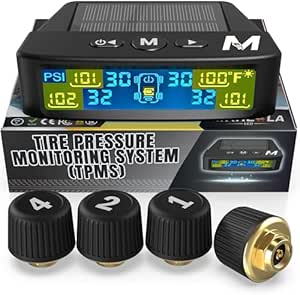
| Marcala Tire Pressure Monitori | Color LCD with auto-dimming |
| Masoll RV Tire Pressure Monito | — |
| Tymate TM7 RV Tire Pressure Mo | Color LCD with adjustable backlight |
| Masoll M13 Tire Pressure Monit | LCD with auto backlight |
| Tire Pressure Monitoring Syste | — |
| Tymate TM2 RV Tire Pressure Mo | Color LCD with automatic backlight |
| U912 Tire Pressure Monitor Sys | — |
| Tire Pressure Monitoring Syste | Color display with automatic brightness adjustment |
| Schrader TPMS Retrofit Kit for | Dash-mounted, solar-powered, wireless |
| Tymate TM12 RV Tire Pressure M | — |
| 2026 New RV Tire Pressure Moni | Color LCD |
| RV Tire Pressure Monitoring Sy | Color LCD |
| Tire Pressure Monitoring Syste | Color LCD |
| Schrader TPMS 29501-4 AirCheck | — |
More Details on Our Top Picks
Marcala Tire Pressure Monitoring System – Set of 4 TPMS Sensors (0-98 PSI)
The Marcala is the easiest fit here for drivers who want an aftermarket TPMS that is quick to install and straightforward to read. Its four sensors monitor pressure and temperature, while the auto-dimming color LCD adapts for day and night visibility. Solar and USB charging give the display flexible power options, unlike the Tymate TM7, which plugs into the vehicle’s cigarette lighter. Marcala’s waterproof sensors suit everyday use in varied weather, but its stated 0–98 PSI range and warning against towing or large RV setups make it a better match for passenger vehicles than demanding trailer combinations. Signal syncing can also be an issue, and an extender may be needed. I’d choose it for uncomplicated installation, not for long rigs or buyers who need generous pressure headroom.
Pros:- Quick installation makes it approachable for drivers new to aftermarket TPMS.
- Auto-dimming color LCD supports visibility in changing light.
- Solar and USB charging offer two ways to power the display.
- Waterproof sensors provide pressure and temperature alerts in varied weather.
Cons:- Signal sync problems may call for an additional extender.
- The product is not recommended for towing setups or large RVs.
- Its 0–98 PSI range may not suit tires needing higher monitoring limits.
Best for: Car, SUV, van, or motorcycle owners who want a four-tire monitor with quick setup and a readable display.
Not ideal for: Drivers towing a large RV or trailer, or anyone who needs dependable signal coverage over a long vehicle combination.
- Sensor range:0–98 PSI
- Display:Color LCD with auto-dimming
- Display power:Solar and USB charging
- Monitoring capacity:1–4 tires
- Vehicle compatibility:Cars, trucks, vans, SUVs, and motorcycles
- Sensor features:Waterproof; battery-saving mode
Our verdict“Choose Marcala for a simple four-tire setup in a passenger vehicle, but skip it for large RVs or towing.”
Masoll RV Tire Pressure Monitoring System, TPMS with 4 Tire Pressure Sensors
Masoll’s four-sensor system stands out for drivers who want a broad set of alerts without building a setup around extra accessories. Its six alarm modes cover high and low pressure, high temperature, fast leakage, low sensor voltage, and lost signal, giving it more explicitly listed warning conditions than the Marcala system. Pre-programmed sensors and automatic alarm-value setup also reduce configuration work, though the tires should be set to their standard pressure before installation. The solar and USB-powered monitor suits RVs and everyday vehicles, and the stated 99 PSI ceiling is slightly higher than Marcala’s 98 PSI. That still limits it for higher-pressure applications, while trailers longer than 38 feet need a signal booster. Sensor batteries are rated for two years, so replacements are part of long-term ownership.
Pros:- Six listed alarm modes cover pressure, temperature, leakage, sensor voltage, and lost signal.
- Pre-programmed sensors and automatic alarm values simplify initial setup.
- Solar and USB charging provide flexible monitor power.
- PSI/Bar and Celsius/Fahrenheit display options suit different preferences.
Cons:- Trailers longer than 38 feet need a signal booster.
- Sensor battery life is listed as two years, so sensor battery replacement is a recurring task.
- The 99 PSI maximum excludes applications that need a higher pressure range.
Best for: RV, pickup, SUV, or van owners who want several distinct tire alerts and pre-programmed four-sensor setup.
Not ideal for: Owners of trailers longer than 38 feet who do not want to add a signal booster, or drivers needing monitoring above 99 PSI.
- Number of sensors:4
- Maximum tire pressure:99 PSI
- Sensor accuracy:±1.5 PSI
- Alarm modes:6: high/low pressure, high temperature, fast leakage, low sensor voltage, and lost signal
- Display units:PSI/Bar and Celsius/Fahrenheit
- Monitor charging:Solar and USB
- Sensor battery life:2 years
- Sensor protection:Waterproof and anti-theft
Our verdict“Pick the Masoll RV system if varied alerts and easy sensor setup matter more than long-trailer coverage or higher pressure capacity.”
Tymate TM7 RV Tire Pressure Monitoring System, Set of 4 Sensors
The Tymate TM7 earns its place for vehicles that need more pressure headroom than several other four-sensor kits provide. Its 0–144 PSI range is well above the Masoll M13’s 0–87 PSI and Marcala’s 0–98 PSI, making the TM7 the clearer fit for higher-pressure tires. The color display plugs into a cigarette-lighter socket, and its dual USB ports let the monitor power other devices rather than relying on solar charging. Adjustable backlighting helps keep readings visible, while multiple alert modes cover pressure and temperature concerns. The tradeoff is a less self-contained power arrangement: the display needs the vehicle socket, and the CR1632 sensor batteries will eventually need replacement. Metal valve stems are recommended, and long trailers may call for an optional repeater.
Pros:- 0–144 PSI range offers substantially more pressure headroom than the Masoll M13 and Marcala.
- Plug-in monitor installation avoids a more involved display power setup.
- Dual USB ports add charging access at the dashboard.
- Adjustable color backlight supports reading the display in different lighting.
Cons:- The monitor requires a cigarette-lighter socket for power.
- CR1632 sensor batteries need replacement after use.
- Long trailers may require an optional repeater, and metal valve stems are recommended.
Best for: RV, pickup, or travel-trailer owners whose tire pressures exceed the ranges supported by lower-pressure four-sensor kits.
Not ideal for: Drivers who want a solar-powered display, dislike using a cigarette-lighter socket, or have long trailers and do not want a repeater.
- Monitoring range:0–144 PSI
- Number of sensors:4
- Display:Color LCD with adjustable backlight
- Monitor power:Cigarette-lighter socket
- Sensor batteries:CR1632 coin batteries; 4 included
- Transmission:Wireless; optional repeater for trailers
- Compatibility:Sedan, SUV, MPV, pickup, RV, and travel trailer
- USB ports:2
Our verdict“Choose the TM7 when higher tire-pressure capacity is the priority and a socket-powered display suits your vehicle.”
Masoll M13 Tire Pressure Monitoring System with 4 Sensors
The Masoll M13 is a more focused choice than the Tymate TM7: its 0–87 PSI range suits vehicles whose tire pressures stay within that band, while the TM7 reaches 144 PSI for higher-pressure needs. The M13’s auto calibration and alarm thresholds can reduce setup steps, and solar charging helps keep the LCD monitor powered without relying on a vehicle outlet. Its four sensors cover cars, SUVs, trucks, RVs, and trailers, but stated compatibility does not remove the need for signal help on longer rigs: trailers over 38 feet require a booster. The lower pressure ceiling is the main limitation, and auto calibration may offer less customization to drivers who prefer to tune thresholds themselves. The short sensor warranty is another ownership detail worth weighing.
Pros:- Solar charging reduces reliance on a powered vehicle outlet.
- Auto calibration and alarm thresholds can simplify setup.
- LCD with auto backlight supports day-and-night viewing.
- Four sensors suit a range of cars, trucks, SUVs, RVs, and trailers.
Cons:- The 87 PSI ceiling is lower than the Tymate TM7’s 144 PSI range and Marcala’s 98 PSI range.
- Trailers longer than 38 feet require a signal booster.
- The listed warranty is one year for the monitor and six months for sensors.
Best for: Owners of cars, trucks, or shorter RV and trailer setups whose tire pressures remain at or below 87 PSI.
Not ideal for: Drivers with higher-pressure tires, trailers longer than 38 feet without a booster, or buyers who want highly customizable alarm thresholds.
- Model:M13+MZS3
- Number of sensors:4
- Pressure range:0–87 PSI
- Accuracy:1.5 PSI
- Display:LCD with auto backlight
- Monitor charging:Solar
- Warranty:1 year for monitor; 6 months for sensors
- Monitor weight:8 ounces
Our verdict“Choose the M13 for a solar-charged four-sensor monitor on vehicles with tire pressures below 87 PSI, not for higher-pressure tires.”
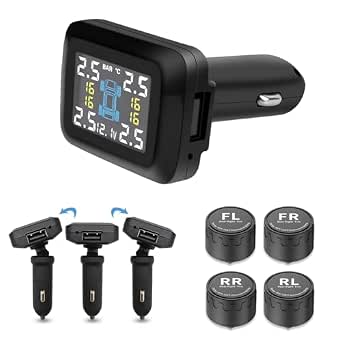
Tire Pressure Monitoring System Wireless Car Charger Powered Adjustable Display for Car RV SUV (0-98 PSI)
This charger-powered TPMS is the most dashboard-focused option in this group: its adjustable display angle lets drivers position readings for a clearer view, while audible and visual alerts signal pressure, temperature, leakage, sensor, or battery issues. Its IP67-rated protection applies to the sensors, and wireless transmission has a listed sensing distance of 19.7 feet. Compared with the Marcala, it gives up solar charging in favor of a car-power connection; compared with the Tymate TM7, its stated measuring range tops out at 87 PSI rather than 144 PSI. That makes it a better fit for standard passenger-vehicle pressures than higher-pressure RV tires. The product description also warns against trailers and medium-to-large vehicles, so the RV compatibility listing should not be read as a promise of suitability for every RV configuration.
Pros:- Adjustable display angle helps drivers position readings for visibility.
- Six alarm types cover pressure, temperature, leakage, sensor faults, and low battery.
- IP67 waterproof and dustproof protection is specified.
- Wireless sensing distance is listed as 19.7 feet.
Cons:- The display requires a car power outlet, unlike the solar-capable Marcala and Masoll systems.
- The stated measuring range tops out at 87 PSI, below the Tymate TM7’s 144 PSI range.
- The product is not recommended for trailers or medium-to-large vehicles.
Best for: Drivers of cars, MPVs, and SUVs who want a powered display they can angle toward their normal driving position.
Not ideal for: Owners of trailers, medium-to-large vehicles, or higher-pressure RV tires, and drivers who need a display that works without a car power outlet.
- Measuring range:7–87 PSI (0.5–6.0 bar)
- Power source:Car charger
- Display adjustment:Adjustable
- Alarm types:6
- Sensing distance:19.7 feet
- Protection level:IP67 waterproof and dustproof
- Compatibility:Cars, MPVs, SUVs, and RVs
Our verdict“Choose this system for an adjustable, outlet-powered display in a passenger car, but avoid it for trailer or larger-RV use.”
Tymate TM2 RV Tire Pressure Monitoring System, TPMS Set of 4 Sensors
I’d choose the Tymate TM2 when a four-sensor starter kit needs room to grow. It arrives with four external sensors but can monitor up to 10 tires, making it more adaptable than the U912, which is aimed at compatible Toyota vehicles and lists a five-year sensor battery life rather than a multi-tire RV setup. The TM2’s 0–87 PSI range and six alarm modes suit many RV and trailer applications, while its color display offers a clear readout at the dash. Solar, USB, and 12-volt socket power options give buyers more ways to keep the monitor running. The tradeoffs are its requirement for metal valve stems for best sensor stability and reduced solar charging in low light. For a very long trailer, a repeater may also be needed.
Pros:- Supports up to 10 tires despite shipping with four sensors.
- Six alarm modes give drivers multiple types of pressure and temperature alerts.
- Color LCD with automatic backlight is suited to changing cabin light.
- Monitor can draw power from solar, USB, or a cigarette lighter socket.
Cons:- Metal valve stems are needed for optimal sensor stability.
- Solar charging can be less effective in low-sun conditions.
- Very long trailers may require a separately obtained repeater.
Best for: RV and trailer owners who want to start with four sensors and add coverage for additional tires later.
Not ideal for: Drivers with non-metal valve stems or very long trailers who want dependable signal coverage without checking fitment or adding a repeater.
- Sensor type:External TPMS sensors
- Sensors included:4
- Supported tires:Up to 10
- Pressure range:0–87 PSI
- Display:Color LCD with automatic backlight
- Operating frequency:433.92 MHz
- Sensor battery life:Up to 6 months
- Power sources:Solar, USB, and cigarette lighter socket
Our verdict“Choose the TM2 if you want an expandable RV-focused system with flexible monitor power, and skip it if your valve stems or trailer length make setup a concern.”
U912 Tire Pressure Monitor System TPMS with 4 External Sensors and 5-Year Battery for Toyota
The U912 has a narrower fit than the other picks here, but its stated five-year sensor battery life is a practical draw for compatible Toyota owners who want to reduce battery changes. It tracks pressure and temperature in real time, and its three-second response time gives alerts a defined update cadence. Compared with the Tymate TM2, which supports up to 10 tires and offers several monitor power options, the U912 is less suited to an expanding RV or trailer setup. Its listed 26-foot sensing distance may also limit placement in longer vehicles unless a repeater is added. I’d treat vehicle compatibility as the deciding factor: the locking external sensors and battery life are appealing, but the product description’s Toyota focus makes it a poor choice for buyers seeking a broadly compatible retrofit.
Pros:- Monitors tire pressure and temperature in real time.
- Five-year sensor battery life can reduce routine battery replacement.
- Locking external sensors add a deterrent against casual removal.
- Specified accuracy is ±1.5% for pressure and ±1°C for temperature.
Cons:- Compatibility is described as limited to suitable vehicles such as Toyota models.
- The 26-foot sensing distance may require a repeater for remote sensors.
- Monitor requires recharging through a DC power cable.
Best for: Toyota owners whose vehicle is confirmed compatible and who prioritize long sensor battery life with pressure and temperature alerts.
Not ideal for: Owners of unverified makes or long RV and trailer combinations who need broad fitment or a longer stated signal range.
- Sensors included:4 external sensors
- Battery life:5 years
- Pressure accuracy:±1.5%
- Temperature accuracy:±1°C
- Response time:3 seconds
- Sensing distance:26 feet
- Mounting type:Tire mount
- Weight:350 g
Our verdict“The U912 fits Toyota owners who can confirm compatibility and value long sensor battery life, but it is a poor match for buyers seeking a flexible RV system.”
Tire Pressure Monitoring System with Solar and USB Charging, 5 Alarm Modes, Real-Time Pressure and Temperature Monitoring, Auto & Color Display, Suitable for 4-Wheeled Vehicles
This TY01 is a straightforward four-sensor choice for drivers who want pressure and temperature monitoring without the larger tire-count ambitions of the Tymate TM12. Its color display adjusts brightness automatically, which can make readings easier to see as cabin light changes, and solar plus USB charging gives the monitor two power routes. The five alarm modes cover a useful range of alerts, while the listed compatibility includes sedans, vans, off-road vehicles, and commercial vehicles. The main compromise is that the product data does not specify sensor battery life, so I can’t compare its upkeep confidently with the U912 and its stated five-year battery. Water resistance is also a concern noted in the supplied product information, and less detailed instructions may make setup less reassuring for first-time installers.
Pros:- Monitors pressure and temperature in real time.
- Automatic display brightness helps keep readings visible as light changes.
- Solar and USB charging provide two monitor power options.
- Five alarm modes offer several alert types.
Cons:- Sensor battery life is not specified in the product data.
- Supplied information raises concerns about some sensors’ water resistance.
- Installation instructions may not provide enough detail for beginners.
Best for: Drivers of four-wheeled cars, vans, or light commercial vehicles who want a simple external-sensor kit with a color display.
Not ideal for: Buyers who need a documented sensor battery lifespan, a clearly stated higher tire capacity, or especially robust water-resistance information.
- Model:TY01
- Sensor type:External pressure sensors
- Sensors included:4
- Display:Color display with automatic brightness adjustment
- Charging:Solar and USB
- Vehicle compatibility:Sedans, off-road vehicles, commercial vehicles, and vans
- Weight:7.4 ounces
- Dimensions:5.75 × 2.05 × 5.87 inches
Our verdict“Pick the TY01 for a basic four-wheel setup with flexible monitor charging, but choose a better-documented option if sensor longevity or weather resistance is your priority.”
Schrader TPMS Retrofit Kit for Vehicles Built Before 2008, Suitable for Passenger Cars and Light Trucks
The Schrader SCHRFK4S serves a different purpose from the RV-oriented Tymate kits: it targets passenger cars and light trucks built before 2008 that lack factory TPMS. Its wireless, solar-powered dash display reports pressure and temperature for four tires, while the product description also lists the spare; however, the spare sensor is sold separately, so full five-tire coverage takes an extra component. That retrofit focus gives it a clearer use case than the general-purpose TY01, but also makes fitment more restrictive. The listed sensor compatibility is for a 0.453-inch rim hole, which rules out buyers with non-standard rims unless they verify compatibility. Installation and setup are part of the job, so this is not as plug-and-play in spirit as an external-sensor kit.
Pros:- Adds tire pressure monitoring to older vehicles that lack a factory system.
- Wireless, solar-powered display avoids a routine display power connection.
- Tracks pressure and temperature across the four main tires.
- Designed for passenger cars and light trucks.
Cons:- Spare sensor is sold separately.
- Requires installation and setup rather than a simple monitor-only fit.
- Sensor compatibility is limited to a 0.453-inch rim hole.
Best for: Owners of pre-2008 passenger cars or light trucks without factory TPMS who can verify the specified rim-hole fit.
Not ideal for: Newer vehicles with factory TPMS, RV owners seeking multi-axle expansion, or buyers who want spare-tire monitoring without sourcing another sensor.
- Model:SCHRFK4S
- Vehicle fit:Vehicles built before 2008; passenger cars and light trucks
- Display:Dash-mounted, solar-powered, wireless
- Monitoring:Pressure and temperature
- Sensor frequency:433 MHz
- Sensor compatibility:0.453-inch rim hole
- Batteries:4 lithium-ion batteries included
- Item weight:1.37 pounds
Our verdict“Choose the Schrader retrofit kit for a compatible older car or light truck without factory TPMS, and skip it if you need broad rim fitment or an RV-focused system.”
Tymate TM12 RV Tire Pressure Monitoring System, TPMS Set of 6 Sensors
For a large RV, multi-axle trailer, or combination vehicle, the Tymate TM12 offers the broadest stated coverage in this group: it supports up to 12 tires across four zones and arrives with six sensors. That makes it a more capable starting point than the Tymate TM2, which supports up to 10 tires and has a lower pressure ceiling of 87 PSI. The TM12’s 0–144 PSI range better suits setups that need readings above that ceiling, while USB-C and solar charging give the display two power options. Automatic calibration is intended to simplify DIY setup, though the initial full USB-C charge is recommended for best performance. Signal range is listed at 50 feet and can extend beyond 100 feet with a repeater, but larger rigs may need that extra equipment, and additional sensors are sold separately.
Pros:- Monitors up to 12 tires across four zones.
- Includes six sensors, offering more coverage out of the box than four-sensor kits.
- 0–144 PSI range accommodates applications above the TM2’s stated ceiling.
- USB-C and solar charging provide flexible monitor power.
Cons:- A full USB-C charge is recommended before use.
- Large rigs or signal obstructions may call for a repeater.
- Additional sensors and repeaters are sold separately.
Best for: RV and trailer owners who need multi-zone monitoring for more than four tires and want a higher pressure range.
Not ideal for: Drivers with only four tires who prefer a simpler, lower-capacity kit, or buyers unwilling to plan for a repeater on a large or obstructed rig.
- Sensors included:6
- Display support:Up to 12 tires across 4 zones
- Pressure range:0–144 PSI
- Power options:USB-C and solar charging
- Transmission range:50 feet; extendable to over 100 feet with a repeater
- Item weight:12.3 ounces
- Dimensions:3.84 × 3.23 × 1.14 inches
- Batteries:1 lithium-ion battery included
Our verdict“Choose the TM12 when your RV or trailer needs multi-zone coverage and a higher pressure ceiling; for a basic four-tire vehicle, its added capacity may be unnecessary.”
2026 New RV Tire Pressure Monitoring System (TPMS) with 4 Sensors, 6 Alarm Modes, Solar & USB Dual Charging, Color LCD Display, 0-88 PSI for Truck, SUV, MPV, Sedan, Trailer, Fifth Wheel
I’d shortlist this system for drivers who want an external-sensor setup that is ready quickly: the manufacturer describes tool-free installation in about two minutes and a display that refreshes readings every 0.3 seconds. Its 0–88 PSI range fits many passenger vehicles and lighter RV or trailer applications, while six alarm modes and temperature monitoring add more context than pressure readings alone. Compared with the B0HCBHC4F6 model, this unit has a narrower stated pressure ceiling but a specifically advertised fast refresh rate. Solar and USB-C charging give the display two power options, though they do not remove the need to maintain the individual sensor batteries. I’d skip it for vehicles longer than 50 feet or tires that require readings above its stated range.
Pros:- Advertised tool-free installation takes about two minutes.
- 0.3-second sensor refresh rate provides frequent updates.
- Solar and USB-C charging offer two ways to power the display.
- Six alarm modes include temperature monitoring.
Cons:- External valve-stem sensors remain exposed and require individual battery upkeep.
- The 88 PSI ceiling is lower than the B0HCBHC4F6 system’s stated 99 PSI range.
- Stated vehicle-length support stops at 50 feet.
Best for: RV and trailer owners who want a simple external-sensor installation, quick display updates, and tire pressures within the 0–88 PSI range.
Not ideal for: Owners of longer-than-50-foot rigs or vehicles whose tires need monitoring above 88 PSI; the stated compatibility and pressure range may not fit.
- Sensors:4 external sensors
- Pressure range:0–88 PSI
- Alarm modes:6
- Display:Color LCD
- Temperature monitoring:Yes
- Charging:Solar and USB-C
- Installation:Tool-free; advertised as about 2 minutes
- Compatibility:RVs, trucks, SUVs, MPVs, sedans, and trailers up to 50 feet
Our verdict“Choose this system for a quick-install RV or trailer setup with frequent updates, provided your rig is under 50 feet and its tires stay below 88 PSI.”
RV Tire Pressure Monitoring System with 4 Sensors and Color LCD Display
The main reason I’d pick this four-sensor kit over the B0HMC8KJQ1 is its 0–99 PSI range, which gives owners more headroom when the narrower 88 PSI ceiling is a concern. The sensors arrive pre-paired, so setup should involve less configuration than systems that require sensor programming; customizable PSI alerts also let drivers tailor warnings to their tires. A color LCD, six alarm modes, and temperature monitoring cover the core functions expected in an aftermarket RV TPMS. Solar-assisted power with USB-C backup is convenient for the display, but the external sensors use CR1632 batteries that need replacement. I’d favor this over the Schrader 29501-4 for straightforward external installation, but not for drivers who want protected, tire-mounted sensors or a kit with more than four sensors.
Pros:- 0–99 PSI range exceeds the 88 PSI ceiling of the B0HMC8KJQ1.
- Pre-paired sensors reduce setup steps.
- Customizable PSI alerts and six alarm modes support tailored warnings.
- Solar-assisted display charging includes USB-C backup.
Cons:- External sensors attach to valve stems and remain exposed.
- Each sensor uses a CR1632 battery that eventually needs replacement.
- Four sensors may not cover every tire on larger multi-axle rigs.
Best for: RV and trailer owners who want pre-paired external sensors, adjustable pressure alerts, and a stated range reaching 99 PSI.
Not ideal for: Drivers seeking internal sensors, a multi-axle setup with more than four monitored tires, or a system without replaceable sensor batteries.
- Sensors:4 pre-paired external sensors
- Pressure range:0–99 PSI
- Alarm modes:6
- Display:Color LCD
- Power:Solar-assisted with USB-C backup
- Sensor battery:CR1632 per sensor
- Warranty:1 year
Our verdict“Choose this kit if your tires call for more pressure headroom than an 88 PSI system offers and four pre-paired external sensors cover your vehicle.”
Tire Pressure Monitoring System with Solar Charge and External Sensors
I’d give this model the nod for buyers who prioritize waterproof external sensors and automatic setup over precise pressure measurement. The four sensors are described as requiring no programming, and the color LCD can show pressure and temperature with six alarm modes. Solar and USB charging supports the display, while the listed sensor battery life is up to two years. The key compromise is its stated error margin of about 3 PSI, which makes it a weaker fit for drivers who need finer readings than the B0HCBHC4F6’s listed system details suggest. Its 0–88 PSI ceiling also rules it out for higher-pressure tires, and the 32-foot transmission range should be checked against the distance between the tires and display in your vehicle. Waterproofing is useful, but it does not widen those limits.
Pros:- Waterproof external sensors are suited to exposure to road conditions.
- Automatic calibration avoids sensor programming.
- Solar and USB charging provide two display power options.
- Six alarm modes include leak, pressure, temperature, and low-battery alerts.
Cons:- The stated sensor error margin of about 3 PSI limits precision.
- The 88 PSI maximum excludes higher-pressure tire applications.
- The listed 32-foot transmission range may not suit every vehicle layout.
Best for: Drivers of compatible vehicles who want waterproof external sensors, automatic setup, and solar or USB charging for the display.
Not ideal for: Owners who need close pressure precision, monitor tires above 88 PSI, or need a transmission distance beyond the stated 32 feet.
- Sensors:4 external sensors
- Pressure range:0–88 PSI
- Alarm modes:6
- Display:Color LCD
- Power:Solar and USB charging
- Sensor battery life:Up to 2 years
- Waterproofing:Waterproof sensors
- Transmission range:32 feet
- Dimensions:3.7 × 3.3 × 0.6 inches
Our verdict“Pick this system for a simple, weather-conscious external setup if its 88 PSI limit, 32-foot range, and roughly 3 PSI error margin fit your needs.”
Schrader TPMS 29501-4 AirCheck BLE Passenger Car Kit – 4 Bluetooth TPMS Sensors for Real-Time Tire Pressure Monitoring
Unlike the three RV-oriented kits in this group, the Schrader 29501-4 is built around internal Bluetooth sensors and smartphone monitoring. Mounting sensors inside the tire protects them from the exposure and removal risks that come with valve-stem units such as the B0FGJYSHRQ, and the stated ±3% measurement accuracy suits passenger-car use within its range. The tradeoff is a more involved installation: this kit requires tire mounting and professional tools, not a quick driveway setup. Its 15–70 PSI measuring range is also narrower than the B0HCBHC4F6’s 0–99 PSI span, so I wouldn’t choose it for many RV or trailer tires. For a classic or custom car without factory TPMS, the internal design and app connection make more sense than an RV display kit, provided installation support is available.
Pros:- Internal tire mounting protects sensors from road debris and casual removal.
- Bluetooth app connection provides real-time smartphone monitoring.
- Stated ±3% accuracy is specified for passenger-car use.
- Designed for classic and custom vehicles without factory TPMS.
Cons:- Professional tire installation and specific tools are required.
- 15–70 PSI range is narrower than the B0HCBHC4F6’s stated range.
- Larger vehicles and trailers may require an additional range extender.
Best for: Classic-car and custom-car owners who lack factory TPMS and want internal sensors with smartphone-based monitoring.
Not ideal for: DIY installers, RV and trailer owners needing pressures above 70 PSI, or drivers who prefer a dedicated in-cabin display over a smartphone app.
- Sensors:4 Bluetooth TPMS sensors
- Mounting:Inside the tire
- Measuring range:15–70 PSI
- Measurement accuracy:±3% of measured pressure
- Output type:Digital
- Sensing distance:10 meters
- Monitoring connection:Bluetooth smartphone app
- Installation:Professional tire installation required
Our verdict“Choose the Schrader kit for a classic or custom passenger car when you can arrange professional installation and want internal Bluetooth sensors rather than an RV-style display.”

How We Picked
I compared the 14 listed systems by the details that most affect a real installation: intended vehicle type, included sensor count, stated pressure range, display and power method, and any vehicle-specific or retrofit claims. I gave more weight to clear fit information than to broad labels such as “for all vehicles,” since a system that cannot cover the tires or pressure needs of a particular setup is a poor match regardless of its display features.
The ranking favors options with a more clearly defined use case and useful coverage for that buyer, rather than treating every four-sensor display kit as interchangeable. That places the Tymate TM7 first as a straightforward RV-focused option, the TM12 higher for buyers needing six sensors, and the Schrader kits in more specialized roles based on vehicle age, type, or Bluetooth preference. Listings with limited specifications remain possible matches, but buyers should verify compatibility, alarm behavior, and included hardware before choosing them.
Factors to Consider When Choosing Aftermarket Tpms Systems
Before choosing an aftermarket TPMS, I would work from the vehicle and tire requirements outward rather than starting with display features. A little checking up front helps avoid a system that has too few sensors, an unsuitable pressure range, or a power setup that does not fit how the vehicle is used.
Match Sensor Count to Every Tire You Need to Monitor
Count the tires you intend to monitor, including those on a trailer or additional axle, before comparing kits. Many systems in this roundup include four sensors, while the Tymate TM12 is listed with six, a meaningful distinction for some RV configurations. Do not assume that a four-sensor package will cover a vehicle just because its title says RV or trailer. Check whether extra sensors can be paired and whether the receiver supports the total number you need. A spare tire may also matter if you want monitoring beyond the road wheels. Buying around the complete setup can prevent a second purchase or partial coverage later.
Check Pressure Range Against Tire Requirements
Use the pressure range printed in the product specifications, then compare it with the tire pressures required for your vehicle and load. The listings here include systems rated up to 88 PSI and others reaching 98 PSI, so the difference can affect suitability for heavier RV and trailer tires. A system whose range does not cover your normal operating pressure is not a safe substitute for a compatible monitor. Also check how the system handles pressure thresholds and whether you can set alerts to suit the vehicle. Avoid choosing based on a maximum figure alone if the listing does not explain its full operating range or alarm settings. When information is unclear, confirm the limit with the seller or manufacturer before fitting sensors.
Choose a Display and Power Setup You Can Live With
A dedicated screen can keep readings visible without opening a phone app, while a Bluetooth system may suit drivers who prefer phone-based information. Solar and USB charging can offer flexibility, but solar availability depends on where the display sits and how the vehicle is parked. A car-charger-powered display may be a better fit for drivers who have an accessible power outlet and do not want to rely on sunlight. Check whether the screen stays readable in the mounting position and whether the power cable will reach cleanly. Think about routine use: a display that is hard to see or keep charged can be ignored, even if its feature list looks appealing.
Verify Vehicle Compatibility Before Buying
“Universal” language does not replace a compatibility check. The U912 listing names Toyota, and the Schrader retrofit kit is aimed at vehicles built before 2008, so both have narrower fit claims than a generic four-wheel system. For factory-style retrofits, confirm the vehicle’s year, make, model, and any required pairing or programming steps. For external sensors, check valve-stem compatibility and whether installation requires tools or a particular stem type. RV owners should also confirm that the receiver can communicate reliably with sensors mounted on a trailer or at the rear of a long vehicle. If the listing leaves these details open, ask before ordering.
Understand Alerts and Monitoring Limits
Alarm count alone does not show how useful a TPMS will be. Look for the conditions it monitors, such as pressure or temperature, and check whether alerts are adjustable for your tires and load. A system that reports several readings may still be inconvenient if warnings are difficult to interpret while driving. Sensor placement, signal distance, and the receiver’s ability to distinguish each tire also matter, especially with trailers. Ask whether the kit gives a clear indication of which tire triggered an alert. Do not treat a TPMS as a replacement for routine tire inspections or for responding appropriately to a warning.
Weigh Retrofit Complexity Against Convenience
Aftermarket systems differ in how much setup they ask of the owner. External sensor kits can avoid a tire-mounted installation, while retrofit kits intended for older vehicles may involve vehicle-specific pairing or other setup steps. Bluetooth models can reduce dashboard hardware but require a compatible phone and a dependable app connection. Before choosing, check what is included, whether batteries are replaceable or rechargeable, and how sensors attach to the valve stems. A lower-effort installation may be worth more than extra display modes for someone who wants basic monitoring. Buyers who need a factory-integrated solution should confirm that an add-on kit meets that expectation rather than assuming every retrofit behaves like original equipment.
Frequently Asked Questions
Can I use a four-sensor TPMS on an RV with more than four tires?
Only if you plan to monitor four tires and the system supports that arrangement; the number of tires physically on the vehicle does not guarantee the kit can monitor all of them. Check the receiver’s maximum sensor capacity and whether additional sensors are available for the exact model. The six-sensor Tymate TM12 is a more direct starting point for buyers whose setup needs more than four monitored positions. Also confirm whether trailer tires can communicate with the display from their mounting distance. Decide which tires you need monitored before buying, rather than relying on the sensor count in the box alone.
How do I know whether a system’s PSI range is suitable for my tires?
Check the pressure requirements for your specific tires and vehicle, then compare those figures with the TPMS operating range in the product specifications. This roundup includes listings with stated upper limits of 88 PSI and 98 PSI, which are not equivalent for every RV or trailer. The monitor must cover the pressures you expect to use and provide suitable alert settings. Do not select a system based only on the highest pressure it can display. If the listing does not state a clear range or threshold behavior, seek confirmation before purchase.
Should I choose a solar-powered display or a Bluetooth TPMS?
Choose based on how you want readings presented and how you power devices in your vehicle. A solar-and-USB display can keep information on a dedicated screen, though its solar charging depends on placement and exposure. The Schrader AirCheck BLE takes a Bluetooth approach, which may suit drivers who prefer phone-based monitoring and are comfortable relying on a compatible phone and app. Check whether the display or app is easy to view while parked and whether charging fits your routine. Neither power style is automatically better; convenience depends on your vehicle layout and habits.
Is a vehicle-specific TPMS a safer choice than a universal kit?
A vehicle-specific listing can narrow the compatibility question, but it still needs to match your exact year, model, and setup. The U912 is identified for Toyota, while the Schrader retrofit kit is described for passenger cars and light trucks built before 2008. Universal-style kits may offer wider intended use, but buyers still need to verify sensor fit, pressure range, and receiver coverage. Check installation or pairing requirements before relying on a product label. The right choice is the one whose documented fit matches your vehicle, not simply the one with the broadest claim.
Can an aftermarket TPMS replace regular tire checks?
No. A TPMS can provide warnings or readings while driving, but it does not remove the need to inspect tires and check pressure using an appropriate gauge. Sensor batteries, communication, installation, or display power can affect what information is available. Follow the vehicle and tire maker’s guidance for pressure checks and tire condition, and respond promptly if the monitor signals a problem. Treat the system as an added monitoring layer, not a guarantee that every tire issue will be detected. This is especially relevant before long trips, towing, or carrying a changing load.
Conclusion
For most RV buyers who need a four-sensor setup, I would start with the Tymate TM7 as the best overall because its listing gives it a clear RV role. For additional sensor coverage, the Tymate TM12 is my pick for specific needs, particularly when six sensors suit the vehicle. The Masoll M13 is a reasonable value-minded option to compare, but I would verify its pressure range and compatibility details before choosing it over a more clearly specified kit. Beginners who want a dedicated display may prefer a straightforward four-sensor system with a stated power method, while phone-first drivers can look at the Schrader AirCheck BLE. For a premium-style retrofit direction, consider the Schrader retrofit kit only if your passenger car or light truck falls within its stated pre-2008 fit; otherwise, choose by sensor count, pressure needs, and confirmed compatibility rather than the product label alone.