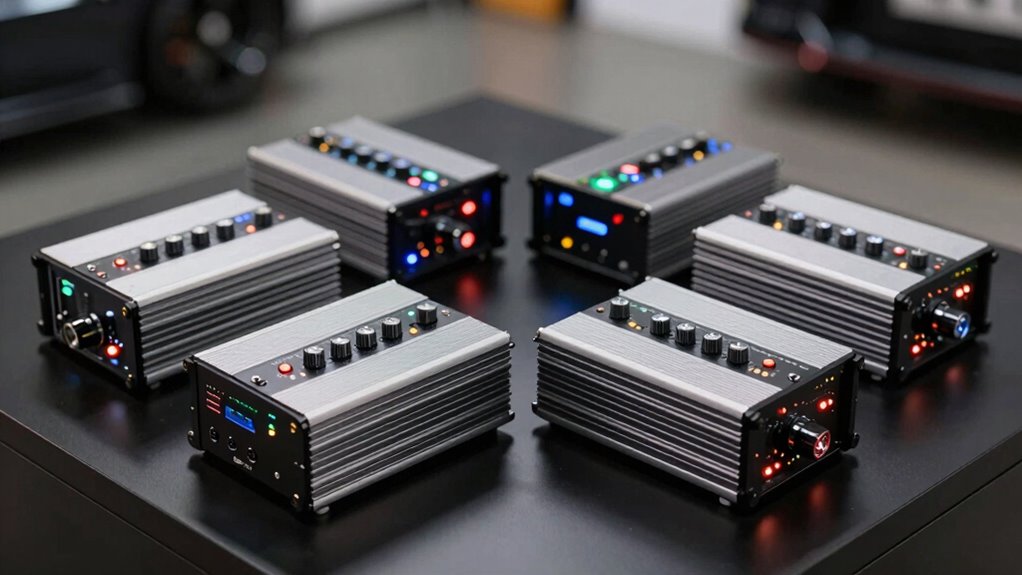

For 4-channel car amplifiers for sound quality, I would put the Alpine S-A32F first for a balanced, compact upgrade, with the Pioneer GM-A6704 as a flexible Class AB alternative and the ORION CEA400.4D as a space-saving Class D option. The main tradeoff is not the biggest advertised wattage: it is matching credible RMS output and speaker impedance to your system without adding excess heat, noise, or installation complexity. Compact Class D models can simplify fitment, while Class AB designs may suit buyers who prefer that format and can accommodate their size and power needs. I compare these 13 options by practical output, design, usability, and fit so you can see which compromises make sense for your car. Read on for the full breakdown and selection guidance.

Get business pricing on garage and car supplies
- Business-only prices and quantity discounts
- Tax-exempt purchasing
- Multiple users, one account, clear invoices
Complete the kit


Key Takeaways
- Alpine S-A32F leads as the balanced pick: its 320-watt rating and compact Class D design make it a more grounded starting point than models promoted mainly with large maximum-watt figures.
- Pioneer GM-A6704 offers a different sound-system fit: its Class AB design and bridgeable channels appeal to buyers building a conventional speaker setup, but it needs more installation space than compact Class D choices.
- ORION CEA400.4D is the compact alternative: it pairs a Class D format with a stated 400W RMS rating, though buyers should confirm channel-level power and speaker impedance against their own setup.
- Several advertised power totals need careful reading: products such as the YaeCCC and BLAUPUNKT highlight large maximum-watt figures, which do not provide the same buying information as verified RMS output at a stated load.
- Low-cost and high-output models demand extra specification checks: the BOSS R1004, Recoil options, and multiple Taramps models differ in stated power and load support, so wiring, fuse requirements, and compatible speakers matter as much as headline wattage.


| channel car amplifiers for sound quality | Channels | Dimensions | Maximum power | Mounting type |
|---|---|---|---|---|
| BOSS Audio Systems R1004 Riot | 4 | 7.75 x 9 x 2 inches | — | — |
| Recoil DI1200-4 Full-Range Cla | 4 | 8.9 x 6.1 x 1.8 inches | 2400 watts | Surface mount |
| ORION CEA400.4D Cobalt Elite C | 4 | — | — | Freestanding |
| Alpine S-A32F S Series Class D | 4 | 11 x 11 x 5 inches | 320 watts | Surface mount |
| BLAUPUNKT 1600W 4-Channel Full | 4 | 11 x 7.4 x 2.2 inches | 1600 watts | — |
| Taramps TS 400X4 Black 2 Ohms | 4 | — | — | — |
| Recoil DI550.4 Full-Range Clas | 4 | 7.48 x 5.90 x 1.77 inches | 1040W | — |
| YaeCCC Car Amplifier 4 Channel | 4 | — | — | Surface mount |
| Taramps TS 1200 Watt 4-Channel | 4 | — | — | — |
| 2026 High Power 4 Channel Car | 4 | — | — | Surface mount |
| ORION CBA2000.4 Cobalt High Ef | 4 | 11 x 7 x 2.5 inches | 2000W | — |
| AUDISHAKO MHD130.4D 2400 Watt | 4 | 8.66 x 4.33 x 1.97 inches | 2400W | Surface mount |
| Pioneer GM-A6704 1000W Max Cla | 4 | 8.5 x 14 x 2.38 inches | 1000W | Surface mount |
More Details on Our Top Picks
BOSS Audio Systems R1004 Riot 400 Watt 4-Channel Car Amplifier
The R1004 is a straightforward choice for replacing a head unit’s limited power or driving a modest four-speaker setup. Its Class A/B design and stated 50 watts max per channel at 4 ohms favor a familiar, uncomplicated installation over the higher output and tuning options offered by the Recoil DI1200-4. It can also handle 2-ohm speaker loads, which gives some flexibility when planning a system, though the supplied figures are maximum rather than RMS ratings and don’t establish its sustained clean output. At 7.75 by 9 inches, it is easier to place than the larger BLAUPUNKT AMP1604. The tradeoff is a lean feature set: the description gives little detail about sound-shaping controls, so buyers seeking precise crossover adjustment should look elsewhere.
Pros:- Compact dimensions suit installations with limited mounting space.
- Supports speaker impedances from 2 to 8 ohms.
- Class A/B topology offers a conventional alternative to the Class D models in this group.
- Four channels can power a basic front-and-rear speaker setup.
Cons:- Listed channel power is maximum output, not a stated RMS rating.
- The product details provide little information about crossover or sound-shaping controls.
- Installation and impedance matching require care to avoid an unsuitable speaker load.
Best for: Drivers replacing a factory head unit’s modest output who want a compact four-channel amp for a basic speaker setup.
Not ideal for: Listeners building a high-output system or seeking detailed crossover controls and clearly stated RMS power figures.
- Channels:4
- Power at 2 ohms:100 watts max x 4
- Power at 4 ohms:50 watts max x 4
- Amplifier class:A/B
- Speaker impedance:2–8 ohms
- Dimensions:7.75 x 9 x 2 inches
- Weight:3.09 lb
- Frequency response:12 Hz–22 kHz
Our verdict“Choose the R1004 for a modest, space-conscious four-speaker upgrade, but pick a model with clearer RMS figures and more controls for a system you plan to tune closely.”
Recoil DI1200-4 Full-Range Class-D 4-Channel Car Audio Amplifier 2400 Watt
The DI1200-4 is the high-output, adjustment-heavy pick here, with listed RMS ratings of 300 watts x 4 at 2 ohms and 210 watts x 4 at 4 ohms. That makes it a better match than the BOSS R1004 for systems using power-hungry speakers or a bridged configuration, provided the rest of the setup can support it. Its gain, crossover, and bass EQ controls give installers room to shape the system rather than simply add volume. Class D operation and a compact 8.9-by-6.1-inch body help manage installation space. The compromise is a greater setup burden: high output and adjustable controls reward careful matching, while the supplied information does not spell out all sound-quality performance details. Buyers wanting a simpler, lower-output installation may find the Alpine S-A32F an easier fit.
Pros:- Provides stated RMS output at both 2 and 4 ohms.
- Bridgeable channels support more than one system configuration.
- Gain, crossover, and bass EQ controls allow system tuning.
- Compact Class D design can simplify placement in a crowded vehicle.
Cons:- High output and adjustable settings call for careful installation and tuning.
- The product information does not provide detailed sound-quality measurements.
- The listed warranty period is one year.
Best for: Experienced installers building a high-output four-channel system with speakers matched to the amp’s 2- or 4-ohm ratings.
Not ideal for: Beginners seeking a plug-and-play upgrade or listeners who do not need high output and extensive setup controls.
- Channels:4
- Amplifier class:D
- RMS power at 2 ohms:300 watts x 4
- RMS power at 4 ohms:210 watts x 4
- Bridged RMS power:610 watts x 2 at 4 ohms
- Maximum power:2400 watts
- Dimensions:8.9 x 6.1 x 1.8 inches
- Mounting type:Surface mount
Our verdict“Pick the DI1200-4 when high stated RMS output and hands-on tuning matter more than beginner-friendly setup.”
ORION CEA400.4D Cobalt Elite Compact Class D 4-Channel Amplifier, 400W RMS
The CEA400.4D pairs a compact Class D format with built-in high- and low-pass crossover controls, making it a useful fit when installation space is tight but basic system tuning still matters. Those filters can help direct appropriate frequencies to speakers or a subwoofer, a practical advantage over the BOSS R1004, whose supplied description lists fewer adjustment features. The stated 400 watts RMS suggests more headroom than a basic factory-system replacement, though the product data does not break that figure down by channel or impedance. That missing detail makes speaker matching harder than with the Recoil DI1200-4, which gives explicit RMS ratings at multiple loads. I’d shortlist this Orion for a constrained installation, but buyers who need thoroughly documented output figures should compare specifications before choosing.
Pros:- Compact Class D design suits space-limited installations.
- Built-in high- and low-pass crossover controls support frequency tailoring.
- Stated 400-watt RMS output is presented as suitable for multiple system types.
- MOSFET power supply is specified.
Cons:- The 400-watt RMS figure is not broken down by channel or speaker impedance.
- The supplied specifications omit several details useful for system matching.
- Crossover setup may be challenging for buyers unfamiliar with amplifier tuning.
Best for: Installers with limited mounting room who want built-in crossover adjustment for a four-channel speaker or mixed speaker-and-subwoofer setup.
Not ideal for: Buyers who need channel-by-channel RMS ratings and impedance-specific output figures before matching speakers.
- Channels:4
- Amplifier class:D
- Stated output power:400 watts RMS
- Power supply:MOSFET
- Built-in crossover:Yes
- Crossover controls:High-pass and low-pass filters
- Supply voltage:12 volts
- Mounting type:Freestanding
Our verdict“Choose the CEA400.4D when space and crossover flexibility take priority, but favor the DI1200-4 if you need explicit output ratings for each load.”
Alpine S-A32F S Series Class D 4 Channel Digital Amplifier, 320 Watts
The Alpine S-A32F takes a more restrained approach than the Recoil DI1200-4: it lists 55 watts RMS per channel at 4 ohms, a clear fit for a conventional four-speaker system rather than a high-output build. That specific rating makes basic speaker matching easier than with the ORION CEA400.4D, whose listed RMS figure lacks a channel breakdown. Its Class D design is suited to buyers looking for a compact digital amplifier, though the supplied dimensions are 11 by 11 by 5 inches and do not make it the smallest option in this group. The product information offers little on crossover controls or other tuning features, so it is less compelling for sound shaping than the Recoil. I’d choose it for a measured system upgrade, not for maximum output or extensive adjustments.
Pros:- Lists 55 watts RMS per channel at 4 ohms.
- Four-channel Class D design suits a conventional speaker setup.
- Surface-mount format supports a fixed installation.
- The per-channel RMS figure gives buyers a useful speaker-matching reference.
Cons:- The supplied dimensions are larger than those of the compact BOSS and Orion options.
- Product details do not specify crossover or other sound-shaping controls.
- The listed weight of 5.3 g appears inconsistent and should not be relied on.
Best for: Drivers adding an amplifier to a standard four-ohm, four-speaker system who value a clearly stated per-channel RMS rating.
Not ideal for: Buyers seeking high output, extensive tuning controls, or a particularly small amp based on the listed dimensions.
- Channels:4
- RMS power:55 watts x 4 at 4 ohms
- Maximum power:320 watts
- Amplifier type:Class D digital
- Voltage:14.4 volts
- Dimensions:11 x 11 x 5 inches
- Mounting type:Surface mount
- Listed weight:5.3 g
Our verdict“Choose the Alpine for a straightforward four-ohm speaker upgrade with a stated RMS rating, but look to the Recoil for greater output and tuning flexibility.”
BLAUPUNKT 1600W 4-Channel Full-Range Car Amplifier AMP1604
The AMP1604 stands out for its stated 79 watts RMS per channel at 2 ohms, giving buyers a more useful sound-quality reference than a maximum-wattage headline alone. It is aimed at a different setup from the Alpine S-A32F, whose stated 55-watt RMS rating is at 4 ohms: the Blaupunkt’s published figure targets a lower-impedance speaker load, so matching speakers and wiring matters. Its aluminum-alloy construction and 11-by-7.4-inch body offer a substantial but still trunk-oriented installation. The tradeoff is limited supporting information: the description does not specify crossover controls, and its listed 90-day warranty is brief. Compared with the compact BOSS R1004, this is a more power-focused choice, but it asks buyers to plan installation and system compatibility carefully.
Pros:- Lists 79 watts RMS per channel at 2 ohms.
- Four channels support front-and-rear speaker configurations.
- Aluminum-alloy construction is specified.
- Full-range design is intended for vehicle speaker systems.
Cons:- The stated RMS output applies to 2-ohm loads, so speaker compatibility needs checking.
- The supplied description does not list crossover or detailed tuning features.
- The stated warranty period is 90 days.
Best for: Car-audio owners choosing compatible 2-ohm speakers who want a stated per-channel RMS figure for a four-channel upgrade.
Not ideal for: Drivers with 4-ohm-only speakers, limited installation room, or a preference for detailed tuning controls and a longer stated warranty.
- Channels:4
- Maximum power:1600 watts
- RMS power:79 watts per channel at 2 ohms
- Voltage:15 volts
- Dimensions:11 x 7.4 x 2.2 inches
- Material:Aluminum alloy
Our verdict“Choose the AMP1604 for a compatible 2-ohm speaker setup and a defined per-channel RMS figure, but skip it if your system needs clearer tuning details or a longer stated warranty.”
Taramps TS 400X4 Black 2 Ohms 400W RMS 4-Channel Car Audio Amplifier
The Taramps TS 400X4 is a practical choice for upgrading factory speakers without requiring an aftermarket head unit: its high-level and RCA inputs support both factory and aftermarket sources. The built-in crossover helps direct suitable frequencies to connected speakers, while bridgeable channels allow a different setup if your system needs more power for a pair of loads. Its stated 400W RMS output is more restrained than the TS 1200’s 4 x 300W RMS at 2 ohms, making this the more sensible fit for modest speaker upgrades rather than a high-output system. The compact Class D design also suits installations where space and efficiency matter. The tradeoff is limited detail about durability, and proper setup still matters; buyers wanting extensive tuning flexibility should compare it with the Recoil DI550.4.
Pros:- High-level and RCA inputs accommodate factory and aftermarket stereos.
- Built-in crossover supports frequency management for connected speakers.
- Bridgeable channels offer flexibility for alternate system layouts.
- Class D design and compact listed weight suit space-conscious installations.
Cons:- 400W RMS output is a less suitable match for high-demand systems than the TS 1200.
- Product data provides limited detail about durability and tuning controls.
Best for: Drivers keeping a factory stereo who want a compact four-channel amp for a moderate speaker upgrade.
Not ideal for: Builders powering demanding speakers or seeking extensive tuning controls; the listed power and feature details are more limited than on the Taramps TS 1200 or Recoil DI550.4.
- Power:400W RMS
- Channels:4
- Impedance:2 ohms
- Bridged power:2 x 200W at 4 ohms
- Amplifier design:Class D
- Inputs:High-level and RCA
- Built-in crossover:Yes
- Item weight:15.84 ounces
- Warranty:1 year
Our verdict“Choose the TS 400X4 for a straightforward factory-stereo speaker upgrade, not for a high-output build that needs extensive adjustment.”
Recoil DI550.4 Full-Range Class-D 4-Channel Car Audio Amplifier 1040W
The Recoil DI550.4 earns its place for buyers who want more hands-on control than the Taramps TS 400X4 lists. Its adjustable gain, crossover, and bass EQ let an installer tailor the signal to the speakers and system, while the documented output—130W x 4 at 2 ohms or 80W x 4 at 4 ohms—makes its capabilities easier to judge than a peak-watt headline alone. Bridging two channels provides another configuration option. Its compact metal chassis and protection circuitry suit installations where room is tight but setup flexibility matters. The tradeoff is that those adjustments can be less welcoming to first-time installers, and its 4-ohm channel output is below the TS 1200’s stated 300W per channel at 2 ohms. I’d skip it if basic, minimal tuning is the priority.
Pros:- Published RMS ratings at both 2-ohm and 4-ohm loads aid system matching.
- Adjustable gain, crossover, and bass EQ provide useful tuning options.
- Compact metal chassis supports installations with limited mounting room.
- Protection circuitry adds safeguards during operation.
Cons:- Setup controls may require audio-installation knowledge to use well.
- The 80W x 4 rating at 4 ohms is lower than the TS 1200’s stated 2-ohm output.
- Peak power headline is less useful for matching speakers than the RMS figures.
Best for: Audio hobbyists who want adjustable gain, crossover, and bass EQ in a compact four-channel installation.
Not ideal for: Beginners who want a simple, low-adjustment installation or builders needing the higher per-channel output listed for the Taramps TS 1200.
- Channels:4
- Amplifier design:Full-range Class D
- Maximum power:1040W
- RMS power at 2 ohms:130W x 4
- RMS power at 4 ohms:80W x 4
- Bridged power:260W x 2 at 4 ohms
- Dimensions:7.48 x 5.90 x 1.77 inches
- Material:Metal
- Warranty:1 year
Our verdict“Pick the DI550.4 if you want compact hardware and meaningful tuning controls, and are prepared to set them up carefully.”
YaeCCC Car Amplifier 4 Channel, 3200W Full Range Car Audio Amplifier
The YaeCCC four-channel amplifier is the space-saving option in this group: its slim, lightweight design is described as suitable for under-seat mounting, which can simplify placement in vehicles without a roomy trunk installation. For sound-quality matching, the more useful figure is its stated 4 x 100W RMS, not the 3200W peak headline. That output is a moderate step for a speaker system, rather than a direct rival to the Taramps TS 1200’s substantially higher published channel rating. A 20Hz–20kHz frequency response and stated signal-to-noise ratio above 90dB provide basic system context, though the supplied data gives fewer tuning details than the Recoil DI550.4. I’d choose it when compact fit matters most, but look elsewhere for detailed controls or clearer documentation around installation and output claims.
Pros:- Slim, lightweight design is presented as suitable for under-seat mounting.
- 4 x 100W RMS gives a more useful power reference than the peak figure alone.
- Supports 2–4 ohm loads according to the supplied specifications.
- Listed frequency response covers 20Hz–20kHz.
Cons:- The 3200W peak headline may distract from its stated 4 x 100W RMS output.
- Supplied data offers fewer details about crossover and tuning controls than the Recoil DI550.4.
- Proper wiring and setup are needed for the intended performance.
Best for: Drivers with limited cabin or trunk space who want a compact amp for a moderate four-speaker upgrade.
Not ideal for: Buyers who need detailed tuning controls, extensively documented specifications, or the higher output listed for the Taramps TS 1200.
- Peak power:3200W
- RMS output:4 x 100W
- Channels:4
- Voltage:12V
- Impedance support:2–4 ohms
- Frequency response:20Hz–20kHz
- Signal-to-noise ratio:>90dB
- Mounting type:Surface mount
Our verdict“Choose the YaeCCC when a compact mounting footprint matters more than extensive tuning options or high documented channel output.”
Taramps TS 1200 Watt 4-Channel Car Amplifier
For a system that needs substantial channel output, the Taramps TS 1200 is the strongest fit among these five by its published RMS figures: 4 x 300W at 2 ohms, with 2 x 600W bridged at 4 ohms. That gives it a different job from the TS 400X4, which is better suited to a moderate speaker upgrade. High-level input with automatic turn-on can help integrate it with a factory stereo, while HPF, LPF, and Full modes offer more system-matching flexibility than the YaeCCC’s listed specifications describe. The tradeoff is installation demand: its higher output and 1340g weight call for suitable wiring, mounting, and careful setup. I’d favor it for a deliberately built, higher-power system, but not for a simple upgrade where the TS 400X4 is easier to justify.
Pros:- Published 4 x 300W RMS at 2 ohms supports high-output system designs.
- Bridged rating of 2 x 600W at 4 ohms allows alternate configurations.
- High-level input with automatic turn-on can aid factory-stereo integration.
- HPF, LPF, and Full modes support different system layouts.
Cons:- Higher output makes wiring, installation, and tuning more demanding.
- At 1340g, it is heavier than the listed TS 400X4 and needs secure mounting.
- Its capabilities may be excessive for a basic factory-speaker upgrade.
Best for: Experienced builders powering demanding speakers or a mixed speaker-and-subwoofer setup that can use high channel output and adjustable filter modes.
Not ideal for: First-time installers or drivers replacing factory speakers with modest power needs; the TS 400X4 is a more proportionate choice.
- Power:1200W RMS
- Channels:4
- RMS power at 2 ohms:4 x 300W
- Bridged power:2 x 600W at 4 ohms
- Inputs:RCA and high-level
- Modes:HPF, LPF, Full
- Weight:1340g
- Model number:TS1200X4
- Warranty:1 year
Our verdict“Choose the TS 1200 for a carefully installed system that needs high four-channel output, not a simple speaker replacement.”
2026 High Power 4 Channel Car Amplifier – 2400W Max, 4x170W RMS @2Ω, 2 Bridged Channels (340W)
This CLES ZYZ Z9500F is a cautious pick for buyers who are comparing listed specifications rather than choosing by the largest power headline. Its title states 4 x 170W RMS at 2 ohms and 340W for bridged channels, but the supplied specs separately list 6800W output and 6800W maximum output, which conflict with the title’s 2400W maximum. That inconsistency makes its real-world power harder to assess than the Recoil DI550.4, whose RMS figures are stated by load. The aluminum housing and protection circuitry are useful design claims, but they do not resolve the rating mismatch. Its six-month warranty is also shorter than the one-year terms listed for both Taramps models. I’d only shortlist it if the seller can clarify the ratings and the warranty suits your needs.
Pros:- Title provides a stated 4 x 170W RMS at 2 ohms figure.
- Aluminum housing is listed as the enclosure material.
- Protection circuitry is described for short-circuit and overload protection.
- Surface-mount format is specified.
Cons:- Power data conflicts: the title says 2400W maximum while supplied specs list 6800W output.
- Six-month warranty is shorter than the one-year terms listed for the Taramps models.
- Supplied information does not give a clear set of RMS ratings across different loads.
Best for: Specification-conscious buyers willing to verify the conflicting power figures and shorter warranty before committing.
Not ideal for: Drivers who need dependable, clearly documented power matching; the Recoil DI550.4 provides more coherent RMS ratings by impedance.
- Channels:4
- Title-listed RMS power:4 x 170W at 2 ohms
- Title-listed maximum power:2400W
- Title-listed bridged power:340W
- Power in supplied specs:6800W output; 6800W maximum output
- Material:Aluminum
- Mounting type:Surface mount
- Model:Z9500F
- Warranty:6 months
Our verdict“Consider the Z9500F only after confirming its actual power ratings and accepting its shorter stated warranty.”
ORION CBA2000.4 Cobalt High Efficiency 4-Channel Class A/B Amplifier, 2000W
The ORION CBA2000.4 is the strongest fit here for a system that needs substantial power across four channels, with a stated 300W RMS per channel at 2 ohms. Its adjustable high- and low-pass filters help match the amp to different speaker ranges, while the bass boost adds another tuning option. Compared with the lower-output Pioneer GM-A6704, this Orion is aimed at buyers building a more demanding speaker setup rather than seeking a modest upgrade. Its Class A/B design and metal body bring a larger installation footprint and potentially more heat than a compact Class D alternative. The listed specs do not spell out detailed power figures for every impedance, and the product notes limited instructions, so careful wiring and setup matter.
Pros:- Stated 300W RMS per channel at 2 ohms suits higher-demand speaker systems
- Adjustable high- and low-pass filters allow frequency matching
- Bass boost provides an additional tuning control
- Metal construction and MOSFET power supply are suited to a robust installation
Cons:- Limited detailed instructions may make setup harder for less experienced installers
- Class A/B design and its 11 x 7 x 2.5-inch body require more installation planning than compact alternatives
- The provided specifications omit detailed RMS figures across all supported impedances
Best for: Installers or experienced audio hobbyists powering four aftermarket speakers that can make use of strong 2-ohm output and adjustable filters.
Not ideal for: Drivers seeking a small, straightforward installation or buyers who need detailed setup guidance and fully specified output figures before choosing.
- Channels:4
- Amplifier class:Class A/B
- Maximum power:2000W
- RMS output:300W per channel at 2 ohms
- Frequency response:10–30 kHz
- Input type:Low-level RCA
- Maximum supply voltage:12V
- Dimensions:11 x 7 x 2.5 inches
- Material:Metal
Our verdict“Choose the ORION CBA2000.4 if your four-speaker system needs its high stated 2-ohm output and you have the experience to install and tune it properly.”
AUDISHAKO MHD130.4D 2400 Watt 4-Channel Full Range Car Audio Amplifier
The AUDISHAKO MHD130.4D makes the most sense when installation space and efficient operation matter alongside speaker control. Its stated 130W x 4 RMS at 4 ohms gives buyers a concrete output figure, and the listed 260W x 4 at 2 ohms adds flexibility for compatible speakers. At just 8.66 x 4.33 x 1.97 inches, it is easier to place than the larger ORION CBA2000.4. It can also bridge to 520W x 2 at 4 ohms, useful for a system that may later shift from four speakers to two channels. The tradeoff is that its tuning options call for technical confidence, and no remote control is included. Its large maximum-power headline should not be confused with its stated RMS ratings.
Pros:- Compact aluminum chassis is easier to fit into restricted spaces
- Class D design is intended to reduce heat and energy loss
- Provides stated RMS ratings at both 4-ohm and 2-ohm loads
- Bridging option supports a two-channel configuration
Cons:- Tuning the available setup for a particular speaker system may require technical knowledge
- No remote control is included
- The 2400W headline is less useful for comparison than the specified RMS output
Best for: Space-conscious builders who want a compact four-channel amp, know their speakers’ impedance, and may want bridged two-channel operation.
Not ideal for: Beginners looking for simple setup or buyers who want a remote control or judge amplifiers mainly by maximum-watt claims.
- Channels:4
- Maximum power:2400W
- RMS output at 4 ohms:130W x 4
- RMS output at 2 ohms:260W x 4
- Bridged RMS output:520W x 2 at 4 ohms
- Input sensitivity:0.25–8V
- Mounting type:Surface mount
- Dimensions:8.66 x 4.33 x 1.97 inches
- Material:Aluminum
Our verdict“Pick the AUDISHAKO if you need a compact, efficient amp with clearly stated RMS options and are comfortable configuring the system yourself.”
Pioneer GM-A6704 1000W Max Class AB Bridgeable 4-Channel Car Amplifier
The Pioneer GM-A6704 suits buyers who want adjustable filtering and bridgeable four-channel operation without making a very high output figure the main selection point. Its variable high- and low-pass filters help tailor the signal to the speakers, which can matter more to a clean, balanced system than an oversized maximum-watt claim. Compared with the ORION CBA2000.4, Pioneer presents a more restrained 1000W maximum-power headline, though the supplied description does not include detailed RMS output figures for a direct performance comparison. It is also larger than the compact AUDISHAKO MHD130.4D, so it may take more planning to mount. The Class AB design offers a different route from that Class D option, but heat during extended use and limited technical detail are meaningful drawbacks.
Pros:- Variable high- and low-pass filters support speaker-focused tuning
- Bridgeable four-channel layout allows more than one system configuration
- Class AB design provides an alternative to the Class D AUDISHAKO
- Pioneer identifies a one-year warranty
Cons:- The provided description lacks detailed RMS output specifications
- Its 8.5 x 14 x 2.38-inch dimensions may complicate installation in tight spaces
- May generate heat during extended operation
Best for: Drivers upgrading a standard aftermarket speaker system who value adjustable filters and bridgeable channels more than a high stated power ceiling.
Not ideal for: Buyers who need verified RMS figures to match an amplifier precisely to their speakers, or who have very limited mounting space.
- Channels:4
- Amplifier class:Class AB
- Maximum power:1000W
- Power source:12V DC
- Maximum supply voltage:26V DC
- Supply current:5A
- Mounting type:Surface mount
- Dimensions:8.5 x 14 x 2.38 inches
- Warranty:1 year
Our verdict“Choose the Pioneer GM-A6704 for a filter-adjustable, bridgeable upgrade when you can confirm its output suits your speakers and have room for its larger chassis.”

How We Picked
I ranked these amplifiers around the factors that most affect a sound-quality upgrade: usable RMS output, whether power figures are clearly specified, Class D or Class AB design, supported speaker impedance, bridging flexibility, and physical fit. I gave more weight to information that helps a buyer match an amp to real speakers than to large maximum-watt claims, since those figures alone do not show how much clean power each channel can provide.
The order favors options with a practical balance of stated output, installation flexibility, and a clear role in a system. That puts the Alpine S-A32F first as a well-rounded compact choice, while the Pioneer GM-A6704 serves buyers who prefer a Class AB, bridgeable design and the ORION CEA400.4D suits space-conscious builds. Models with less complete or less directly comparable power details rank lower, not because a large number proves poor sound, but because buyers need to verify more before matching them safely to speakers.
| channel car amplifiers for sound quality | Mounting type |
|---|---|
| BOSS Audio Systems R1004 Riot | — |
| Recoil DI1200-4 Full-Range Cla | Surface mount |
| ORION CEA400.4D Cobalt Elite C | Freestanding |
| Alpine S-A32F S Series Class D | Surface mount |
| BLAUPUNKT 1600W 4-Channel Full | — |
| Taramps TS 400X4 Black 2 Ohms | — |
| Recoil DI550.4 Full-Range Clas | — |
| YaeCCC Car Amplifier 4 Channel | Surface mount |
| Taramps TS 1200 Watt 4-Channel | — |
| 2026 High Power 4 Channel Car | Surface mount |
| ORION CBA2000.4 Cobalt High Ef | — |
| AUDISHAKO MHD130.4D 2400 Watt | Surface mount |
| Pioneer GM-A6704 1000W Max Cla | Surface mount |
Factors to Consider When Choosing 4 Channel Car Amplifiers For Sound Quality
I would choose a four-channel amp by working backward from the speakers, the vehicle, and the intended listening level—not by sorting models by advertised wattage. These checks help prevent mismatched loads, strained speakers, and installations that are harder than the system needs.
Match RMS power to the speakers
Use the amplifier’s RMS output per channel at the speaker’s impedance, then compare it with the speaker’s continuous power rating. A single total such as “400 watts” may combine all channels or describe a different operating condition, so it does not answer how much power each speaker receives. A modest mismatch is not automatically harmful, but clipping from an underpowered amp pushed too hard can damage speakers just as excess power can. Leave some headroom for clean peaks rather than choosing an amp solely for louder maximum output. If a listing does not state RMS power by channel and load, treat that as a prompt to check the manufacturer’s documentation before buying.
Read impedance and bridging details together
Amplifiers have limits for the speaker load connected to each channel, often expressed in ohms. A lower-impedance speaker can draw more current; connecting one below the amp’s supported minimum may cause overheating, shutdown, or failure. Bridging combines channels for greater output to a speaker or subwoofer, but it usually changes the minimum safe load and reduces the number of independent channels available. Do not assume that a bridgeable amp can power any subwoofer configuration. Check the manual’s wiring diagrams and confirm the impedance seen by each bridged pair before planning the system.
Choose Class D or Class AB for the installation
Class D amplifiers are often attractive when space, heat, and electrical draw matter, particularly in a compact vehicle or a crowded factory location. Class AB models can be a good fit for buyers who want that established amplifier format and have room for its installation demands. Neither class alone guarantees better sound: circuit design, gain setup, speaker matching, and the vehicle’s noise environment all affect the result. Compare dimensions and ventilation needs before deciding, since an amplifier squeezed into a poorly ventilated space may perform worse than its specifications suggest. Pick the format that fits the car and system rather than treating class as a sound-quality shortcut.
Check the signal path before buying power
Confirm whether the amp accepts the signal your head unit provides, including the needed RCA or speaker-level inputs. A factory stereo may lack RCA pre-outs, and adding an amplifier without compatible inputs or an appropriate interface can add cost and installation work. Also check whether you need high-pass filters for door speakers or low-pass filtering for a bridged subwoofer; filter controls help direct suitable frequencies to each driver. Built-in controls do not replace correct tuning, but they can reduce reliance on extra equipment. Buyers upgrading a factory system should map the complete signal chain before selecting an amplifier.
Plan wiring, power, and mounting as part of the system
The amp’s electrical needs determine the required power wire, ground, fuse, and sometimes whether the vehicle’s charging system can support the upgrade. Follow the manufacturer’s fuse and wire guidance rather than choosing cable based on the amplifier’s advertised maximum wattage. A poor ground or undersized wire can cause voltage drop, noise, and unreliable operation that may be mistaken for an amplifier problem. Measure the mounting area and leave room for airflow, terminals, and service access. A smaller amp can be the better purchase if it fits safely without forcing awkward wiring or blocking ventilation.
Treat headline wattage as a starting point, not a ranking
Large maximum-watt claims do not make amplifiers directly comparable, especially when products list different loads, channel counts, or measurement conditions. For sound quality, seek clear RMS specifications, distortion information, and a stated impedance; if those details are missing, compare with caution. A well-matched amp with enough clean output can be more useful than a model whose headline figure looks larger but is difficult to verify. Buyers should also check warranty terms, available documentation, and installation support, since those affect the effort of resolving fit or setup questions. Pay more when clearer specifications, suitable controls, or a better fit solve a real system need—not just for a bigger number on the box.
Frequently Asked Questions
Is the Alpine S-A32F a better fit than the Pioneer GM-A6704 for a sound-quality upgrade?
I would choose between them based on installation and system preferences, not on a blanket claim that one amplifier must sound better. The Alpine is the more compact Class D option, which can simplify placement where space or heat is a concern. The Pioneer uses a Class AB design and offers bridgeable channels, which may suit a system planned around that format. Compare their RMS output at your speakers’ impedance and check dimensions before deciding. If those specifications do not match your setup, the model’s general reputation matters less than compatibility.
Can I compare amplifiers using the wattage printed in their names?
Not reliably. A name may feature maximum or total power, while another product lists RMS output, and those figures describe different things. For a useful comparison, find continuous power per channel at the impedance you will use, along with the conditions under which it was measured. If that information is unavailable, avoid assuming that the larger number means louder or cleaner sound. Confirm the specs in the manufacturer’s documentation before pairing the amp with speakers.
Will a four-channel amplifier power both my speakers and a subwoofer?
It can, if the amp supports bridging and the speaker and subwoofer loads fall within its limits. A common approach is to use two channels for front speakers and bridge the other pair for a subwoofer, but bridging changes the load each channel sees and leaves fewer independent outputs. Check the manual for bridged RMS output and minimum impedance, then compare those figures with the subwoofer’s configuration. If you want separate front and rear speaker control as well as a sub, a dedicated subwoofer amplifier may be a cleaner system plan.
Do I need to replace my factory stereo to install one of these amplifiers?
Not always, but the amplifier must receive a compatible audio signal. Some factory stereos provide speaker-level outputs that an amplifier can accept; others need a line-output converter or a different integration interface. Check for the amp’s input type and any stated input-voltage range, then verify what the factory head unit supplies. Factory systems may also apply equalization or volume-dependent processing, which can affect the final tuning. Planning the signal path first can prevent buying an amp that cannot connect cleanly to the existing stereo.
What should I verify before choosing a compact Class D model?
Check the actual RMS output at your speakers’ impedance, its minimum supported load, and whether its dimensions leave room for wiring and airflow. Compact designs can make installation easier, but a small enclosure does not remove the need for ventilation or correct power wiring. Confirm that the unit has the inputs and crossover controls your system needs, especially if you are keeping a factory stereo or bridging channels. Read the installation guidance for fuse, wire, and ground requirements before purchase. This is especially useful when comparing compact options such as the Alpine S-A32F and ORION CEA400.4D.
Conclusion
For most buyers seeking a balanced sound-quality upgrade, I would start with the Alpine S-A32F as the best overall, thanks to its compact Class D format and clearly stated 320-watt rating. The best value depends on verified output and local availability, but the Recoil DI550.4 is a sensible candidate for buyers who want a simpler, lower-output Class D setup—provided its channel and load specifications match their speakers. For a best premium-style choice from this lineup, I would favor the Pioneer GM-A6704 when a Class AB design and bridging flexibility suit the build; I would not treat its maximum-watt figure as proof of superior sound. The best for beginners is the Alpine for a compact, straightforward upgrade, while the best for tight installations is the ORION CEA400.4D. Whichever you choose, confirm RMS output, impedance, signal inputs, wiring needs, and mounting clearance before committing.