If you’re towing heavy trailers, both fifth wheel and gooseneck hitches can handle the workload, but your choice depends on your needs. Fifth wheels offer better maneuverability, easier reversing, and smoother stability, especially over long distances. Goosenecks are quicker to install and excel in heavy-duty, high-capacity hauling. Understanding these differences and compatibility with your truck helps you choose the best option. Keep exploring to discover which hitch suits your specific hauling needs best.

Get business pricing on garage and car supplies
- Business-only prices and quantity discounts
- Tax-exempt purchasing
- Multiple users, one account, clear invoices
Key Takeaways
- Fifth wheel hitches offer better weight distribution and maneuverability for heavy trailers, especially at lower speeds.
- Gooseneck hitches are quicker to install and highly stable for heavy-duty, long-distance hauling.
- Fifth wheels provide a tighter turning radius, making them ideal for navigating tight spaces with heavy loads.
- Goosenecks tend to be more straightforward to install, often requiring less modification to the truck bed.
- Both hitch types are safe and effective; choose based on trailer size, truck compatibility, and specific hauling needs.
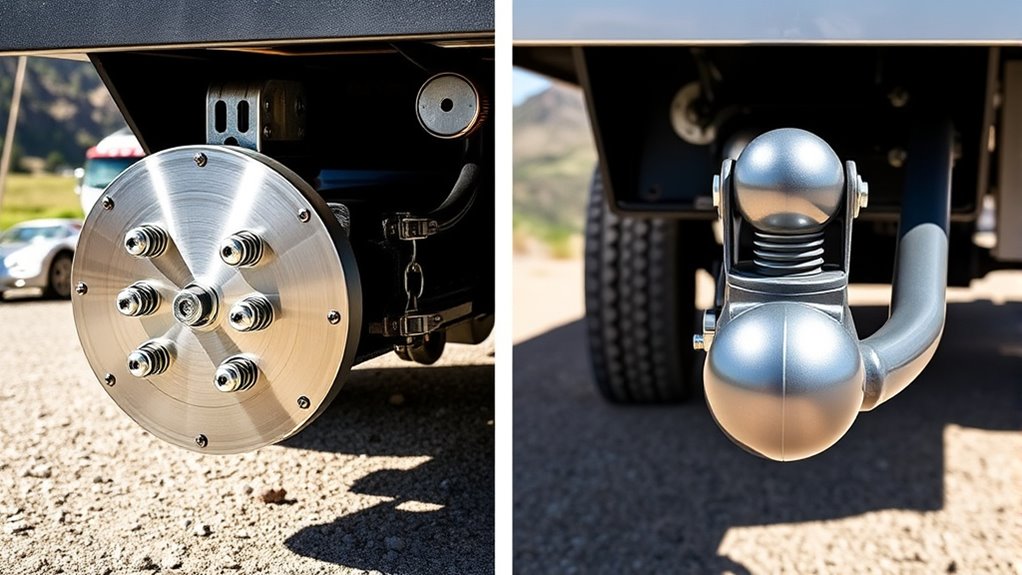
When choosing between a fifth wheel and a gooseneck trailer, understanding their differences can help you make an informed decision. Both types of trailers are popular for hauling heavy loads, but they have distinct features that affect hitch installation and trailer maneuvering. Grasping these differences ensures you select the right option for your needs and can operate it safely and efficiently.
Hitch installation is a critical factor to *take into account*. Fifth wheel hitches mount in the bed of your truck, connecting directly over the rear axle. This setup offers a stable, secure connection that supports heavy loads and provides better weight distribution. Installing a fifth wheel hitch requires a custom-fit mounting kit, which can be a straightforward or complex process depending on your truck model. It often involves drilling into the truck bed and ensuring proper alignment for safe operation. Conversely, gooseneck hitches attach via a ball hitch mounted in the truck bed, usually over or slightly in front of the rear axle. Installing a gooseneck is generally quicker and less invasive, often involving a simple ball installation and some minor modifications. Both hitch types demand proper installation to *make certain* safety, but the complexity varies. Additionally, the compatibility of each hitch with your truck’s make and model can influence installation ease and safety considerations.
Fifth wheel hitches require custom mounting; goosenecks are quicker and simpler to install.
When it comes to trailer maneuvering, each hitch type offers different handling characteristics. Fifth wheel trailers tend to be easier to maneuver at low speeds. The hitch’s central position over the rear axle provides a tighter turning radius, making it simpler to navigate through tight spaces or reverse with precision. This improved maneuverability is especially advantageous if you frequently park or maneuver in confined areas. On the other hand, gooseneck trailers, while offering excellent stability for heavy loads, can be slightly more challenging to handle in tight turns. Because the hitch is located at the rear of the truck bed, the trailer can swing out more during sharp turns, requiring extra caution and skill. However, with practice, many operators find goosenecks just as manageable as fifth wheels, especially for long-distance hauling on open roads.
Both hitch systems also influence trailer maneuvering in terms of trailer sway and stability. Fifth wheels, with their higher hitch point and central position, tend to reduce sway, providing a smoother ride. Goosenecks, however, are highly stable once properly hitched, making them suitable for heavy-duty applications even if they might require more attention during tight turns. Ultimately, your choice depends on your hauling needs, your truck setup, and your comfort level with maneuvering each type. Understanding the differences in hitch design and performance can help ensure you select the best option for your specific hauling requirements.
fifth wheel hitch installation kit
As an affiliate, we earn on qualifying purchases.
As an affiliate, we earn on qualifying purchases.
Frequently Asked Questions
Can I Convert a Fifth Wheel Hitch to a Gooseneck?
You can convert a fifth wheel hitch to a gooseneck, but it depends on hitch compatibility and conversion feasibility. Usually, you’ll need an adapter or kit designed for this purpose, and not all hitches are suitable for conversion. Check with your hitch manufacturer to verify the process is safe and effective. Keep in mind, professional installation is recommended to maintain trailer safety and performance.
Which Hitch Offers Better Maneuverability in Tight Spaces?
You’ll find that a gooseneck hitch offers better maneuverability in tight spaces because it has a tighter turning radius, making it easier to navigate around obstacles. Plus, it tends to reduce trailer sway during sharp turns, giving you more control. A fifth wheel hitch, on the other hand, usually has a larger turning radius, which can make maneuvering in confined areas more challenging.
Are There Weight Limits Specific to Each Hitch Type?
Absolutely, each hitch has its weight limits. Fifth wheel hitches typically handle a trailer capacity of up to 20,000 pounds, thanks to their sturdy design and hitch durability. Goosenecks often surpass that, supporting up to 30,000 pounds or more. You need to keep these limits in mind because trying to push them is like tempting fate. Always pick a hitch that matches your trailer’s weight to stay safe and avoid surprises.
How Do Maintenance Requirements Differ Between Fifth Wheel and Gooseneck?
You need to regularly perform hitch maintenance, including hitch lubrication to keep parts moving smoothly, and wear inspection to identify potential issues early. Fifth wheels generally require more frequent lubrication of the kingpin and locking mechanisms, while goosenecks need inspection of the hitch ball and mounting points for wear. Both types benefit from routine checks to ensure safe towing, but the specific maintenance tasks depend on your hitch type.
What Are the Safety Considerations for Each Hitch Type?
Think of safety considerations like a tightrope walk—you need balance and awareness. You should regularly check hitch compatibility and guarantee proper trailer coupling, whether you use a fifth wheel or gooseneck. Always double-check that the hitch is securely locked before towing, and inspect for wear or damage. Proper training and understanding of each hitch type help prevent accidents, making your journey safer and smoother.
As an affiliate, we earn on qualifying purchases.
Conclusion
Now that you know the differences between fifth wheel and gooseneck hitches, the choice really boils down to your specific needs. Both are built for heavy-duty towing, but one might feel like a perfect fit while the other’s a bit of a square peg. Remember, it’s better to get it right the first time than to be caught between a rock and a hard place. Choose wisely, and you’ll be set for the long haul.
As an affiliate, we earn on qualifying purchases.
As an affiliate, we earn on qualifying purchases.
Fall Picks
fall essentials
As an affiliate, we earn on qualifying purchases.