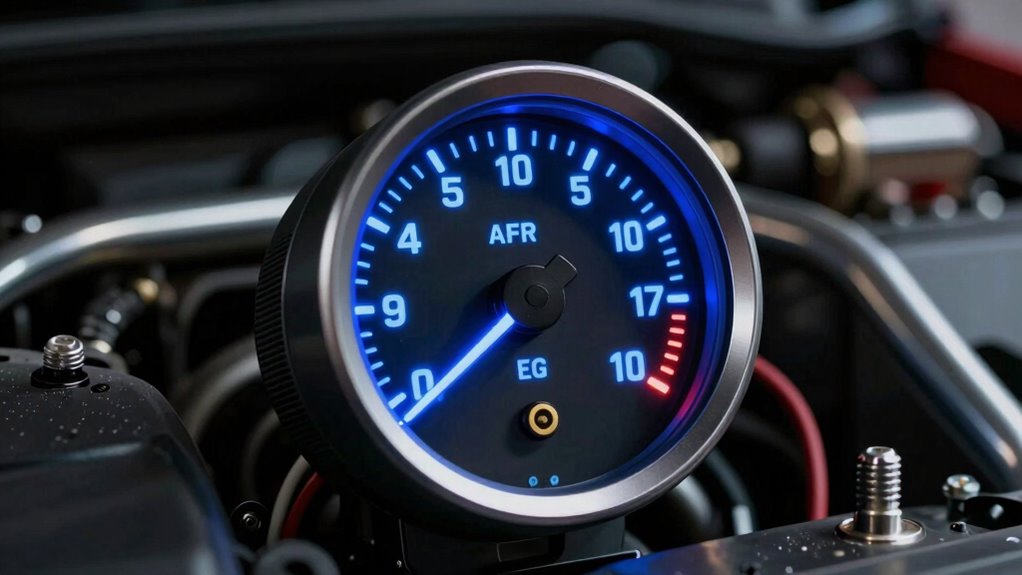

Once you crank up the boost, wideband gauges become essential because they give you real-time, precise data on your air-fuel mixture. This helps you avoid running too rich or too lean, which can cause engine damage or decreased efficiency. They allow you to fine-tune your engine for peak performance and fuel economy while preventing harmful emissions. Keep going to discover more about how these gauges protect your engine and enhance your tuning.

Get business pricing on garage and car supplies
- Business-only prices and quantity discounts
- Tax-exempt purchasing
- Multiple users, one account, clear invoices
Key Takeaways
- Wideband gauges provide real-time, accurate air-fuel ratio data essential for safe high-boost tuning.
- They help prevent running too rich or too lean, protecting engine components under increased boost.
- Proper monitoring ensures optimal fuel mixture, maximizing power and fuel efficiency during boost adjustments.
- Wideband gauges assist in maintaining emissions compliance and regulatory standards at higher boost levels.
- They enable precise tuning to avoid engine damage from improper air-fuel mixtures during boost increases.

Understanding your vehicle’s performance requires more than just monitoring boost levels; it also involves keeping an eye on air-fuel ratios with wideband gauges. When you start cranking up boost, the engine’s air and fuel mixture becomes more critical. Without a precise view of the air-fuel ratio, you risk running too rich or too lean, which can severely impact overall performance. Wideband gauges give you real-time data, allowing you to fine-tune your engine settings for optimal operation. Proper air-fuel mixture not only improves fuel efficiency but also reduces harmful exhaust emissions, making your vehicle more environmentally friendly and cost-effective to run.
Monitoring air-fuel ratios with a wideband gauge ensures optimal performance and reduces emissions during boost adjustments.
As you turn up the boost, your engine demands more air, and the fuel delivery must match that increased airflow. If the mixture is too rich, you’re wasting fuel and increasing emissions unnecessarily. Leaner mixtures, on the other hand, can lead to knocking, overheating, and potential engine damage. Wideband gauges help you find that sweet spot where fuel efficiency is maximized without compromising power or engine health. This balance ensures that you’re getting the most out of each gallon of fuel while keeping emissions within acceptable limits. Maintaining proper air-fuel ratios becomes especially important during high-boost conditions, where small deviations can cause big problems. Engine tuning is essential to achieve this balance and prevent costly mistakes.
Using a wideband gauge also helps you monitor exhaust emissions more accurately. Elevated emissions not only harm the environment but can also cause your vehicle to fail emissions tests, leading to costly repairs or fines. By keeping an eye on your air-fuel ratios, you can make adjustments before emissions levels become problematic. This proactive approach saves you money and helps you stay compliant with local regulations. Additionally, consistent monitoring allows you to optimize your tune for different driving conditions, whether you’re hitting the track or daily commuting. The importance of engine management cannot be overstated when tuning for higher boost levels. The result is a vehicle that runs cleaner, smoother, and more efficiently.
In essence, once you start turning up boost, a wideband gauge becomes an essential tool. It provides the critical data needed to balance fuel efficiency and emissions, ensuring your engine performs reliably and responsibly. Without it, you’re flying blind, risking damage, poor fuel economy, and excessive pollution. With a wideband gauge, you gain control, precision, and peace of mind—knowing that your modifications are working as intended and that your engine remains healthy under increased boost conditions. It’s an investment that pays off in better performance, lower operating costs, and a greener footprint. Proper monitoring tools are essential for safe and effective tuning at higher boost levels.
As an affiliate, we earn on qualifying purchases.
Frequently Asked Questions
How Often Should I Recalibrate My Wideband Gauge?
You should recalibrate your wideband gauge every 6 to 12 months to maintain ideal gauge accuracy. Calibration frequency depends on driving conditions, how often you push your boost, and if you notice any irregular readings. Regular calibration ensures your readings stay precise, helping you avoid potential engine issues. Always follow the manufacturer’s recommendations for calibration intervals, especially after any sensor replacement or if you experience inconsistent gauge performance.
Can Wideband Gauges Cause Engine Damage if Misread?
Yes, wideband gauges can cause engine damage if misread, especially if sensor calibration is off. Poor calibration can lead to inaccurate gauge accuracy, causing you to run your engine too rich or too lean. This imbalance stresses engine components, risking damage over time. To prevent this, regularly recalibrate your sensor, verify proper installation, and stay attentive to gauge readings. Proper maintenance helps keep your engine safe and running efficiently.
Are There Wireless Wideband Gauge Options Available?
Yes, wireless wideband gauge options are available. They use wireless connectivity to transmit data to your display, eliminating the need for messy wires. When choosing one, consider battery life, as some models require frequent charging or battery replacements. Wireless gauges offer convenience and a clean setup, but make certain they have reliable wireless signals and long-lasting batteries so you can monitor your air-fuel ratio accurately without interruptions.
How Do Ambient Temperatures Affect Wideband Readings?
Ambient temperatures greatly influence your wideband readings. Temperature fluctuations can cause the sensor to give inaccurate data if it’s not properly calibrated for current conditions. To maintain precision, you should calibrate your gauge more frequently in varying ambient temps. When temperatures rise or fall sharply, check and recalibrate your wideband sensor to verify accurate readings, especially during high-boost situations where precise AFR monitoring is essential for engine safety.
What’s the Ideal Air-Fuel Ratio for Different Fuel Types?
For ideal fuel efficiency and combustion stability, you should aim for an air-fuel ratio (AFR) around 14.7:1 for gasoline, 12.8:1 for diesel, and about 13.0:1 for ethanol blends. These ratios guarantee complete combustion, maximizing power while minimizing emissions. Adjusting your wideband gauge accordingly helps you maintain these perfect ratios, especially when tuning for increased boost, ensuring your engine runs smoothly and efficiently under different fuel types.
car boost gauge with wideband sensor
As an affiliate, we earn on qualifying purchases.
As an affiliate, we earn on qualifying purchases.
Conclusion
Just like a captain needs her compass in uncharted waters, your wideband gauge guides you through the turbulent seas of increased boost. Ignoring it risks steering into unseen hazards, much like a sailor ignoring the stars. When you push your car’s limits, this gauge becomes your trusted ally, illuminating the true air-fuel ratio. Without it, you’re sailing blind—destined to either sail smoothly or crash against unseen reefs in the darkness.
high performance wideband O2 sensor
As an affiliate, we earn on qualifying purchases.
As an affiliate, we earn on qualifying purchases.
As an affiliate, we earn on qualifying purchases.
Columbus Day / Indigenous Peoples' Day Picks
long weekend sales
As an affiliate, we earn on qualifying purchases.