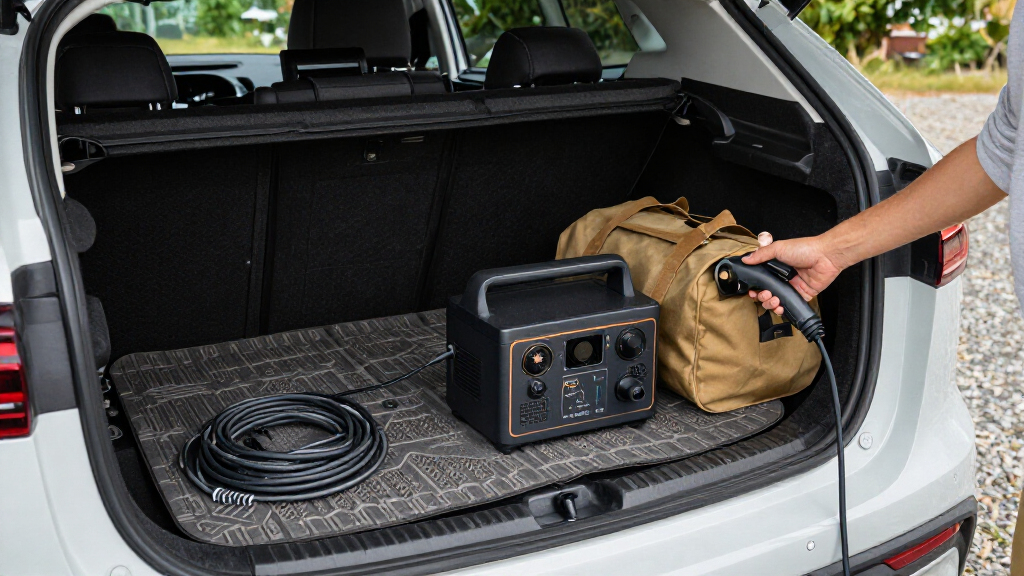

The best portable power station for most car owners is the Jackery Explorer 1000 v2, which pairs a large 1,070Wh capacity with 1,500W output for longer trips and bigger loads. For a smaller, more car-friendly setup, the Anker SOLIX C300 offers 288Wh in a compact class, while the VTOMAN Jump 600X is a more specialized pick for buyers who want jump-start capability alongside portable power. The central tradeoff is capacity versus size: larger stations can run more devices for longer, but take up more cargo space and may need more planning to recharge. Smaller units are easier to carry and store, though their runtime is limited. Read on for the full comparison and guidance on matching a station to your vehicle, trip, and backup needs.

Get business pricing on garage and car supplies
- Business-only prices and quantity discounts
- Tax-exempt purchasing
- Multiple users, one account, clear invoices
Complete the kit


Key Takeaways
- The Jackery Explorer 1000 v2 leads for extended car trips because its 1,070Wh capacity and 1,500W output are a substantial step up from the 256–292Wh compact options.
- Most compact picks cluster around 256–300Wh, so distinctions such as output, battery chemistry, charging options, and portability matter more than small capacity differences.
- The VTOMAN Jump 600X and the 2000A jump starter with compressor serve a different job: they appeal to drivers who prioritize vehicle-starting support, not just powering devices.
- The BLUETTI Elite 30 V2 stands out on rated output within the compact group, with 600W available from a 288Wh station; that higher output does not mean longer runtime.
- The Anker SOLIX C1000 Gen 2 is the capacity-focused premium alternative, while small options such as the MARBERO M82 make more sense for lightweight, limited-power needs than as a main car backup.
| Jackery Explorer 1000 v2 Portable Power Station, 1070Wh, 1500W |  | Best for Extended Car Trips | Battery capacity: 1,070Wh | Battery type: LiFePO4 (LFP) | Running output: 1,500W | VIEW LATEST PRICE | See Our Full Breakdown |
| BailiBatt 300W Portable Power Station, 266Wh |  | Best for Simple Car-Trip Backup | Capacity: 266Wh | AC output: 300W; 110V pure sine wave | USB-C ports: 2: 24W and 18W | VIEW LATEST PRICE | See Our Full Breakdown |
| DARAN 350W Portable Power Station, 288Wh |  | Best for Flexible Recharging | Capacity: 288Wh | Battery type: LiFePO4 | AC output: 350W | VIEW LATEST PRICE | See Our Full Breakdown |
| Anker SOLIX C300 Portable Power Station, 288Wh |  | Best Compact Option for Car Charging | Battery capacity: 288Wh | Battery type: LiFePO4 | Running output: 300W | VIEW LATEST PRICE | See Our Full Breakdown |
| MARBERO M82 Portable Power Station, 88Wh, 120W Surge |  | Best Ultralight Pick for Phone and Small-Device Backup | Capacity: 88Wh | Battery capacity: 24,000mAh | Output wattage: 80W | VIEW LATEST PRICE | See Our Full Breakdown |
| 2000A Car Jump Starter with Air Compressor and 400W Inverter |  | Best for Roadside Emergencies | Peak amperage: 2000 A | Battery: 12 V lead-acid, 22 Ah (20,000 mAh listed) | Inverter output: 400 W | VIEW LATEST PRICE | See Our Full Breakdown |
| VTOMAN Jump 600X Portable Power Station, 600W |  | Best for Frequent Road Trips | Battery chemistry: LiFePO4 | Continuous AC output: 600 W | Peak output: 1200 W | VIEW LATEST PRICE | See Our Full Breakdown |
| Bailibatt 300W Portable Power Station, 257Wh |  | Best for Simple, Low-Power Car Charging | Capacity: 257 Wh | Maximum output: 300 W | AC outlets: 2 × 120 V pure sine wave | VIEW LATEST PRICE | See Our Full Breakdown |
| DYNESS 300W Portable Power Station with 256Wh LiFePO4 Battery |  | Best for Included Car Recharging | Battery capacity: 256 Wh | Battery chemistry: LiFePO4 | Continuous output: 300 W | VIEW LATEST PRICE | See Our Full Breakdown |
| BLUETTI Elite 30 V2 Portable Power Station, 288Wh, 600W |  | Best Premium Compact Station | Capacity: 288 Wh | Battery chemistry: LFP | Continuous output: 600 W | VIEW LATEST PRICE | See Our Full Breakdown |
| Jackery Explorer 300 Portable Power Station, 292Wh |  | Best Compact Pick | Battery capacity: 292Wh | Battery chemistry: LiFePO4 | Peak surge output: 600W | VIEW LATEST PRICE | See Our Full Breakdown |
| Anker SOLIX C1000 Gen 2 Portable Power Station with Car Charging Cable |  | Best for High-Capacity Car Backup | Battery capacity: 1,024Wh | Battery type: LiFePO4 | Output wattage: 2,000W | VIEW LATEST PRICE | See Our Full Breakdown |
| portable power stations for car | Battery capacity |
|---|---|
| Jackery Explorer 1000 v2 Porta | 1,070Wh |
| BailiBatt 300W Portable Power | — |
| DARAN 350W Portable Power Stat | — |
| Anker SOLIX C300 Portable Powe | 288Wh |
| MARBERO M82 Portable Power Sta | 24,000mAh |
| 2000A Car Jump Starter with Ai | — |
| VTOMAN Jump 600X Portable Powe | — |
| Bailibatt 300W Portable Power | — |
| DYNESS 300W Portable Power Sta | 256 Wh |
| BLUETTI Elite 30 V2 Portable P | — |
| Jackery Explorer 300 Portable | 292Wh |
| Anker SOLIX C1000 Gen 2 Portab | 1,024Wh |
More Details on Our Top Picks
Jackery Explorer 1000 v2 Portable Power Station, 1070Wh, 1500W
For car owners who need more than phone charging and short emergency backup, the Explorer 1000 v2 offers the most capacity in this group: 1,070Wh and 1,500W of running output. That gives it more headroom for several devices or higher-draw gear than the Anker SOLIX C300, though it is also a much heavier unit at 23.8 pounds. Its three AC outlets, USB ports, and 12V car port suit a road-trip setup where passengers need different charging options. The LiFePO4 battery is rated to retain over 70% capacity after 4,000 cycles. Rapid charging has a catch: the one-hour mode must be enabled in the app, while the default charge takes 1.7 hours. Solar panels are not included, and solar charging is limited to Jackery panels.
Pros:- 1,070Wh capacity and 1,500W output provide much more reserve than the compact 288Wh models.
- Three AC outlets, USB ports, and a DC car port support a varied in-car setup.
- LiFePO4 battery is rated to retain over 70% capacity after 4,000 charge cycles.
- App controls include charging modes and an emergency one-hour charge option.
Cons:- At 23.8 pounds, it is less convenient to move than the 4.13 kg Anker SOLIX C300.
- Solar panel is not included, and solar charging is compatible only with Jackery panels.
- The one-hour charging mode requires app activation; default charging takes 1.7 hours.
Best for: Road-trippers and car campers who need substantial capacity for multiple devices or equipment beyond phones and small electronics.
Not ideal for: Drivers seeking a light, low-capacity unit for occasional phone charging, or buyers who want broad third-party solar-panel compatibility.
- Battery capacity:1,070Wh
- Battery type:LiFePO4 (LFP)
- Running output:1,500W
- Surge peak:3,000W
- Ports:3 AC, 2 USB-C, 1 USB-A, 1 DC car port
- USB-C output:Up to 100W
- Weight:23.8 lbs
- Charging time:1 hour with emergency charging enabled; 1.7 hours by default
- Solar compatibility:Jackery solar panels only; panel not included
Our verdict“Choose the Explorer 1000 v2 if car trips call for long-lasting, high-output power and you can accept its extra weight and Jackery-only solar support.”
BailiBatt 300W Portable Power Station, 266Wh
The BailiBatt is a straightforward choice for drivers who want a small reserve for phones, lights, and other modest loads without carrying a large station. At 6.5 pounds, it is easier to lift in and out of a car than the Jackery Explorer 1000 v2, while its 266Wh capacity offers more staying power than the 88Wh MARBERO M82. Seven outputs, including a 12V car port and two USB-C ports, help a small group charge several devices at once. The LCD displays input and output wattage alongside remaining battery, which makes it easier to judge what the connected gear is drawing. Its 300W output sets a firm limit, however, and the USB-C ports are uneven at 24W and 18W. Solar charging needs a separately purchased panel.
Pros:- 6.5-pound body is easier to carry than the high-capacity Jackery Explorer 1000 v2.
- Seven outputs include AC, USB-C, USB-A, DC, and a 12V car port.
- LCD shows input and output wattage plus remaining battery.
- Three-mode LED light includes Bright, Strobe, and SOS settings.
Cons:- 266Wh capacity and 300W output restrict it to smaller loads and shorter backup needs.
- USB-C ports have different output limits of 24W and 18W.
- Solar panel is sold separately.
Best for: Drivers who want a portable backup for phones, small electronics, and lights, with a readable battery and power-use display.
Not ideal for: Car campers who need to run higher-wattage appliances or want a long-duration reserve for several days.
- Capacity:266Wh
- AC output:300W; 110V pure sine wave
- USB-C ports:2: 24W and 18W
- Other outputs:2 QC3.0 USB-A ports, 12V car port, DC output
- Total outputs:7
- Weight:6.5 lb
- Display:LCD with input/output wattage and remaining battery
- Lighting:Bright, Strobe, and SOS modes
- Warranty:24 months
Our verdict“Pick the BailiBatt for lightweight, small-device car backup with useful display and port variety, not for running demanding gear.”
DARAN 350W Portable Power Station, 288Wh
The DARAN’s main advantage for car use is that it supports AC, car-charger, and compatible solar recharging, giving drivers several ways to replenish its 288Wh battery. That flexibility contrasts with the BailiBatt 300W, whose product information lists a solar panel as a separate purchase but gives less detail about recharging options. The DARAN also edges the Anker SOLIX C300 on stated running output at 350W versus 300W, though neither is meant for high-draw appliances. Two AC outlets, a 60W USB-C port, two USB-A ports, and a 12V socket can serve up to six devices at once. Its LiFePO4 battery is rated for more than 3,000 cycles. The tradeoff is modest capacity, and the 600W peak is surge capacity—not a sustained operating level.
Pros:- Recharge options include AC, car charger, and compatible solar panels.
- 350W running output is higher than the Anker SOLIX C300’s stated 300W.
- LiFePO4 battery is rated for more than 3,000 cycles.
- Six-device capacity, status display, and three-mode LED light suit shared trips.
Cons:- 288Wh capacity limits runtime compared with the Jackery Explorer 1000 v2.
- 600W is a peak surge rating, while sustained AC output is limited to 350W.
- Solar panel is sold separately.
Best for: Car campers who want multiple recharge routes and enough outlets for a group’s small electronics and lights.
Not ideal for: Drivers planning to power appliances that exceed 350W or needing the long reserve of a 1,000Wh-class station.
- Capacity:288Wh
- Battery type:LiFePO4
- AC output:350W
- Peak surge output:600W
- Battery cycle life:3,000+ cycles
- Ports:2 AC, 1 60W USB-C PD, 2 18W USB-A, 1 12V car socket
- Recharge methods:AC, car charger, and compatible solar panel
- AC recharge time:0–80% in 2.5 hours with 100W AC input
- LED light modes:Solid, Strobe, and SOS
Our verdict“Choose the DARAN if car and solar recharging flexibility matters more than long runtime or appliance-level output.”
Anker SOLIX C300 Portable Power Station, 288Wh
The Anker SOLIX C300 makes the most sense for drivers who value compact size and a broad set of ways to recharge. Its 288Wh capacity is close to the DARAN’s, but the Anker offers eight outlets, including three USB-C ports, and supports wall, solar, car, and USB-C charging. That range can make it easier to fit into a mixed car-and-camp routine. It is also rated at 25 dB at 3.3 feet, a helpful detail for use near a sleeping area. Compared with the 6.5-pound BailiBatt 300W, the C300 has a more clearly specified charging mix but weighs 4.13 kg, so it is not the lightest small station here. Its 300W output and 288Wh capacity remain intended for smaller loads, and solar compatibility has panel restrictions.
Pros:- Eight outlets include three USB-C ports, three AC outlets, and a car socket.
- Can recharge from wall power, solar, car power, or USB-C.
- LiFePO4 battery is rated for 3,000 cycles.
- Stated 25 dB operating noise may suit quiet campsites or sleeping areas.
Cons:- 300W output and 288Wh capacity limit it to smaller loads and shorter use.
- At 4.13 kg, it is heavier than the 6.5-pound BailiBatt 300W.
- Solar compatibility excludes several Anker SOLIX panels and other 5V/3A USB-C panels.
Best for: Drivers and campers who want a compact station with many charging options, several USB-C ports, and low stated operating noise.
Not ideal for: Buyers who prioritize the lightest possible unit, need more than 300W of sustained output, or own incompatible Anker solar panels.
- Battery capacity:288Wh
- Battery type:LiFePO4
- Running output:300W
- Surge output:600W
- Outlets:8 total: 3 AC, 1 car socket, 3 USB-C, 1 USB-A
- USB-C output:2 ports at 140W each; 1 port at 15W
- Weight:4.13 kg
- Noise level:25 dB at 3.3 ft
- Recharge time:Up to 80% in 50 minutes via wall outlet
Our verdict“Choose the C300 for compact car and campsite use when varied recharging and USB-C access matter more than high output or minimum weight.”
MARBERO M82 Portable Power Station, 88Wh, 120W Surge
At 3.2 pounds, the MARBERO M82 is the easiest station here to tuck into a car and carry to a picnic table or campsite. Its 88Wh capacity and 80W output make it a better fit for phones, small electronics, and modest DC loads than the 288Wh Anker SOLIX C300 or DARAN. That tradeoff is clear: the M82 is notably easier to carry, but offers far less energy and cannot handle higher-wattage appliances. It has eight ports, including AC, USB, USB-C PD, and DC outputs, plus a three-level LED light with SOS mode. The included cigarette-lighter output cable adds useful car-oriented flexibility. Charging is supported through an adapter or compatible MARBERO solar panels, but the solar panel is not listed as included.
Pros:- At 3.2 pounds, it is lighter and smaller than the other stations in this batch.
- Eight ports cover AC, USB, USB-C PD, and DC connections.
- Three-level LED light includes an SOS mode.
- Includes a cigarette-lighter output cable and supports adapter or compatible solar charging.
Cons:- 88Wh capacity offers much less reserve than the 288Wh DARAN and Anker SOLIX C300.
- 80W output is unsuitable for higher-wattage appliances.
- Solar panel is not listed as included and must be a compatible MARBERO model.
Best for: Drivers who want a very light emergency unit for topping up phones and small devices, with an integrated light for roadside use.
Not ideal for: Car campers who need extended runtime, sustained power above 80W, or enough capacity for larger appliances.
- Capacity:88Wh
- Battery capacity:24,000mAh
- Output wattage:80W
- Surge power:120W
- Ports:8
- Weight:3.2 lbs
- Dimensions:6.5 × 4.6 × 3.1 in
- Charging time:0–80% in 2 hours with included adapter
- Solar compatibility:MARBERO 30W or 60W panels
Our verdict“Pick the M82 for light, short-duration backup for phones and small devices, but choose a larger station for longer trips or heavier loads.”
2000A Car Jump Starter with Air Compressor and 400W Inverter
This is the most car-specific pick in this group: it pairs a 2000A jump starter with a tire inflator, so it can address two common roadside problems without relying on a separate power station and compressor. The digital pressure display helps you track inflation, while the 400W inverter, USB ports, and 12V socket add capacity for small devices and accessories. Compared with the VTOMAN Jump 600X, it favors jump-starting and tire care over a lighter, rechargeable power-station design with more continuous AC output. The tradeoff is its lead-acid battery, which is likely less convenient to carry than the lithium-based units here. Its 5W solar panel is a maintenance aid, not a practical primary charging source, and the listed 260 PSI rating does not indicate how quickly it inflates a tire.
Pros:- Combines jump-starting, tire inflation, and inverter power in one unit.
- Digital pressure display helps monitor tire inflation.
- Multiple AC, USB, and 12V outputs support varied small devices.
- Includes LED lighting and several electrical safety protections.
Cons:- Lead-acid battery may be heavier and less convenient to carry than the lithium-based stations.
- The 5W solar panel is described as a maintenance backup rather than a primary charging method.
Best for: Drivers who want one vehicle-oriented emergency unit for jump-starting, tire inflation, and powering small accessories.
Not ideal for: Campers or travelers who mainly need a lightweight, rechargeable station for electronics; the lead-acid battery and jump-start-focused design are less suited to frequent carrying and general-purpose use.
- Peak amperage:2000 A
- Battery:12 V lead-acid, 22 Ah (20,000 mAh listed)
- Inverter output:400 W
- AC outlets:2 × 110 V
- Engine compatibility:Up to 8.5L gas or diesel, as stated
- Other outputs:USB ports and 12 V DC socket
- Solar panel:5 W
Our verdict“Choose this if roadside readiness matters more than a lightweight power station for camping or everyday device charging.”
VTOMAN Jump 600X Portable Power Station, 600W
The Jump 600X suits drivers who want a compact station that can also serve as a regular travel and camping battery. Its 600W pure sine wave output gives it twice the continuous AC capacity of the Bailibatt 300W, while the 100W USB-C PD port can handle compatible laptops without using an AC adapter. At 9.92 pounds, it is still portable, and its LiFePO4 battery is rated for 3,000 cycles to 80% capacity. That makes it a stronger fit for repeated trips than a smaller, occasional-use unit. The name may suggest jump-starting, but the supplied information describes a power station rather than confirming jump-start capability. Buyers also need to add a solar panel separately, and appliances must stay within its 600W continuous limit.
Pros:- 600W continuous pure sine wave output exceeds the 300W Bailibatt and DYNESS stations.
- 100W USB-C PD supports compatible laptop charging.
- LiFePO4 battery is rated for 3,000 cycles to 80% capacity.
- Compact 9.92 lb design supports travel and camping use.
Cons:- Solar panel is sold separately.
- Combined device load must remain within the 600W continuous output.
- The supplied product details do not confirm a jump-start function despite the model name.
Best for: Road-trippers and campers who regularly charge laptops and small appliances and want a portable station with a long stated cycle life.
Not ideal for: Drivers specifically seeking a confirmed engine jump starter, or anyone who needs to run appliances above 600W continuously.
- Battery chemistry:LiFePO4
- Continuous AC output:600 W
- Peak output:1200 W
- AC waveform:Pure sine wave
- USB-C PD output:100 W
- Maximum solar input:120 W MPPT
- Battery cycle life:3,000 cycles to 80% capacity
- Weight and dimensions:9.92 lb; 9.4 × 8.1 × 7.2 in
Our verdict“Pick the Jump 600X for regular car trips that call for more AC and USB-C power than the smaller 300W stations provide.”
Bailibatt 300W Portable Power Station, 257Wh
The Bailibatt 300W is a straightforward choice for drivers who want to charge several small devices from one compact battery. Its 257Wh capacity and eight outputs cover phones, cameras, and compatible low-wattage gear, while two pure sine wave AC outlets provide flexibility the single-outlet DYNESS PPS300 lacks. An LCD and battery management system make it easier to check charge status and monitor basic protection functions. The tradeoff is limited headroom: its 300W maximum output rules out many higher-draw appliances, and its 24W USB-C output is less suited to demanding laptop charging than the VTOMAN Jump 600X’s 100W port. Car charging and solar are listed as options, but the car cable and solar accessories are not included. The listed weight also conflicts with the product description, so portability is harder to judge precisely.
Pros:- Eight outputs include two pure sine wave AC outlets and multiple USB ports.
- LCD display and battery management system provide status information and protection monitoring.
- Can recharge from an AC outlet, a car outlet, or an optional solar panel.
- Rated for more than 1,500 charge cycles.
Cons:- 300W maximum output limits use with higher-draw appliances.
- Car charging cable and solar accessories are not included.
- Weight is inconsistent in the supplied details: 4.6 lb in the description and 5.4 lb in the specifications.
Best for: Drivers who need a modest-capacity station for phones, cameras, and other small devices, with multiple output choices.
Not ideal for: Buyers planning to power high-wattage appliances, charge laptops quickly over USB-C, or use car and solar charging without sourcing extra accessories.
- Capacity:257 Wh
- Maximum output:300 W
- AC outlets:2 × 120 V pure sine wave
- USB-C output:24 W PD
- USB-A outputs:3 ports: 1 QC3.0 and 2 × 5 V/3 A
- 12V DC outputs:2 × 12 V/10 A; 120 W total
- Recharge methods:AC wall outlet, 12 V car outlet, or optional solar
- Weight and dimensions:5.4 lb listed in specifications; 8 × 4 × 6.5 in
Our verdict“Choose the Bailibatt for a range of small-device charging needs, but skip it if you need more than 300W or a ready-to-use car charging cable.”
DYNESS 300W Portable Power Station with 256Wh LiFePO4 Battery
Among the smaller stations here, the DYNESS PPS300 makes car recharging especially direct: its package includes a car cigarette cable, unlike the Bailibatt 300W, whose car charging cable is not included. Its 256Wh LiFePO4 battery, 300W continuous output, and six-port layout suit phones, lights, and other modest loads on a road trip or at camp. AC, car, solar, and dual-input charging give owners several ways to replenish it, though the solar panel is optional. Compared with the VTOMAN Jump 600X, this model has half the continuous AC output and a less powerful listed USB-C offering, but it is a more focused fit for buyers who can stay within 300W and value an included vehicle charging lead. The supplied data does not specify its weight, making carry comfort difficult to compare.
Pros:- Includes a car cigarette cable for vehicle recharging.
- LiFePO4 battery chemistry is intended for long cycle life and stable storage.
- Supports AC, car, solar, and dual-input recharging.
- Six output ports cover common small-device and accessory charging needs.
Cons:- 300W continuous output restricts use to smaller appliances and devices.
- Solar panel is not included.
- Weight is not specified in the supplied product data.
Best for: Drivers seeking a compact LiFePO4 station for small electronics who want a car charging cable included in the box.
Not ideal for: Travelers who need to run loads above 300W, want a confirmed lightweight figure, or expect solar charging accessories to come with the unit.
- Battery capacity:256 Wh
- Battery chemistry:LiFePO4
- Continuous output:300 W
- Starting wattage:600 W
- AC output:1 × 110 V pure sine wave
- Output ports:6: 1 AC, 1 USB-C, 1 USB-A, 2 DC, and 1 car outlet
- Recharge methods:AC, compatible solar, car charger, or dual input
- Dimensions:9.3 × 5 × 6.8 in
Our verdict“Pick the DYNESS if included car recharging and LiFePO4 storage matter more than the extra AC capacity offered by the VTOMAN Jump 600X.”
BLUETTI Elite 30 V2 Portable Power Station, 288Wh, 600W
The Elite 30 V2 is the most feature-rich compact station in this selection, pairing 600W continuous output with 288Wh capacity and a stated 1500W Power Lifting Mode. It offers more operating headroom than the Bailibatt and DYNESS 300W models, while its included car charging cable makes vehicle recharging less of an add-on purchase. Fast AC charging—0–80% in 45 minutes—and UPS switching up to 10ms add value for users who also want home backup, rather than a car-only battery. At 9.5 pounds, it remains fairly compact, but the capacity still limits runtime for energy-hungry devices. Its higher output does not change that energy limit, and the supplied details do not clarify which loads suit Power Lifting Mode, so buyers should check appliance requirements before relying on it.
Pros:- 600W continuous output gives it more load capacity than the 300W Bailibatt and DYNESS stations.
- Includes a car charging cable and supports solar and other charging methods.
- AC charging reaches 80% in a stated 45 minutes.
- UPS switching of up to 10ms can help keep connected devices running during a power interruption.
Cons:- 288Wh capacity can limit runtime for higher-power devices.
- At 9.5 lb, it is heavier than the smaller Bailibatt unit.
- The supplied details do not explain which appliances are suitable for Power Lifting Mode.
Best for: Drivers who want a compact station with 600W output, included car charging, fast AC replenishment, and occasional home backup use.
Not ideal for: Buyers who need long runtimes for high-power appliances or a very light unit for carrying over long distances.
- Capacity:288 Wh
- Battery chemistry:LFP
- Continuous output:600 W
- Surge output:1500 W
- Weight and dimensions:9.5 lb; 9.8 × 7 × 6.6 in
- AC charging:0–80% in 45 minutes; 0–100% in 70 minutes
- USB-C PD output:140 W
- UPS switching time:Up to 10 ms
- Charging sources:Solar, AC, car, lead-acid, or generator
Our verdict“Choose the Elite 30 V2 if you want premium charging and backup features in a compact 600W station, and accept limited energy capacity.”
Jackery Explorer 300 Portable Power Station, 292Wh
The Jackery Explorer 300 suits drivers who want a light, grab-and-go source for phones, laptops, and other modest loads without filling the trunk. Its 292Wh LiFePO4 battery and 300W rated output offer more capacity than the 88Wh MARBERO M82, while the 7.1-pound listed weight keeps it easier to carry than larger stations such as the Anker SOLIX C1000 Gen 2. Two AC outlets, USB ports, a 100W USB-C port, and a 120W car port let it serve several devices at once. The tradeoff is limited output for larger appliances, and the solar panel is sold separately. The product information also gives two weights, 7.1 and 7.5 pounds, so buyers should expect a small discrepancy.
Pros:- Compact 7.1-pound listed weight and integrated carry handle make it easy to move between a car and campsite
- LiFePO4 battery is rated for over 4,000 charge cycles before reaching 70% capacity
- Six-device charging support includes a 100W USB-C port and a 120W car port
- Compatible with Jackery solar panels for off-grid recharging
Cons:- 300W rated output limits use with higher-draw appliances
- Compatible solar panel is sold separately
- Product information lists both 7.1 and 7.5 pounds
Best for: Drivers who want a lightweight station for charging phones, a laptop, cameras, and other low-wattage devices during trips or short outages
Not ideal for: Buyers who need to run high-wattage appliances or power several demanding devices for long periods; its 300W rated output and 292Wh capacity are modest
- Battery capacity:292Wh
- Battery chemistry:LiFePO4
- Peak surge output:600W
- Ports:2 AC outlets, 1 USB-C PD (100W), 2 USB-A, 1 car port (120W)
- Weight:7.1 pounds listed; description also states 7.5 pounds
- Dimensions:9.1 x 5.2 x 7.8 inches
- Solar charging:Approximately 80% in 2.8 hours with a 100W panel or 7.5 hours with a 40W panel
Our verdict“Choose the Explorer 300 for a compact car-trip station focused on everyday electronics, not high-wattage gear or extended backup.”
Anker SOLIX C1000 Gen 2 Portable Power Station with Car Charging Cable
For drivers who want a station that can support more than personal electronics, the Anker SOLIX C1000 Gen 2 brings 1,024Wh of capacity and up to 2,000W output in a portable format. That gives it a very different role from the Jackery Explorer 300: the Jackery is lighter and easier to stow, while this Anker is better suited to longer outages and higher-demand equipment. Its 10 ports, fast AC recharge, and 600W maximum solar input make replenishing a larger battery practical when suitable power is available. The IP54 rating and raised feet add protection around damp campsites, but do not make it waterproof. It is also far bulkier than compact options, and the car charging cable ships separately despite appearing in the included-components list.
Pros:- 1,024Wh capacity and 2,000W output support more demanding devices and longer use than compact 300W-class stations
- Ten ports allow multiple devices to draw power at once
- Fast AC recharge and up to 600W solar input provide multiple ways to replenish its larger battery
- IP54 water resistance and raised rubber feet offer added protection around wet ground
Cons:- Larger body is less convenient to carry and store in a crowded vehicle than the Jackery Explorer 300
- Car charging cable is shipped separately, so it may not be ready for car charging on arrival
- Solar charging at the stated maximum requires a compatible setup capable of up to 600W input
Best for: Drivers and campers who need substantial capacity for longer trips, emergency backup, or higher-wattage devices and can accommodate a larger unit
Not ideal for: Minimalist travelers seeking a lightweight station for phones and small electronics, or buyers who need a car charging cable immediately without arranging separate shipment
- Battery capacity:1,024Wh
- Battery type:LiFePO4
- Output wattage:2,000W
- Peak output:3,000W
- Number of ports:10
- AC recharge time:49 minutes at 1,600W
- Solar input:Up to 600W (60V maximum); stated recharge time is 1.8 hours with 600W solar input
- Dimensions:15.1 x 8.2 x 9.6 inches
- Water resistance:IP54
Our verdict“Choose the SOLIX C1000 Gen 2 when capacity and appliance support matter more than compact size, and confirm the car cable’s shipping timing.”

How We Picked
I ranked these options around the ways people use portable power in and around a car: charging phones and laptops, supporting small appliances at a campsite, keeping essential electronics powered during delays, and adding vehicle-starting help. I weighed usable capacity and rated output together, since watt-hours shape runtime while watts determine which devices a station can run. I also considered car-relevant charging options, portability, and battery details where listed; a convenient charging method can matter more on a trip than a headline capacity alone.
The order reflects how broadly useful each product appears for car owners, then how well it serves a more specific need. Larger, versatile stations rank ahead for buyers seeking a primary road-trip power source, while compact models earn their place through easier storage and targeted use. Jump starters are judged as a separate class, because vehicle-starting capability is not interchangeable with a power station’s battery capacity. Where product details are limited or the specifications overlap, I avoid treating small numerical differences as proof of a clear performance advantage.
Factors to Consider When Choosing Portable Power Stations For Cars
Choosing a power station for a car is not just a matter of picking the biggest battery. I’d start with what you need to run, how long you expect to be away from a wall outlet, and whether emergency vehicle starting is part of the plan. These broader checks can prevent a bulky purchase that is hard to recharge—or a compact one that runs out before the trip is over.
Match Capacity to Your Actual Runtime
Watt-hours estimate how much energy a station stores, but actual runtime is lower than a simple capacity-to-device calculation because conversion and operating losses use some energy. Add up the watt-hours of the devices you expect to run, or estimate their draw in watts and multiply by the hours of use. A phone and camera setup has very different needs from a cooler, CPAP machine, or cooking appliance. Buyers often choose a large station for occasional phone charging, paying in cargo space for capacity they may never use. For longer trips or devices that run for hours, a larger battery can be more useful than adding a second small station. Leave a reserve for unexpected delays rather than planning to drain the battery completely.
Check Output Against Device Startup Demands
Rated output in watts indicates what a station can support at one time, not how long it can support it. Compare that rating with each device’s running draw and, for motorized or compressor-based equipment, its startup demand. A device may briefly need more power when switching on than its label suggests for normal operation. A station with a large battery can still be the wrong fit if its output rating is too low for the appliance. The reverse is also true: high output does not make a small battery last longer. When a device’s power needs are uncertain, check its manual or label before buying instead of relying on a broad category name such as “small appliance.”
Plan How You Will Recharge Between Stops
Car charging can be convenient while driving, but it may be much slower than charging from a household outlet, and charging time depends on the station, cable, and vehicle supply. Confirm whether the required car cable is included or must be purchased separately, then check the manufacturer’s stated input limits. A long drive can replenish some energy, but a short commute may not restore much capacity after heavy use. Solar input can add flexibility at a campsite, though panel compatibility, weather, and setup time all affect the result. Avoid assuming that a larger station will recharge quickly just because it has more capacity. For frequent trips, compare the full charging routine—not only the battery size.
Decide Whether You Need a Power Station or a Jump Starter
A portable power station is built mainly to supply power to devices, while a jump starter is designed to help start a vehicle with a depleted battery. Some products combine functions, but the labels and ratings do not make those jobs interchangeable. If a dead battery is your main roadside concern, check for explicit jump-start capability and compatibility with your vehicle rather than assuming an inverter or large battery can start an engine. If you mainly need lights, phones, and camping equipment, a dedicated power station may be the more useful tool. Combination units can reduce the number of items in a trunk, though buyers should verify each function’s limits. Keep a separate roadside kit if the chosen station does not provide the starting support you need.
Treat Portability as a Vehicle-Fit Question
Capacity brings weight and bulk, so think about where the unit will sit and how often you will move it. Measure the available trunk or cargo area, including room for cables and ventilation, rather than judging fit from product photos. A compact station is easier to store in a smaller car, but a very small battery may be a poor substitute for a dedicated backup source. Larger models suit trips where power needs justify the space, especially if the station can stay packed in the vehicle. Check handle design and lifting weight if you expect to carry it between the car and a campsite. The best balance depends on whether the station is mostly parked in the trunk or carried by hand.
Read Battery and Safety Details Before Buying
Battery chemistry can affect cycle life, weight, and how a product is intended to be used, so compare the manufacturer’s stated battery details rather than focusing only on capacity. Check operating temperature guidance, storage instructions, and any limits on charging or use inside a vehicle. Heat inside a parked car can become a serious concern, and a power station should not be left exposed to conditions beyond its specified range. Look for clear overload and temperature protections, plus support information for replacement or service. Do not store the unit where it can shift, block vehicle controls, or suffer impacts during travel. These details are easy to overlook when comparing headline watt-hour figures, but they affect whether the station is practical to keep in a car.
Frequently Asked Questions
Can a portable power station jump-start my car?
Most portable power stations are designed to power devices, not to deliver the high current needed to start an engine. In this lineup, the VTOMAN Jump 600X and the 2000A jump starter with air compressor are the options aimed at vehicle-starting support, but buyers should check the product instructions and vehicle compatibility before relying on either. A standard station’s inverter rating does not confirm that it can jump-start a car. If starting a vehicle is your main concern, choose a unit that explicitly lists that function and keep its jump leads and charge level ready. For a broader emergency kit, a dedicated jump starter can complement a separate station for electronics.
Is a 288Wh station enough for a weekend car trip?
It can be enough for light use, such as charging phones, a camera, and small electronics, especially if you can recharge while driving or at a campsite. It is less suited to running higher-draw equipment for long periods or powering several devices continuously. Actual runtime depends on device draw and conversion losses, so estimate your planned use instead of treating the full 288Wh as available output. The compact group in this roundup is close in capacity, making output, charging methods, and portability useful tie-breakers. If you expect to use a cooler or other sustained load, calculate its energy needs before settling on a compact station.
Should I choose a higher-wattage station or a larger battery?
Choose higher output when a device’s power demand—including any startup surge—exceeds what a lower-rated station can supply. Choose more watt-hours when the devices already fit the station’s output limit but need to run longer. The BLUETTI Elite 30 V2 illustrates why those figures should be read separately: its 600W rating is a notable output figure for a compact unit, but its 288Wh capacity still limits total stored energy. A large battery with insufficient output may not run a particular appliance, while a high-output compact station may run it only briefly. Check both the device’s power draw and the expected hours of use before deciding.
Can I keep a power station plugged into my car while driving?
Many stations support charging from a vehicle outlet, but the safe method and acceptable input depend on the station and the vehicle. Follow the manufacturer’s instructions for the approved cable, input rating, and charging conditions; do not assume every outlet or cable combination is suitable. Vehicle outlets can have different power limits, and the engine-off behavior varies by car, which can affect charging and the vehicle battery. The Anker SOLIX C1000 Gen 2 is specifically listed with a car charging cable, but buyers should still check its instructions and their vehicle’s outlet limits. Never route cables where they can interfere with pedals, seat movement, or other controls.
Is a small power station better for keeping in the car year-round?
A smaller model is easier to store, but size alone does not make a station suitable for permanent vehicle storage. Temperature guidance matters because a parked car can become much hotter or colder than the conditions recommended for charging, operation, or storage. Review the manufacturer’s limits and storage instructions, and consider taking the unit indoors when conditions fall outside them. The MARBERO M82’s 88Wh capacity may suit limited charging needs, but it is not a substitute for a larger backup source if you need extended runtime. If you keep any station in a car, secure it against movement and check its charge periodically according to the manufacturer’s guidance.
Conclusion
For the best overall balance of capacity and output, I’d choose the Jackery Explorer 1000 v2 for longer car trips and more demanding device loads. Buyers seeking a best-value compact option should compare the BailiBatt and DARAN 300W-class models against the Anker SOLIX C300, focusing on their charging options and the exact devices they need to run rather than small capacity differences. The best premium pick is the Anker SOLIX C1000 Gen 2 for shoppers who want a larger station and the included car charging cable. For beginners with light power needs, a compact unit such as the Jackery Explorer 300 offers a more manageable starting point than a large-capacity system. Drivers who specifically want starting help should look at the VTOMAN Jump 600X or the 2000A jump starter with compressor; those needing a minimal, lightweight electronics backup can consider the MARBERO M82. Choose by the job you need the unit to do, then confirm runtime, output, charging, and vehicle-storage limits before buying.
Evergreen bestsellers Picks

Dyson V15s Detect Submarine Wet and Dry Vacuum, Yellow/Nickel

Vitamix Propel Series 510 Professional-Grade Blender, Black

Dyson HushJet Compact Air Purifier, White/Silver
As an affiliate, we earn on qualifying purchases.