
TL;DR
Get ready for Prime Big Deal Days — try Prime free
Exclusive member deals on October 6–7, plus fast free delivery. Cancel anytime.
Start your free trialAs an affiliate, we earn on qualifying purchases.
A Tesla FSD vehicle completed a test drive through Brussels with mostly positive results. The ride demonstrated significant progress but also revealed some challenges. The event highlights ongoing advances in autonomous driving technology.
A Tesla equipped with its Full Self-Driving (FSD) system completed a test drive through Brussels, Belgium, with mostly positive results. The event marks a notable step forward in autonomous vehicle testing in European urban environments, where regulatory and infrastructural challenges are significant. While the ride demonstrated the system’s capabilities in navigating complex city streets, it also exposed areas where the technology still faces hurdles, making it a key development in Tesla’s autonomous driving program.
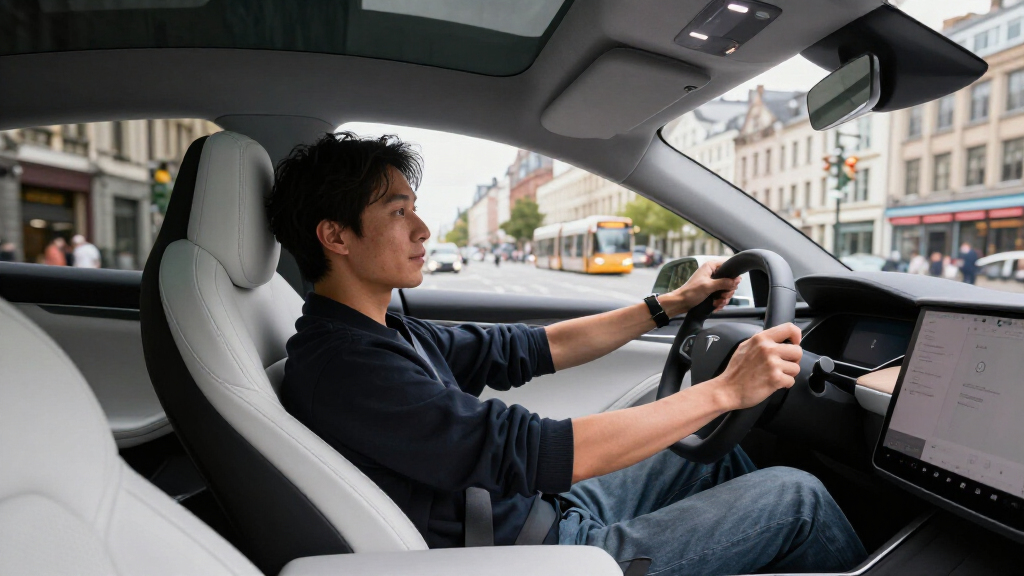
During the test, a Tesla Model S running FSD software successfully navigated busy Brussels streets, obeying traffic signals, merging into traffic, and handling roundabouts without human intervention. The ride was conducted under controlled conditions, with Tesla engineers closely monitoring the vehicle’s behavior. According to sources familiar with the event, the vehicle encountered minimal issues, and the system responded appropriately to most urban driving scenarios, including pedestrian crossings and bike lanes.
However, the test was not entirely flawless. Observers noted moments where the system hesitated at complex intersections and occasionally made conservative decisions, such as stopping longer than necessary at certain signals. Tesla representatives confirmed that some minor glitches were observed but emphasized that these are expected during ongoing development and testing phases. No accidents or safety-critical incidents occurred during the ride.
The Brussels test is part of Tesla’s broader effort to validate FSD capabilities outside North America, where city layouts and traffic behaviors differ significantly. The company has been gradually expanding its testing programs across Europe, aiming to meet regional regulatory standards and improve the system’s robustness in diverse environments.
Implications for Tesla’s Autonomous Driving Progress
This successful test drive signals meaningful progress for Tesla’s FSD system, especially in complex European urban settings where traffic rules and infrastructures vary widely from North America. It demonstrates that Tesla’s autonomous driving technology is approaching a level of reliability suitable for real-world deployment, though it remains a work in progress. The event could influence regulatory discussions and public acceptance of autonomous vehicles in Europe, where authorities are cautious but increasingly interested in autonomous technology’s potential to improve road safety and traffic flow.
For consumers, this test showcases Tesla’s ongoing efforts to refine FSD, which could eventually lead to broader availability and more advanced features. However, the ride also underscores that full autonomy is not yet achieved, and drivers must remain attentive when using FSD in complex urban environments.
As an affiliate, we earn on qualifying purchases.
European Urban Testing as a Key Milestone
Tesla has been progressively expanding its autonomous vehicle testing outside North America, with European cities like Brussels becoming focal points due to their dense traffic and varied road layouts. Historically, Tesla’s FSD has shown strong performance in North American settings, but European cities present unique challenges such as narrower streets, different signage systems, and diverse traffic behaviors.
This Brussels test follows recent similar trials in other European locations, reflecting Tesla’s strategic push to adapt its software for global markets. The company’s approach involves incremental testing, data collection, and software updates based on real-world driving experiences. Regulatory environments in Europe are more cautious about autonomous vehicles, making successful tests like this crucial for future deployment approvals.
While Tesla has not announced specific timelines for widespread FSD rollout in Europe, such tests are viewed as essential steps toward that goal. The event also comes amid increased public and regulatory scrutiny of autonomous vehicle safety and reliability.
auto care detailing kits for Tesla
As an affiliate, we earn on qualifying purchases.
As an affiliate, we earn on qualifying purchases.
Unresolved Challenges and Areas for Improvement
While the test was largely successful, it is not yet clear how the FSD system will perform across a broader range of real-world conditions and in less controlled environments. Observers noted moments of hesitation and conservative decision-making, indicating that the system still requires refinement. It is also uncertain how regulatory authorities will interpret these results and whether they will accelerate approval processes for wider deployment.
Additionally, Tesla has not disclosed specific details about the full scope of the test, such as the exact duration, routes taken, or the number of scenarios encountered, leaving some questions about the comprehensiveness of the evaluation.
noise reduction door seal kits for Tesla Model 3
As an affiliate, we earn on qualifying purchases.
As an affiliate, we earn on qualifying purchases.
Next Steps in Tesla’s European Autonomous Testing
Tesla plans to conduct further autonomous vehicle tests across multiple European cities to gather more data and improve system robustness. The company is expected to release additional updates to FSD software based on these trials, aiming for increased reliability in complex urban scenarios.
Regulatory bodies in Europe will likely scrutinize the Brussels test results closely, with potential for new guidelines or approvals to be announced in the coming months. Tesla may also expand testing to include more challenging environments or different traffic conditions to validate the system’s capabilities further.
Public demonstrations and pilot programs could follow, helping to build consumer confidence and support regulatory acceptance for broader deployment of autonomous vehicles in Europe.
Tesla autonomous driving accessories
As an affiliate, we earn on qualifying purchases.
As an affiliate, we earn on qualifying purchases.
Key Questions
How reliable is Tesla’s FSD system based on this Brussels test?
The test showed that Tesla’s FSD system can handle many urban driving scenarios successfully, but some hesitations and conservative decisions indicate that the system is still under development and not fully reliable for all conditions.
Will Tesla’s FSD be available for regular consumers in Brussels soon?
It is not yet clear when Tesla will offer FSD to consumers in Brussels or wider Europe, as regulatory approvals and further testing are still ongoing.
What challenges does Tesla face in deploying FSD in European cities?
European cities pose unique challenges such as narrower streets, diverse traffic behaviors, and different signage, requiring Tesla to adapt its software and meet regional safety standards.
Are there any safety concerns from this test?
No safety-critical incidents were reported during the test. However, minor hesitations and conservative responses highlight that the system is still evolving and needs further refinement before widespread deployment.
What does this test mean for the future of autonomous vehicles?
This successful test indicates progress toward safer, more reliable autonomous driving in complex urban environments, but full deployment will require continued testing, regulatory approval, and software improvements.
Source: rss
NFL season / tailgating Picks
team gear
As an affiliate, we earn on qualifying purchases.