
For premium TIG welder options for fabrication work, I rank the Everlast PowerTIG 210EXT as the best overall for its broad AC/DC control set and advanced pulse features. The Lincoln Electric Square Wave 205 is a more approachable choice for focused TIG work, while the Weldpro Digital TIG ACDC 250GD suits buyers who need higher output and a water-cooled torch. The main tradeoff is between refined welding control, portability and input flexibility, and the extra equipment or setup that higher-output machines can demand. I compare all 10 options by fabrication fit, usability, versatility, and practical limitations below.

Get business pricing on garage and car supplies
- Business-only prices and quantity discounts
- Tax-exempt purchasing
- Multiple users, one account, clear invoices
Complete the kit



Key Takeaways
- The Everlast PowerTIG 210EXT leads for control: Its AC/DC operation and advanced pulse functions make it the most versatile specialist pick in this group, though its feature set may be more than a straightforward TIG user needs.
- The Weldpro 250GD is the output-and-cooling choice: Its 250-amp rating and water-cooled torch package favor sustained fabrication work, but the larger setup is less appealing for occasional, mobile jobs.
- The Lincoln Square Wave 205 prioritizes accessible TIG operation: It is a focused option for buyers who value a simpler path into AC/DC TIG over multiprocess breadth or extensive advanced controls.
- Multiprocess capability changes the value equation: The Miller Multimatic 215 PRO adds MIG and Stick alongside TIG, useful for mixed-shop work, but buyers focused on TIG control may prefer a dedicated machine.
- Several 200–225-amp models cover overlapping shop needs: The PRIMEWELD TIG225X, Eastwood TIG 220, and 200A ARCCAPTAIN offer different equipment and control packages, so torch setup, input needs, and workflow matter more than amperage alone.
| ARCCAPTAIN TIG 205P Pro Pulse Welder, 5-in-1 Welding Machine, 120V/240V | 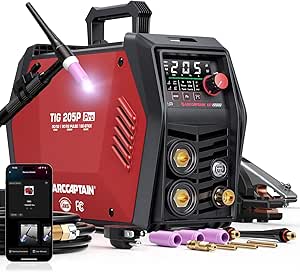 | Best for App-Connected DC Fabrication | Power source: 120V/240V | Welding modes: DC TIG, Pulse TIG, Lift TIG, Spot TIG, MMA | Weight: 22.8 pounds | VIEW ON AMAZON | See Our Full Breakdown |
| Everlast PowerTIG 210EXT 210Amp AC/DC TIG Stick Advanced Pulse Welder |  | Best for Advanced Aluminum Fabrication | Power source: AC/DC | Voltage: 240 volts | Amperage capacity: 210 A | VIEW ON AMAZON | See Our Full Breakdown |
| Miller Multimatic 215 PRO Multiprocess Welder, MIG, TIG, Stick, 120V/240V |  | Best for Mixed-Process Fabrication | Power source: DC | Input voltage: 120V/240V | Processes: MIG, Pulsed MIG, TIG, Pulsed TIG, Stick | VIEW ON AMAZON | See Our Full Breakdown |
| Lincoln Electric Square Wave 205 TIG Welder K5613-1 |  | Best for Straightforward AC/DC TIG Work | Model number: K5613-1 | Power supply: 120V/230V | Processes: TIG and Stick | VIEW ON AMAZON | See Our Full Breakdown |
| Eastwood TIG 220 AMP AC/DC TIG Welder and Stick Welding with Auto-Darkening Helmet |  | Best for a Ready-to-Weld Aluminum and Steel Package | Power: 220 AMP | Voltage: 120V and 240V | Materials: Steel and aluminum | VIEW ON AMAZON | See Our Full Breakdown |
| Weldpro Digital TIG ACDC 250GD 250 Amp TIG/Stick Welder with Pulse Memory and Water Cooled Torch |  | Best for High-Amperage Fabrication | Power: 220 volts | Duty cycle: 30% at full amperage (DC); 60% (AC) | Weight: 92 pounds | VIEW ON AMAZON | See Our Full Breakdown |
| YESWELDER 205A TIG Welder Pulse Stick/DC TIG/Pulse TIG 3-in-1 |  | Best for Portable Steel and Stainless Work | Model: TIG-205P | Power input: Dual voltage, 110V/220V | Maximum output: 200 amps | VIEW ON AMAZON | See Our Full Breakdown |
| Bestarc TIG Welder AC/DC, 215Amp Aluminum TIG Welder with Pulse TIG |  | Best for Waveform Control | Amperage: 215 amps | Input voltage: 110V/220V | Weight: 48.3 pounds | VIEW ON AMAZON | See Our Full Breakdown |
| ARCCAPTAIN TIG Welder AC/DC 200A with Pulse 7-in-1 Aluminum Welding Machine |  | Best Compact AC/DC Option | Power source: AC/DC | Maximum welding current: 200 amps | Weight: 12 kg (26.5 pounds) | VIEW ON AMAZON | See Our Full Breakdown |
| PRIMEWELD TIG225X 225 Amp IGBT AC/DC TIG/Stick Welder with Pulse CK17 Flex Torch and Cable |  | Best for Aluminum and Thinner-Material Control | Input voltage: 110V/220V | Amperage: 225 amps | Welding types: TIG and Stick | VIEW ON AMAZON | See Our Full Breakdown |
| premium tig welder options for fabrication work | Weight |
|---|---|
| ARCCAPTAIN TIG 205P Pro Pulse | 22.8 pounds |
| Everlast PowerTIG 210EXT 210Am | 60 pounds |
| Miller Multimatic 215 PRO Mult | 50.9 pounds |
| Lincoln Electric Square Wave 2 | 36 pounds |
| Eastwood TIG 220 AMP AC/DC TIG | 44.8 pounds |
| Weldpro Digital TIG ACDC 250GD | 92 pounds |
| YESWELDER 205A TIG Welder Puls | 10.7 pounds (4.85 kg) |
| Bestarc TIG Welder AC/DC | 48.3 pounds |
| ARCCAPTAIN TIG Welder AC/DC 20 | 12 kg (26.5 pounds) |
| PRIMEWELD TIG225X 225 Amp IGBT | 40,823 grams |
More Details on Our Top Picks
ARCCAPTAIN TIG 205P Pro Pulse Welder, 5-in-1 Welding Machine, 120V/240V
The ARCCAPTAIN TIG 205P Pro suits fabrication shops and home workshops focused on steel and other DC TIG work, especially where process variety matters. Its five modes—DC TIG, Pulse TIG, Lift TIG, Spot TIG, and MMA—let one machine cover detailed TIG jobs and stick welding, while app control supports parameter adjustments and monitoring. Dual-voltage input also makes it easier to move between compatible 120V and 240V outlets than the 240V-only Everlast PowerTIG 210EXT.
The tradeoff is material range: no AC TIG means it is not suited to aluminum TIG welding, unlike the Everlast or Lincoln Square Wave 205. At 22.8 pounds it is lighter than several multiprocess picks here, but it still asks for more lifting than a compact bench unit. App access is part of the feature set, so buyers who want every adjustment on the machine itself may prefer another option.
Pros:- Five welding modes cover several DC TIG and MMA tasks with one machine.
- 120V/240V input gives flexibility across compatible workshop outlets.
- App control supports real-time monitoring and adjustments.
- Safety protections are included.
Cons:- No AC TIG function, so it is not a suitable choice for aluminum TIG work.
- Full feature access requires a smartphone app.
- At 22.8 pounds, it is not the lightest option for frequent carrying.
Best for: Fabricators working mainly with steel who want several DC TIG and stick modes, dual-voltage flexibility, and app-based parameter control.
Not ideal for: Aluminum fabricators or buyers who prefer a fully self-contained control interface, since this model lacks AC TIG and relies on its app for full feature access.
- Power source:120V/240V
- Welding modes:DC TIG, Pulse TIG, Lift TIG, Spot TIG, MMA
- Weight:22.8 pounds
- Package dimensions:17.4 x 16.3 x 8.2 inches
- Warranty:3 years
- AC TIG:Not included
Our verdict“Choose the ARCCAPTAIN if your fabrication is primarily DC work and app control matters more than aluminum capability.”
Everlast PowerTIG 210EXT 210Amp AC/DC TIG Stick Advanced Pulse Welder
For fabrication that spans aluminum and steel, the Everlast PowerTIG 210EXT brings the more specialized TIG controls in this group. AC/DC operation, adjustable AC frequency, waveform options, and pulse modes give experienced welders room to tune the arc to different material and joint demands. Its programmable memory can also help keep repeat jobs consistent. Compared with the Lincoln Square Wave 205, the Everlast description calls out more advanced waveform and pulse adjustment; that control is useful for a practiced operator, but adds setup complexity.
This is a shop-oriented package rather than a grab-and-go machine: it runs on 240 volts and weighs 60 pounds, with a PowerCool 500 and PowerCart 500 included. That package may suit a dedicated fabrication station, but the weight and fixed-voltage requirement limit where it can work. Buyers who need 120V access or broad MIG capability should look instead at the Miller Multimatic 215 PRO.
Pros:- AC/DC TIG supports aluminum as well as other materials.
- Adjustable pulse, AC frequency, and waveform options allow detailed arc tuning.
- Programmable memory can save settings for repeat fabrication jobs.
- PowerCool 500 and PowerCart 500 are listed as included components.
Cons:- The advanced control set may take time for less experienced welders to learn.
- At 60 pounds, it is cumbersome for frequent transport.
- 240V input limits use where only 120V power is available.
Best for: Experienced fabricators with a 240V work area who regularly TIG weld aluminum and steel and want adjustable AC, pulse, and waveform controls.
Not ideal for: Beginners seeking simple setup, mobile welders who need a lighter machine, or shops that need 120V operation or MIG capability.
- Power source:AC/DC
- Voltage:240 volts
- Amperage capacity:210 A
- Welding processes:TIG and Stick
- Weight:60 pounds
- Dimensions:24 x 9 x 17 inches
- Included components:PowerCool 500, PowerCart 500
Our verdict“Pick the Everlast for a dedicated 240V fabrication setup where advanced aluminum TIG control outweighs portability and simplicity.”
Miller Multimatic 215 PRO Multiprocess Welder, MIG, TIG, Stick, 120V/240V
The Miller Multimatic 215 PRO makes the most sense when fabrication work regularly shifts between MIG, TIG, and Stick rather than centering on TIG alone. It adds Pulsed MIG and Pulsed TIG to that process range, while Auto-Set and Program Memory can reduce repeated setup work. Its 120V/240V input also gives it an outlet flexibility the 240V-only Everlast PowerTIG 210EXT does not offer. The listed maximum steel thickness changes from 3/16 inch on 120V to 3/8 inch on 240V, giving buyers a clear reason to connect to the higher-voltage supply for heavier work.
That breadth has a cost in size and focus: at 50.9 pounds, it is not a light carry, and buyers seeking a dedicated TIG machine may find its MIG capacity less useful than the Lincoln Square Wave 205’s TIG-and-Stick focus. The product data specifies a DC power source, so I would not choose it for aluminum TIG fabrication that requires AC TIG.
Pros:- Combines MIG, Pulsed MIG, TIG, Pulsed TIG, and Stick processes.
- 120V/240V input supports different workshop power connections.
- Auto-Set and Program Memory can simplify setup and repeat jobs.
- Listed steel capacity reaches 3/8 inch on 240V.
Cons:- The listed DC power source does not provide AC TIG for aluminum work.
- At 50.9 pounds, it is bulky for frequent movement.
- Its multiprocess breadth may be unnecessary for a TIG-only fabrication shop.
Best for: Fabrication shops and serious workshop users who need one machine for MIG, pulsed MIG, TIG, pulsed TIG, and Stick across 120V and 240V power.
Not ideal for: Aluminum TIG specialists or buyers who want a lighter, TIG-first machine, since the listed power source is DC and the unit weighs 50.9 pounds.
- Power source:DC
- Input voltage:120V/240V
- Processes:MIG, Pulsed MIG, TIG, Pulsed TIG, Stick
- Weight:50.9 pounds
- Dimensions:24 x 14 x 19 inches
- Maximum steel thickness at 240V:3/8 inch
- Maximum steel thickness at 120V:3/16 inch
Our verdict“Choose the Miller when process flexibility is the priority and aluminum AC TIG is not part of the job mix.”
Lincoln Electric Square Wave 205 TIG Welder K5613-1
The Lincoln Electric Square Wave 205 is the TIG-focused choice for fabricators who want AC/DC capability without stepping up to a broader multiprocess package. AC frequency and balance adjustments support aluminum TIG work, while DC TIG covers steel and other compatible jobs; Stick adds a practical second process. Its 120V/230V supply options make it more adaptable to shop power than the 240V-only Everlast PowerTIG 210EXT. At 36 pounds, it is also easier to reposition than the Everlast or Miller Multimatic 215 PRO.
The supplied foot Amptrol, torch, regulator, and hose give a buyer a useful starting setup, though the product details provide less information about advanced pulse or memory controls than the Everlast description. I would favor this Lincoln for a clearer TIG-and-Stick role, not for a shop that wants MIG alongside TIG. Buyers who need MIG, Pulsed MIG, and Stick in one unit will get more process range from the Miller, at the cost of greater weight and bulk.
Pros:- AC/DC TIG capability supports aluminum and other material work.
- Adjustable AC frequency and balance provide control for aluminum welding.
- 120V/230V power options fit a range of workshop supplies.
- Includes a TIG torch, foot Amptrol, gas regulator, and hose.
Cons:- Does not provide the MIG process range offered by the Miller Multimatic 215 PRO.
- Available product details give limited information on advanced controls.
- At 36 pounds, it is heavier than the ARCCAPTAIN TIG 205P Pro.
Best for: TIG fabricators who weld both aluminum and steel, want Stick as a secondary process, and need 120V/230V supply flexibility.
Not ideal for: Shops that need MIG or detailed, documented pulse and memory features, since this is presented as a TIG-and-Stick machine and the listed feature detail is limited.
- Model number:K5613-1
- Power supply:120V/230V
- Processes:TIG and Stick
- Weight:36 pounds
- AC adjustment:Adjustable AC frequency and balance
- Included accessories:TIG torch, foot Amptrol, gas regulator, gas hose, electrode holder, ground clamp, adapters
Our verdict“Choose the Lincoln for portable-enough AC/DC TIG and Stick work when MIG capability is not a requirement.”
Eastwood TIG 220 AMP AC/DC TIG Welder and Stick Welding with Auto-Darkening Helmet
The Eastwood TIG 220 AMP AC/DC stands out for buyers who want aluminum and steel capability bundled with a welding helmet. Its adjustable AC waveform, pulse, and amperage settings give fabricators options for tuning work across materials, and the listed capacity reaches up to 1/4-inch material. Dual-voltage operation is useful when a shop has both 120V and 240V access. Compared with the Lincoln Square Wave 205, this Eastwood listing puts more emphasis on adjustable pulse and explicitly includes a wide-view auto-darkening helmet, which can make the package more appealing to someone assembling a workstation.
The compromise is mobility and process breadth. At 44.8 pounds, it is heavier than the Lincoln and far less suited to frequent carrying than the ARCCAPTAIN TIG 205P Pro. It covers TIG and Stick rather than the Miller’s MIG-centered range, so it is a narrower fit for shops that want one machine across several processes. Buyers who already own a helmet may also get less value from the included accessory.
Pros:- AC/DC TIG supports work with aluminum and steel.
- Adjustable AC waveform, pulse, and amperage offer control over welding settings.
- Dual-voltage operation supports 120V and 240V supplies.
- Includes a wide-view auto-darkening helmet.
Cons:- At 44.8 pounds, it is less convenient to move than the Lincoln Square Wave 205.
- The listed processes are TIG and Stick, not MIG.
- The helmet adds less practical value for buyers who already own suitable headgear.
Best for: Fabricators who need AC/DC TIG for aluminum and steel, want pulse adjustments, and are building a setup that can use an included auto-darkening helmet.
Not ideal for: Mobile welders prioritizing low carry weight, or shops seeking MIG capability in the same machine; the included helmet may also be redundant for buyers who already have one.
- Power:220 AMP
- Voltage:120V and 240V
- Materials:Steel and aluminum
- Maximum material thickness:Up to 1/4 inch
- Weight:44.8 pounds
- Package dimensions:24.21 x 16.34 x 16.34 inches
- Included components:Welder, auto-darkening helmet
Our verdict“Pick the Eastwood if you want AC/DC TIG and Stick with pulse controls and a helmet in the same package, rather than a lighter or broader-process machine.”
Weldpro Digital TIG ACDC 250GD 250 Amp TIG/Stick Welder with Pulse Memory and Water Cooled Torch
For fabrication work that calls for substantial AC/DC TIG capacity and saved setups, I rank the Weldpro 250GD ahead of lighter, lower-output choices such as the YESWELDER 205A. Its 250-amp rating and AC/DC capability suit work across aluminum, steel, and other metals, while memory presets can reduce repeated setup when jobs call for familiar parameters. The included foot pedal, flow meter, gas hose, ground clamp, and torch give a fabricator a useful starting package. The tradeoff is shop commitment: at 92 pounds, it is much less convenient to move than the YESWELDER, and its full-amperage DC duty cycle is 30%. A water cooler and heavy-duty cart are separate purchases, and the control setup may feel involved for a first-time TIG user.
Pros:- AC/DC TIG capability supports aluminum as well as steel and other metals.
- 250-amp output gives more headroom than the YESWELDER 205A for higher-demand work.
- Memory function helps recall settings for recurring fabrication jobs.
- Includes a foot pedal and core torch and gas accessories.
Cons:- At 92 pounds, moving it between work areas may require assistance.
- Water cooler and heavy-duty cart are sold separately.
- Full-amperage DC duty cycle is 30%, and setup may challenge less experienced operators.
Best for: Fabricators with a dedicated 220V work area who need AC/DC TIG capacity, repeatable presets, and room to add water cooling.
Not ideal for: Mobile welders or beginners seeking a light, simple machine; its 92-pound body, setup complexity, and separately purchased cooler add friction.
- Power:220 volts
- Duty cycle:30% at full amperage (DC); 60% (AC)
- Weight:92 pounds
- Modes:AC/DC TIG and Stick
- Included components:Flow meter, foot pedal, gas hose, ground clamp, and torch
- Water-cooler connection:Rear electrical receptacle for optional water cooler
Our verdict“Choose the Weldpro if your fabrication shop needs higher AC/DC TIG output and preset recall more than portability or a ready-to-run water-cooling package.”
YESWELDER 205A TIG Welder Pulse Stick/DC TIG/Pulse TIG 3-in-1
I would pick the YESWELDER 205A for fabrication jobs centered on steel and stainless, especially when the machine needs to move between a home shop and job sites. Its 10.7-pound weight and dual-voltage input make it easier to carry and power than the 92-pound Weldpro 250GD, while high-frequency arc start and a large LED screen make setup and ignition more approachable. Stick, DC TIG, and Pulse TIG cover useful processes for varied repair and fabrication tasks. The key limitation is material range: it cannot weld aluminum, so it is a poor substitute for the AC/DC Bestarc or PRIMEWELD TIG225X when aluminum fabrication is on the list. Its 200-amp maximum and learning curve around the settings also make it less suited to demanding, aluminum-focused production work.
Pros:- Light 10.7-pound body is easier to transport than the Weldpro 250GD.
- Dual-voltage input supports use with 110V or 220V power.
- Three modes include Stick, DC TIG, and Pulse TIG.
- Large LED display, auto memory, and high-frequency arc start aid setup and ignition.
Cons:- Cannot weld aluminum because it does not offer AC TIG.
- Maximum output is 200 amps, below the Weldpro 250GD and PRIMEWELD TIG225X ratings.
- Multiple settings may take time for new TIG operators to learn.
Best for: Fabricators who mainly weld steel or stainless and want a light dual-voltage machine for shop, repair, and mobile jobs.
Not ideal for: Aluminum fabricators or buyers needing AC TIG; this model is DC-only and lacks the material range of the Bestarc AC/DC or PRIMEWELD TIG225X.
- Model:TIG-205P
- Power input:Dual voltage, 110V/220V
- Maximum output:200 amps
- Weight:10.7 pounds (4.85 kg)
- Welding modes:Stick (MMA), DC TIG, Pulse TIG
- Display:Large LED screen
- Foot-pedal interface:5-pin
Our verdict“Choose this YESWELDER for portable, dual-voltage steel and stainless fabrication, but skip it if aluminum work is part of your regular workload.”
Bestarc TIG Welder AC/DC, 215Amp Aluminum TIG Welder with Pulse TIG
The Bestarc AC/DC 215A earns a distinct place for fabricators who want several TIG control modes in one machine. Alongside AC and DC TIG, it offers pulse, square-wave, and Stick modes, giving operators more ways to shape a weld for aluminum, stainless steel, and copper. The included foot pedal also supports live heat adjustment, a practical advantage when joint fit or material thickness varies across a fabrication job. Compared with the simpler DC-only YESWELDER 205A, Bestarc can handle aluminum; compared with the 225-amp PRIMEWELD TIG225X, it offers a broader named mode set but less rated amperage. At 48.3 pounds, it is not a casual carry-around machine, and its controls may take time to master. The provided data does not specify wattage, so I would not assume a particular power draw.
Pros:- AC/DC capability supports aluminum and steel-focused fabrication.
- Pulse, square-wave, and Stick modes add process flexibility.
- Included foot pedal allows remote heat adjustment.
- Dual-voltage operation supports 110V and 220V input.
Cons:- At 48.3 pounds, it is heavier to move than the YESWELDER 205A.
- Feature-rich controls may require a learning period.
- Wattage is not specified in the provided product data.
Best for: Fabricators who work across aluminum, stainless, and copper and want AC/DC, pulse, square-wave, and pedal control in one welder.
Not ideal for: Buyers who prioritize frequent transport, basic controls, or a higher stated output; it weighs 48.3 pounds and is rated at 215 amps.
- Amperage:215 amps
- Input voltage:110V/220V
- Weight:48.3 pounds
- Dimensions:17.8 × 8.07 × 12.87 inches
- Modes:DC TIG, AC TIG, Pulse TIG, Square Wave, and Stick
- Material compatibility:Aluminum, stainless steel, and copper
- Included control:Foot pedal
Our verdict“Choose the Bestarc if waveform and process options matter more to your fabrication work than minimizing weight or keeping controls simple.”
ARCCAPTAIN TIG Welder AC/DC 200A with Pulse 7-in-1 Aluminum Welding Machine
Among these picks, the ARCCAPTAIN TIG200PACDC is a strong fit when portability and broad process coverage need to coexist. At 12 kg (26.5 pounds), it is far easier to move than the Weldpro 250GD, yet it still offers AC/DC welding for aluminum and steel, plus pulse TIG, Stick, spot welding, and multiple waveforms. Its large LED display and digital parameter controls suit fabricators who want to adjust settings precisely rather than use a bare-bones machine. Compared with the Bestarc 215A, the ARCCAPTAIN is rated for 15 fewer amps, so it gives up some output headroom; its appeal is a more compact package with a wide set of listed functions. The digital controls and shutdown procedure may require attention, and a new operator should expect some setup learning.
Pros:- AC/DC capability accommodates aluminum and steel fabrication.
- Seven-in-one feature set includes TIG, pulse TIG, Stick, and spot welding.
- At 26.5 pounds, it is easier to transport than the Weldpro 250GD.
- Large LED display supports precise digital parameter adjustment.
Cons:- Its 200-amp maximum is lower than the Bestarc 215A and PRIMEWELD TIG225X.
- Digital controls and setup may be challenging for less experienced welders.
- The specified shutdown procedure requires attention to fan and screen power-down.
Best for: Fabricators who need a moveable AC/DC machine for aluminum and steel jobs and value multiple welding modes in a compact package.
Not ideal for: Operators who want the highest output in this group or straightforward analog controls; the Bestarc is rated higher, and the ARCCAPTAIN’s digital setup takes practice.
- Power source:AC/DC
- Maximum welding current:200 amps
- Weight:12 kg (26.5 pounds)
- Dimensions:21.5 × 17 × 14 inches
- Welding functions:7-in-1; includes TIG, pulse TIG, Stick, and spot welding
- Display:Large LED display
- Included components:Power adapter cord, TIG torch, wire brush, ground clamp, TIG accessories set, flow meter, and owner’s manual
Our verdict“Choose the ARCCAPTAIN for a portable, mode-rich AC/DC fabrication machine, but select a higher-output option if your work regularly pushes its 200-amp ceiling.”
PRIMEWELD TIG225X 225 Amp IGBT AC/DC TIG/Stick Welder with Pulse CK17 Flex Torch and Cable
For mixed fabrication that includes aluminum, stainless, and thinner metals, I would shortlist the PRIMEWELD TIG225X. Its AC/DC TIG and Stick capability covers a wider material range than the DC-only YESWELDER 205A, while its 225-amp rating sits between that machine and the 250-amp Weldpro. Pulse functionality and the flexible CK17 torch give the operator useful control when access or heat management matters; the product data also lists welding up to 1/4-inch aluminum and 3/8-inch mild steel. This is a more focused TIG/Stick choice than the Bestarc, which lists square-wave and additional mode options. The PRIMEWELD is still heavy at 40,823 grams, and its 110/220V input means buyers need a compatible supply. Its feature set may also take time for a beginner to set up.
Pros:- AC/DC TIG and Stick support work on aluminum, stainless steel, and mild steel.
- Flexible CK17 torch supports precise positioning and access around fabrication joints.
- Pulse function adds heat-control options for thinner metals.
- 225-amp output is higher than the YESWELDER 205A and ARCCAPTAIN 200A.
Cons:- Listed weight of 40,823 grams makes frequent transport less convenient.
- Requires a compatible 110V or 220V power supply.
- The setup and controls may be challenging for beginners.
Best for: Fabricators who need AC/DC TIG for aluminum and steel, value a flexible torch for tighter access, and work with thinner material.
Not ideal for: Buyers who need a lightweight machine, extensive process modes, or a simple first welder; it is heavy and setup may take practice.
- Input voltage:110V/220V
- Amperage:225 amps
- Welding types:TIG and Stick
- Pulse frequency:200 Hz
- Material compatibility:Aluminum, stainless steel, and mild steel
- Torch:CK17 Flex Torch
- Weight:40,823 grams
- Listed material capacity:Up to 1/4-inch aluminum and 3/8-inch mild steel
Our verdict“Choose the TIG225X for AC/DC fabrication across aluminum and thinner metals when torch flexibility matters more than low weight or a broader mode list.”

How We Picked
I compared the 10 machines by how well their stated capabilities map to real fabrication tasks: AC/DC availability for aluminum and steel, output range, pulse and waveform controls, input flexibility, and whether the machine supports TIG-only or multiprocess work. I also looked at practical shop factors such as included torch equipment, cooling requirements, control complexity, and how much setup a buyer may need before welding.
The ranking favors machines that combine useful fabrication control with a sensible fit for their intended buyer, rather than rewarding the largest amperage number or longest feature list. The Everlast 210EXT ranks first for its broad specialist control package; the Weldpro 250GD follows for higher-output, water-cooled work, while the Lincoln Square Wave 205 earns a place for a more focused and approachable TIG setup. Multiprocess models and lower-output or feature-dense alternatives rank according to whether their extra versatility or compactness justifies the compromises for TIG-centered fabrication.
Factors to Consider When Choosing Premium Tig Welder Options For Fabrication Work
Choosing a fabrication TIG welder is less about finding the machine with the most modes and more about matching its controls, power supply, and accessories to the work you repeat. I would start with the materials and duty cycle, then check shop power and torch setup before paying for advanced functions.
Match AC/DC capability to the materials you actually fabricate
AC/DC TIG is the practical requirement if aluminum is part of your regular work, while DC-only capability can suit steel and stainless-focused fabrication. Do not buy AC/DC solely because it appears more premium: the added capability is useful only if your jobs call for it. For aluminum, examine how the machine lets you adjust cleaning action and balance, since control over the arc can matter more than a headline output figure. If your work is mostly thin stainless, stable low-amperage control may serve you better than a higher maximum rating. A mixed-material shop should favor a machine with accessible settings you can repeat, not just a large menu of adjustments. This narrows the choice before comparing brand names or accessory bundles.
Treat amperage and duty cycle as a pair
Maximum amperage describes a ceiling, not how long a machine can weld there or how it performs on delicate work. Check the duty-cycle specification at the output you expect to use, then compare it with the length of your typical seams and the pauses built into your workflow. A higher-output unit may be valuable for thicker sections or long production runs, but can bring more weight, cooling needs, and installation demands. For thin stock, a predictable low end and stable arc are often more useful than extra peak power. Avoid choosing from amperage alone, especially when two machines have different cooling arrangements. If your jobs vary widely, prioritize a usable range and clear output controls.
Check shop power, plugs, and circuit capacity before ordering
Dual-voltage labels do not mean every outlet can deliver the machine’s full output. Confirm the required input current, plug type, and circuit capacity at both voltages, and account for what is already running on that circuit. A 120V connection can add convenience for light work or a remote setup, while 240V is generally the more practical supply for demanding fabrication. Buyers can make an expensive mistake by assuming a standard receptacle will support high-output welding just because the machine accepts that voltage. Also check whether the needed adapter or input cable is included. Plan the electrical setup before selecting a welder, not after it arrives.
Pay for controls that solve repeatable fabrication problems
Pulse can help manage heat input and bead appearance, especially on thinner material, but it is not a substitute for correct fit-up, filler choice, and technique. AC balance and frequency controls can be useful for aluminum work, while programmable memory can help repeat settings across recurring parts. Advanced menus add value when you will learn and use them; they can slow down a buyer who wants basic TIG adjustments. Think about the jobs that cause rework in your shop and identify which control would address that problem. If no specific task benefits from a feature, it should not carry much weight in your decision. A simpler interface may be the better fabrication tool when several people share the machine.
Include torch, cooling, and consumables in the real setup
The machine is only one part of a TIG station: torch, regulator, gas hose, ground lead, pedal or fingertip control, and consumables all affect readiness and comfort. Compare what is supplied with what you already own, and check connector compatibility before assuming an existing torch will fit. A water-cooled torch can improve comfort during extended, high-output work, but it also calls for a cooler, hoses, and maintenance. An air-cooled setup is simpler for intermittent use and mobile fabrication, though heat can limit long sessions. Bundle contents should be judged by fit and quality, not by quantity alone. Budget time and space for gas handling and cable routing as well as the welder itself.
Choose specialist TIG or multiprocess based on shop workload
A dedicated TIG machine puts its design focus on TIG controls, while a multiprocess unit can consolidate equipment for shops that also use MIG and Stick. The all-in-one route can save bench space and simplify a mixed workflow, but extra processes do not automatically mean better TIG operation. A specialist may be a stronger fit if TIG is the main fabrication method and fine control takes priority. Consider how often each process is used, who will operate the machine, and whether switching between tasks is part of a normal day. Occasional MIG work may not justify compromising on a TIG-centered setup. Compare process capability alongside controls and accessories, rather than treating a larger process count as a benefit by itself.
Frequently Asked Questions
Is a 200-amp TIG welder enough for a fabrication shop?
It can be enough for a broad range of general fabrication, but the answer depends on material thickness, joint design, and how long you weld at higher output. Check the duty cycle at the amperage you expect to use rather than relying on the machine’s maximum rating. A machine with a stable low end may also be a better match for mixed work than one chosen only for its peak output. For extended welding on thicker material, higher output and suitable cooling can reduce the need to work at the machine’s limit. Match the specification to your recurring jobs, not the thickest part you might weld once.
Should I choose a dedicated TIG machine or a multiprocess welder?
Choose a dedicated TIG unit if TIG is the core of your fabrication work and you want its controls and setup to be the focus. A multiprocess machine makes more sense when MIG or Stick work is frequent enough to replace separate equipment or simplify a shared shop. Compare the TIG-specific controls and included accessories rather than assuming each process receives equal attention. Also think about changeover time, storage, and how many people use the machine. If another process is only an occasional backup, a dedicated TIG model may be the more direct fit.
Do I need a water-cooled torch for fabrication work?
A water-cooled torch is most useful for sustained, higher-output work where torch heat and operator comfort become limiting. It adds a cooler, hoses, space, and maintenance, so it is not automatically the right choice for short jobs or a mobile setup. Air-cooled torches keep the station simpler, though they may become uncomfortable during long sessions. Consider the length and frequency of your welds, not just the machine’s maximum amperage. If you already have compatible cooling equipment, the added setup burden may be smaller.
What should I verify before using a dual-voltage welder on 120V?
Check the input-current requirement, plug and adapter details, circuit rating, and the output limits at 120V. Dual-voltage support does not mean the machine can reach its full rated output from a household outlet. A shared or undersized circuit can also restrict performance or interrupt work. Review the manual’s electrical requirements and confirm that the outlet is on a suitable circuit before connecting the machine. Treat 120V as a convenience for compatible work, not a substitute for 240V when the job needs sustained higher output.
Which TIG features are worth paying extra for on thin aluminum or stainless?
For thin material, prioritize stable low-amperage control and a pedal or torch control that lets you manage heat as the joint develops. Pulse can help control heat input and bead spacing, but it cannot fix poor fit-up or an unsuitable filler choice. For aluminum, useful AC adjustments can make it easier to tune cleaning action and arc behavior to the material and joint. Memory settings are helpful if you repeat jobs and want to return to known setups. Pay for controls that address a specific problem in your work rather than collecting functions you are unlikely to use.
Conclusion
For a single TIG-focused fabrication machine with broad AC/DC controls, I recommend the Everlast PowerTIG 210EXT as best overall. The best premium fit for higher-output, sustained work is the Weldpro Digital TIG ACDC 250GD, particularly for buyers prepared for a water-cooled setup. For a more focused and approachable TIG choice, I would put the Lincoln Electric Square Wave 205 forward for beginners; those who want MIG and Stick as well should look at the Miller Multimatic 215 PRO instead. The best value candidates are the PRIMEWELD TIG225X and the 200A ARCCAPTAIN, with the better fit depending on the torch package, controls, and power requirements that match your shop. For buyers who need several processes in one unit, the Miller is the specific-workflow pick; for buyers who prioritize a simpler TIG-centered setup, choose a dedicated model and verify its input and accessory needs before committing.